

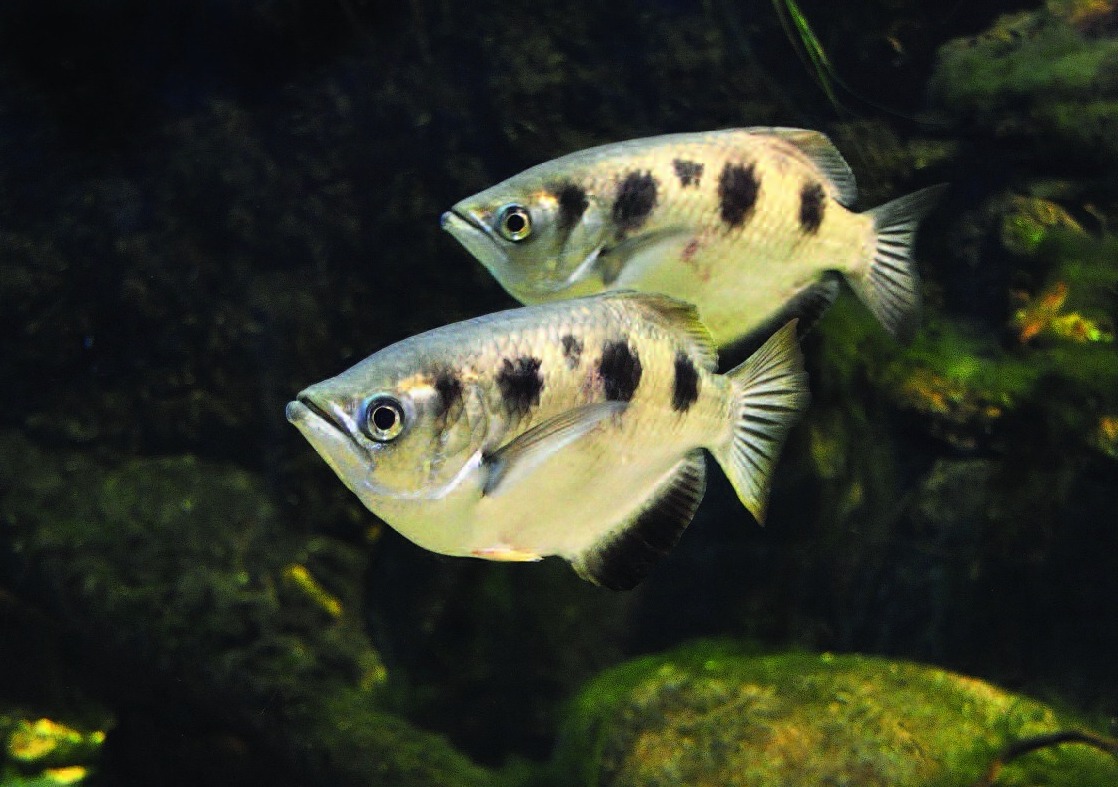
Toxotes chatareus
Seven-spot Archerfish
Species Summary
Toxotes chatareus has a wide distribution across northern Australia, from the Kimberley region eastwards to Cape York and down the east coast as far south as the Pioneer River near Mackay, Queensland, as well as through South-East Asia from India and Sri Lanka to New Guinea. It is commonly found in brackish estuaries but also ranges well into freshwater, sometimes several hundred kilometres upstream of tidal influence.
Etymology
The genus name Toxotes is Greek for “archer” or “bowman,” proposed by Georges Cuvier in 1816 after he noted the “remarkable” ability of these fish to shoot drops of water at insects within reach, making them fall into the water to be eaten. The species name is a genuine mystery: Scottish physician and naturalist Francis Hamilton described the species in an 1822 monograph on the fishes of the Ganges without explaining what “chatareus” means, and the word appears in no Latin dictionary. Since Hamilton often based Indian fish names on local names, it may be a Latinisation of “chata” — possibly related to Samudrik-chanda, a name recorded for this species in West Bengal, or perhaps a reference to Chata Kalikapur, a town on a Ganges distributary not far from where the type specimens were collected. Notably, Hamilton had no idea this fish was an archerfish at all, and originally placed it among the climbing perches.
Distribution & Habitat
Found in tidal mangrove estuaries, freshwater rivers, streams, billabongs and swamps, and successfully translocated into some inland lakes such as Lake Eacham and Tinaroo Dam. An intact riparian zone is critical for Toxotes chatareus, since it supplies much of its food; inland, it favours deep waterholes fringed with overhanging vegetation, especially Pandanus, and wetlands where riparian vegetation has been degraded and replaced by invasive grasses (as in many lower Burdekin River wetlands) support very few. Small juveniles are most often seen around dense macrophyte beds, while adults, being predominantly surface feeders, are usually observed near the surface.
Keeping & Caring
Relatively easy to keep, Toxotes chatareus adapts quickly to captivity and tolerates a wide range of water conditions with one notable exception: soft, acidic water, which can lead to kidney failure if the fish is kept in it long term (a link first identified by pathologists examining sick fish from a public aquarium over an extended period). They have hearty appetites, become tame and responsive, and are good jumpers, so a tight-fitting lid is essential. Tankmates are generally ignored, though the species’ large mouth means small tankmates can become prey, and individuals can be aggressive toward other, smaller archerfish, so it is best to keep them either singly or in groups of similarly sized fish. Seven-spot Archerfish does very well in a freshwater aquarium, unlike the similar-looking Banded Archerfish (T. jaculatrix), which is primarily a mangrove dweller better suited to brackish conditions.
Recently wild-collected fish, especially those taken from marine environments, can develop a viral infection called Lymphocystis one to two weeks after collection if stressed by poor water quality in transit combined with a rapid shift from marine to freshwater conditions. There is no quick cure, though raising salinity toward full seawater often helps recovery; even then, the white, fungus-like growths characteristic of the infection can take weeks to clear.
Temperature & Water Parameters
A tropical species tolerant of a wide range of salinity, from full seawater to pure freshwater. For general aquarium purposes, 22–28 °C, pH 7.0–9.0, general hardness 100–400 ppm and salinity 0–5 ppt all suit it well.
Feeding
Toxotes chatareus has a good appetite and quickly learns to accept most common aquarium foods, feeding mainly near the surface but also searching near the substrate in shallower tanks. Small juveniles take frozen brine shrimp, bloodworm, mysis and krill, plus live black worm, small crickets or other suitably sized insects; adults take the same frozen foods (kept bulky, still in cubes) plus adult crickets, earthworms and pieces of fish or prawn, soon learning to accept floating pellets too, and will also take small live fish. In a sufficiently tall aquarium with driftwood breaking the surface, offering terrestrial insects lets the fish show off its archery skills. In the wild it preys mainly on insects and other invertebrates in overhanging vegetation, supplemented with a wide range of aquatic invertebrates, and appears able to track seasonal changes in food availability and adjust its foraging strategy accordingly, rather than relying solely on prey falling from above.
Breeding
Toxotes chatareus has not been bred under standard aquarium conditions, but has been spawned by hormone induction on three occasions by aquaculturists Alan and Bruce Sambell. Broodstock was collected from freshwater habitats in the Laura River, Cape York, using small hooks baited with bread, then conditioned on a heavy feeding regime. With no obvious external means of sexing the species, fish showing increasing abdominal weight were caught and gently squeezed to check for eggs or milt; males proved to be in breeding condition, but females, despite looking ready by their weight, had not passed any eggs, so the whole group was hormone-induced with Ovaprim (0.5 ml per kilogram, injected into the body cavity) and placed in a 2,000-litre freshwater spawning tank at midsummer temperatures around 24–28 °C.
Days later, an inspection of the tank found what looked like a mass of infertile, fungused eggs; assuming the spawning had failed, the tank was being drained to move the broodstock elsewhere when Bruce Sambell realised, just in time to stop the drain, that newly hatched fry were present among the eggs — almost certainly the first known captive spawning of an archerfish. The larvae were moved to a 300-litre saltwater tank with a conical base and gentle aeration, and fed daily on saltwater rotifers (sourced from the Bribie Island Aquaculture Research Centre and cultured on algae paste). After about ten days the fry graduated to Artemia nauplii, and after a further ten days were transferred to a quarter-acre freshwater plankton pond, fertilised to encourage a plankton bloom. Three months later the fish had reached harvestable size, but the grow-out pond was raided daily by kingfishers, and netting the pond wasn’t practical at the time; after repeating the attempt over following summers with similarly poor results, the breeders decided they’d “fed enough kingfishers” and moved on. Breeding size is around 180 mm (males 150+ g, females 200+ g).
Remarks
Archerfish are of course named for their intriguing ability to knock down terrestrial prey with a shot of water from the mouth, and they are genuinely skilful at it, accurate at distances of two metres or more; observers have noted that prey sitting on a bank can even be washed into the water by a rapid series of broad, spraying shots, and the fish can leap clear of the water to catch prey directly. Many an aquarist who has kept archerfish can recount being squirted themselves, sometimes right in the eye. One memorable account comes from a keeper who once worked at the Territory Wildlife Park in Darwin, where staff trained a pond of Seven-spot Archerfish to squirt a dark red bucket in exchange for a reward of frozen prawns — the fish learned the trick so well that, for months afterward, they would reliably squirt a female staff member who happened to wear a similar red cardigan past the pond, without her ever learning why. Another ANGFA member recalled a fellow hobbyist who trained his archerfish to “drown” lit cigarettes whenever smokers dared light up in his fishroom. Captive fish have also been seen using well-aimed underwater “shots” to dislodge small shrimp hiding behind driftwood — suggesting more behavioural flexibility than most fish are given credit for. Juveniles are all black at first, becoming silver with prominent black stripes as they grow, the stripes eventually breaking up into the spots typical of adults; small juveniles also carry a distinctive white patch on the back that fades with age, and in the wild young fish appear in the wet season, schooling in quiet backwaters.
Compiled for Home of the Rainbowfish from ANGFA sources: G. Briggs, B. Sambell, D. Wilson, K. Martin, B. Hansen & C. Scharpf, “Fish in focus: Seven-spot Archerfish Toxotes chatareus (Toxotidae)”, Fishes of Sahul 32, June 2018, pp. 1271–1280.
References
- Pusey B., M. Kennard and A. Arthington (2004) Freshwater Fishes of North-Eastern Australia. CSIRO Publishing, Victoria.