

Brackish Water Species
Overview
A number of Australian coastal fishes are, at heart, saltwater species that tolerate freshwater to varying degrees, moving between the two as they search for food or as their life cycle demands. Some are permanent estuary residents; others are essentially marine fish that push some way up freshwater rivers; a few migrate between fresh and salt water on a seasonal or life-stage basis. Wherever fresh and salt water mix along the Australian coast, the resulting brackish estuaries support their own distinctive fauna, including a range of gobies as well as several blue-eyes: the widespread Pseudomugil signifer is often found in this environment, along with P. cyanodorsalis and P. inconspicuus, all of which can make good candidates for a brackish aquarium.
Species adapted to brackish conditions cope with frequent changes in salinity in different ways — some simply move within the water column or up- or downstream to avoid the most saline conditions, while others rely on osmoregulation to match their internal chemistry to the water around them. Whichever the case, fish should always be acclimatised to brackish conditions gradually, over several days; moving a fish straight between fresh and full-strength salt water risks serious osmotic shock.
A brackish aquarium is more involved to set up than a standard freshwater tank, but a display furnished with treated mangrove roots, rock and a sandy substrate can be very attractive. A working range is roughly 24–30 °C and pH 7.8–8.4, with ammonia, nitrite and nitrate kept low as in any aquarium. Brackish water can be mixed at about three parts freshwater to one part saltwater, or approximated by adding around 10 g of aquarium marine salt per litre of fresh water; day-to-day maintenance is much like a freshwater tank, with partial water changes roughly every two weeks (topped up with the appropriate salt each time). Live plants are more of a challenge, since most freshwater species will not tolerate the added salt, so a well-chosen selection of hardy species — or convincing synthetic ones — is often the practical answer. The species below are some of the more commonly available fishes suited to this style of aquarium.
Scats
Aquarists often talk about the “Red Scat” and the “Spotted Scat” as though they were different fish, but both names refer to the one species, Scatophagus argus, whose colouration varies considerably across its range. It is an extremely hardy fish, reaching up to 38 cm in the wild though rarely much beyond 20 cm in the aquarium (the larger size generally only being reached in full-strength sea water). Juveniles often shoal in the lower tidal reaches of coastal streams and range freely into fresh water, while adults are more typically found scavenging around harbours and estuaries across tropical and sub-tropical Australia; the species copes well in freshwater but tends to do best in brackish conditions, thriving in full sea water, and is omnivorous, taking algae and invertebrates. Scatophagus multifasciatus, the Striped Scat, turns up in the aquarium trade from time to time and grows even larger, to around 40 cm in the wild (again, considerably less in captivity); its body silvers with age and its black stripes become more sharply defined, sometimes with a reddish or coppery flush across the head and back. It ranges from around Sydney north through coastal Queensland and across the Northern Territory to Western Australia, with adults mostly confined to estuaries and lower coastal rivers and juveniles pushing further upstream, especially over summer; it too is an omnivore, feeding on small invertebrates and detritus. Both scats carry venom glands in the dorsal fin, so care is warranted when handling them — not generally dangerous, but worth respecting, particularly for anyone prone to allergic reactions to stings.
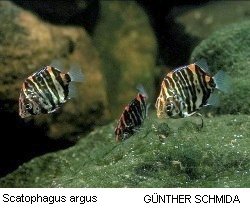
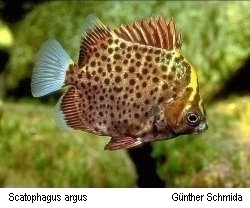
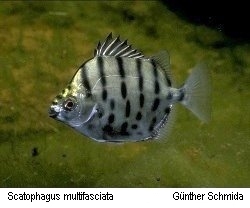
Silver Batfish (Mono)
Monodactylus argenteus, commonly called the Mono or Silver Batfish, is a highly adaptable species that will settle happily into fresh, brackish or full marine conditions, making it a natural fit for a brackish display. Its laterally compressed, tiny-scaled silver body is topped by a tall, peaked yellow-to-orange dorsal fin. It is an active, mostly midwater schooling fish that appreciates a spacious aquarium and is not fussy about diet, ranging along the coast from southern New South Wales north through Queensland and the Northern Territory, most commonly in estuaries and the lower reaches of coastal rivers. Although generally regarded as a marine species, it regularly pushes into fresh water.
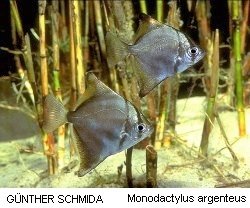
Archerfish
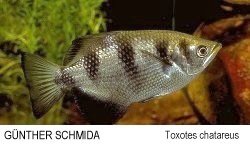
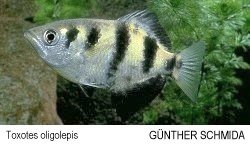
Six species make up the archerfish family, Toxotidae, of which four have been recorded in Australian waters: Toxotes chatareus (the most commonly encountered), T. jaculatrix, T. lorentzi and T. oligolepis. Distinguishing between them by eye is genuinely difficult — reliable identification usually comes down to fin-ray, scale and gill-raker counts, or simply knowing the collection locality. Archerfish breed in both freshwater streams and brackish estuaries in the wild, though captive breeding does not appear to have been documented; wild fish can reach 40 cm but 15–20 cm is more typical. They are most often found around submerged mangrove roots, sunken timber or overhanging branches, hunting aquatic and terrestrial insects — famously including insects knocked down with a well-aimed jet of water spat from the surface, a party trick that has made the group popular in public-aquarium displays worldwide as well as a fascinating focus for a home brackish tank.
Other Species
A number of other fishes will do well in a brackish aquarium. One less commonly encountered option reported from the tropical north of Australia and the Gulf of Papua drainage is Coius campbelli (also known by the synonym Datnioides campbelli), a member of the tigerfish family; a fairly large aquarium is needed for any specimen collected or acquired.
Account compiled for Home of the Rainbowfish from A. R. Tappin (1996–2000), “Among the Mangroves”, originally published at rainbowfish.angfa.org.au, archived by the National Library of Australia. Republished with the author’s permission.