
Australian Freshwater Shrimp
Overview
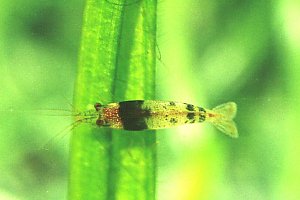
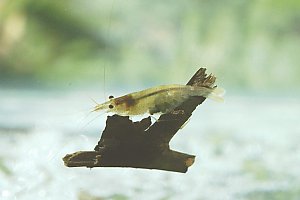
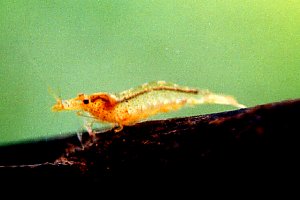
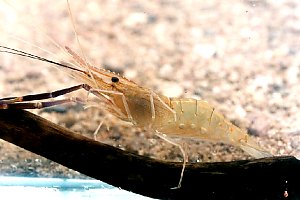
Freshwater shrimps are usually kept for practical reasons — as consumers of detritus and soft algae — but they make interesting, active additions to a rainbowfish aquarium in their own right. Being omnivorous scavengers, they will happily take ordinary fish food over algae or detritus when it is offered, and seem particularly keen on soft-boiled zucchini and newly hatched brine shrimp. Australia and New Guinea are home to a number of freshwater shrimp genera, of which Paratya and Caridina are the most commonly encountered by aquarists. Both share a prominent rostrum, a well-developed abdomen ending in a tail fan, and long, slender legs, the first two pairs tipped with tufts of fine setae; juveniles are simply smaller versions of the adults.
Paratya
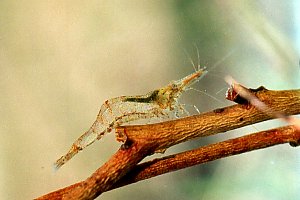
Australia has only one native Paratya species, Paratya australiensis, found across mainland Australia and Tasmania and growing to a maximum of about 3.5 cm (related species occur on Lord Howe and Norfolk Islands, in New Zealand, New Caledonia and Japan). It carries a small spine above each eye at the base of the rostrum, and is unusual among freshwater shrimp in producing free-swimming, planktonic larvae. This is timed to avoid being swept downstream: the breeding cycle begins in summer, just as habitats are starting to contract to isolated pools, so that by the time stream flow strengthens again the young shrimp have already grown large enough to resist being carried away. Raising this species in the aquarium calls for plenty of microorganisms or microalgae for the planktonic young to feed on.
Caridina
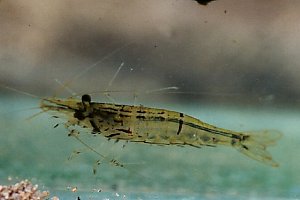
Closely related to Paratya, the genus Caridina is distinguished by a shorter, stouter rostrum, well-developed eyes lacking a supraorbital spine, and an absence of the outer branch (exopod) on all walking legs; its members are small shrimp of similar size to Paratya, generally reaching only about 2–4 cm. Several species have been recorded from northern Australia, including Caridina confusa, C. indistincta, C. serratirostris, C. cf. nilotica, C. zebra and a larger species with a notably long rostrum, aptly named C. longirostris, along with C. thermophila from the Lake Eyre drainage of inland Australia. Comparatively little has been published on their biology; C. indistincta in particular is commonly found in strongly acidic coastal sand-dune habitats in the wild, though a neutral to slightly alkaline pH is recommended for keeping it in captivity, along with a temperature of about 20–24 °C. One important caution: Caridina species are extremely sensitive to copper, with reported mortality at levels as low as 2 µg/L, so copper-based aquarium medications should be avoided wherever shrimp are present.
Other Genera
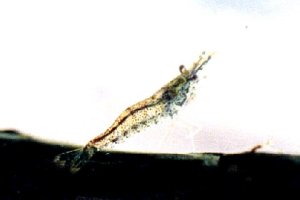
Caridinides wilkinsi is a small shrimp related to Caridina, ranging across northern Australia from the Northern Territory to the Johnstone River on the north Queensland coast. Australatya striolata is another common species, found in coastal freshwater streams of eastern Queensland and New South Wales; a stout-bodied, comparatively sedentary shrimp in the aquarium (though a strong swimmer when it needs to be in the wild), it tends to filter detritus from under rocks and among plants rather than actively forage, and is translucent green, greenish-blue or brown with a pale stripe down the centre of the back and five darker longitudinal stripes along each side of the carapace.
Macrobrachium — Not for the Fish Tank
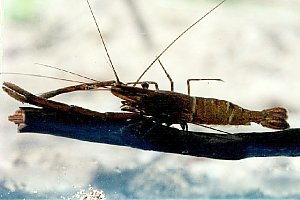
Macrobrachium species are a different proposition altogether: medium to large shrimp, some reaching 115 mm in carapace length, with a greatly elongated second pair of clawed legs that makes them capable, mostly nocturnal predators of small fish. Even an unsuccessful strike can leave a fish with damaged fins or torn tissue, which rules this genus out as a companion for rainbowfishes. Australia has several species inhabiting both fresh and brackish estuarine water, including M. australiense, M. handschini, M. rosenbergii and M. tolmerum, plus an as yet unnamed species from the upper Tully River in Queensland; the biology of M. rosenbergii in particular is well documented, since it is farmed commercially as a food species in many parts of the world.
Account compiled for Home of the Rainbowfish from A. R. Tappin (2000), “Australian Freshwater Shrimp”, originally published at rainbowfish.angfa.org.au, archived by the National Library of Australia. Republished with the author’s permission.
References
- Hancock M.A. and S.E. Bunn (1997) Population dynamics and life history of Paratya australiensis Kemp, 1917 (Decapoda: Atyidae) in upland rainforest streams, south-eastern Queensland, Australia. Marine and Freshwater Research 48: 361-369.
- Horwitz P. (1995) A preliminary key to the species of Decapoda (Crustacea: Malacostraca) found in Australian inland waters. Identification Guide No. 5. Co-operative Research Centre for Freshwater Ecology, Albury.
- Walsh C.J. and B.D. Mitchell (1995) The freshwater shrimp Paratya australiensis (Decapoda, Atyidae) in estuaries of south-western Victoria. Marine and Freshwater Research 46: 959-965.
- Williams N.J. (1983) Toxicity of copper to three Magela Creek fishes and a shrimp in simulated Gulugul Creek water. Environmental Protection in the Alligator Rivers Region, Paper 65 of the scientific workshop held at Jabiru, NT, 17-20 May. Supervising Scientist for the Alligator Rivers Region.
- Williams W.D. and M.J. Smith (1979) A taxonomic revision of Australian species of Paratya (Crustacea: Atyidae). Australian Journal of Marine and Freshwater Research 30: 815-832.
- Williams W.D. (1980) Australian Freshwater Life, 2nd Edition. Macmillan, Melbourne.