

Kiunga auromarginata
Gold-margined Blue-eye
Species Summary
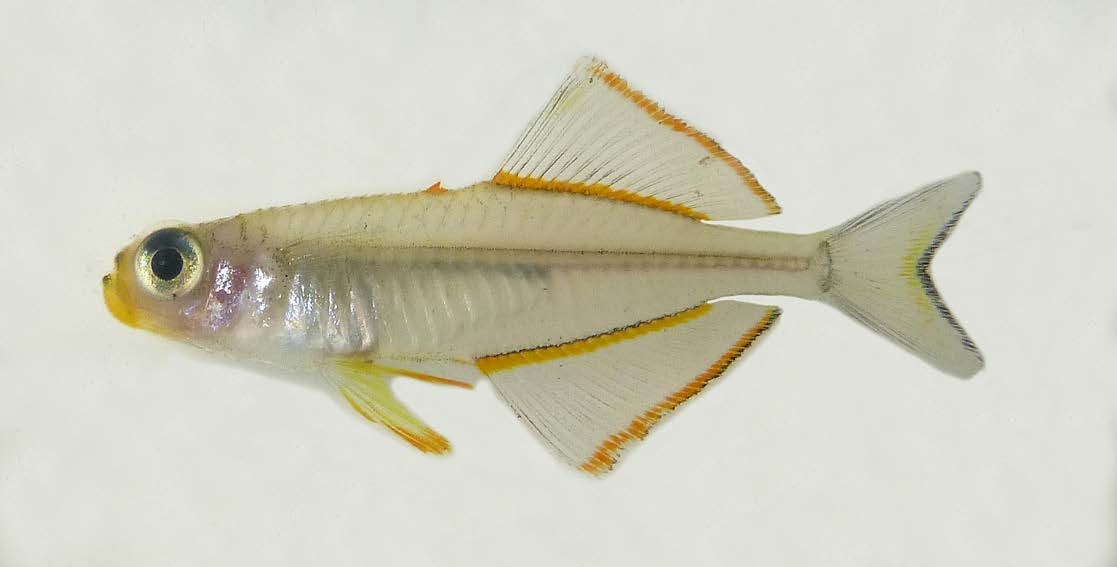
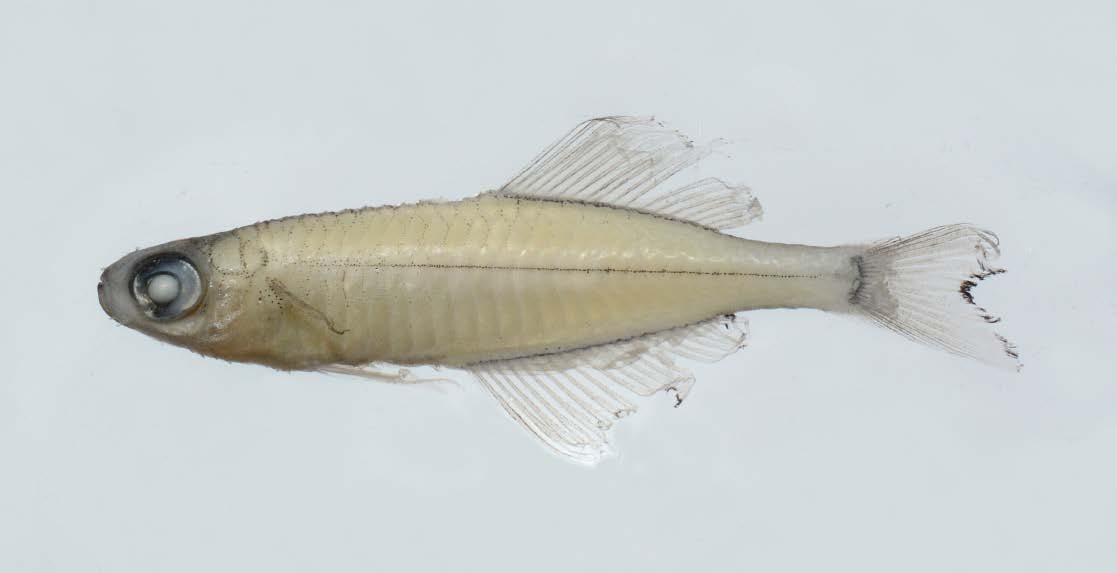
Kiunga auromarginata is a tiny, delicate blue-eye of the genus Kiunga, a group of small pseudomugilids restricted to foothill tributary streams of the Upper Fly River system in Western Province, Papua New Guinea. It was one of three species described in a 2024 revision of the genus, which recognised a remarkable radiation of five closely related species within a single small river basin. The body is slender and largely semi-transparent, reaching only about 24 mm in standard length. It is readily told from its relatives by bright orange to gold markings — on the tip of the jaws and snout, on the minuscule first dorsal fin, and along the margins and bases of the second dorsal and anal fins — the feature that gives it its name. The caudal fin has a blackish rear edge and the pelvic fins are yellowish with orange edges.
Distribution & Habitat
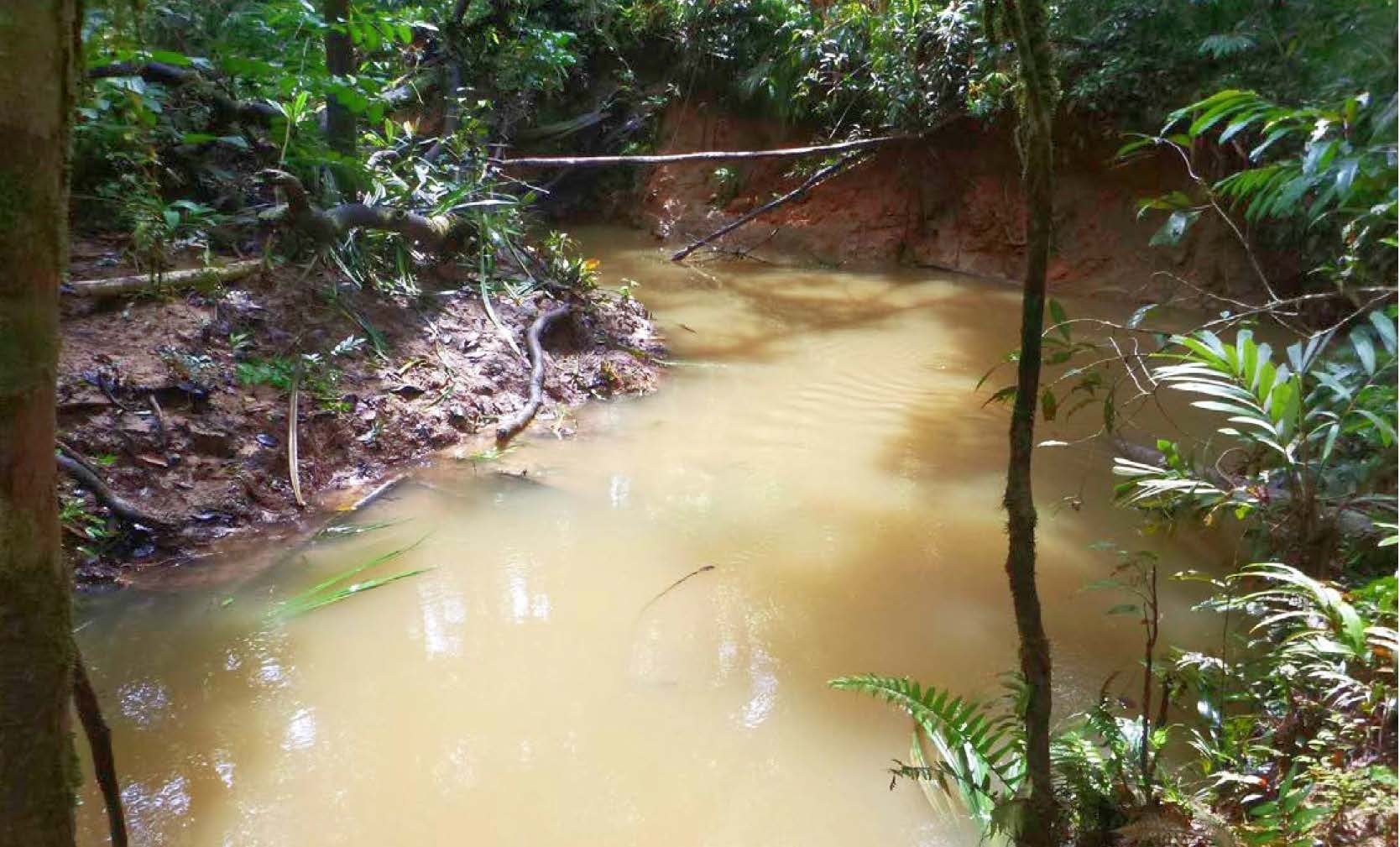
Kiunga auromarginata is confirmed only from Taki Creek, a small tributary of the Elevala River about 4.3 km south of Gasuke Village, on the eastern side of the Fly River. Two further records from nearby creeks (Agime Creek and an unnamed creek) are presumed to be this species on grounds of proximity, but no specimens were kept to confirm them, so they are noted only tentatively. The type-locality habitat is a lowland creek roughly 5–8 m wide and 1–1.5 m deep, slow-flowing, with clay banks and a soft organic bed, some submerged water plants and woody debris. Like all Kiunga, it lives in clear, shallow, well-shaded rainforest streams at low elevation (about 40–100 m above sea level).
Description
A slender species, adults to about 24.5 mm SL. The second dorsal fin carries 17–19 segmented rays and the anal fin 17–20 — more than in K. ballochi or K. bleheri — and both fins are moderately tall with a triangular profile. There are 28 lateral scales, 5 transverse scales and 3–5 cheek scales; the body is slender (greatest depth about 26% of standard length) and the caudal fin is forked. Against its congeners it is distinguished by the combination of a slender body, the high fin-ray counts, the 3–5 cheek scales, and the distinctive orange fin markings.
Etymology
The genus name Kiunga is named for the village of Kiunga, Papua New Guinea, the largest settlement in the area where K. ballochi occurs. The species name auromarginata combines the Latin auro-, from aureus, gold, and marginata, edged or bordered, referring to its golden-orange fin margins.
Etymology compiled from C. Scharpf (2024), “Fishes of Sahul: an Etymological Survey (Part 7), Pseudomugilidae and Telmatherinidae”, Fishes of Sahul 38(2): 2176–2189, and etyfish.org.
Remarks
Fish from Taki Creek were first reported in the 2020 review of the genus (Amick, Yarrao & Storey) as an “eastern form” of K. ballochi, but were noted even then as looking sufficiently different to be a possible separate species; the 2024 revision confirmed this and described them as new. Genetic analysis places Kiunga auromarginata as the closest relative of K. filamentosa.
Account compiled for Home of the Rainbowfish from G. R. Allen, M. P. Hammer, P. J. Unmack & A. W. Storey (2024), “A remarkable radiation of five species in the genus Kiunga (Teleostei: Pseudomugilidae) from the Fly River system, Papua New Guinea with descriptions of three new species”, Fishes of Sahul 38(2): 2137–2157, with discovery history from P. K. Amick, M. Yarrao & A. W. Storey (2020), “A review of the genus Kiunga (Teleostei: Pseudomugilidae), with notes on distribution, potential environmental impacts and recommendations for research and conservation”, Fishes of Sahul 34(3): 1626–1636.