

Pseudomugil connieae
Popondetta Blue Eye
Synonymy
- Popondetta connieae Allen, 1981
- Popondichthys connieae Allen, 1987
- Pseudomugil connieae Saeed, Ivantsoff & Allen, 1989
Species Summary
When Pseudomugil connieae were initially discovered they were mistakenly identified as Pseudomugil furcatus, a species described by Nichols in 1955. However, when Gerald Allen realised that they were a new species he called them Popondetta connieae after his wife Connie (Lagos) Allen. When it was discovered that the genus Popondetta already existed, he renamed them Popondichthys connieae. However, in 1989 they were placed in the genus Pseudomugil, where they remain today.
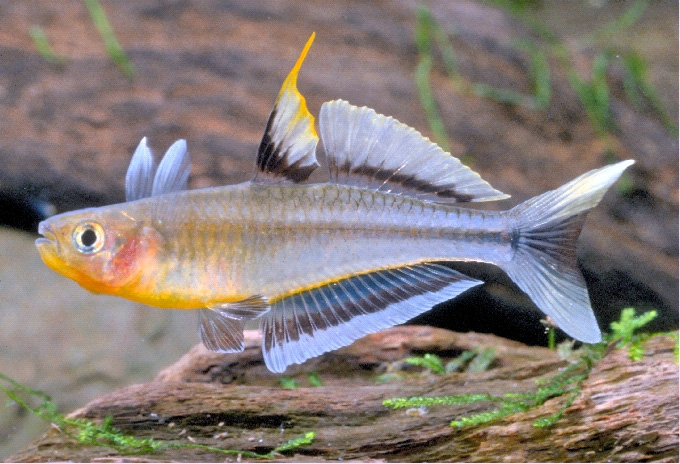
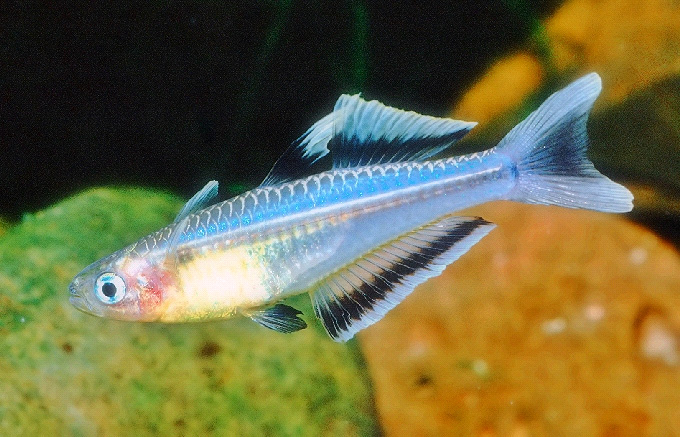
Males are easily distinguished from females by their brighter colours and longer and more elongated dorsal fin. The body colour is yellow-green in both males and females. The dorsal and anal fins of the males have a broad white or yellow outer margin and black band across the middle. The outer region of the first dorsal fin is yellow. Females are similarly coloured but not as intense, and have much smaller fins, which lack the detailed markings of the males. They have a moderately compressed and elongated body and grow to a length of around 4 to 5 cm.
Etymology
The genus name Pseudomugil combines the Greek pseudo-, false, and pseúdēs, referring to how the type species, P. signifer, may resemble the mullets (Mugilidae) in overall shape, width of head, and number of rays in the first dorsal fin, though such a resemblance is false. The species is named in honour of Allen’s wife Connie, as a small token of appreciation for her invaluable assistance over the years; she usually prepares her husband’s manuscripts for publication.
Etymology compiled from C. Scharpf (2024), “Fishes of Sahul: an Etymological Survey (Part 7), Pseudomugilidae and Telmatherinidae”, Fishes of Sahul 38(2): 2176–2189, and etyfish.org.
Distribution & Habitat
Pseudomugil connieae were initially collected from a number of small creeks in the vicinity of Popondetta, situated on the northern side of the central dividing range, eastern Papua New Guinea. They are common in the vicinity of Popondetta and have been collected from a number of localities within a 25 km radius. They are generally found in small, clear, relatively swift-flowing freshwater streams. Temperature and pH in these streams recorded at the time of collection ranged from 24–27°C and 7.7–7.9.
Remarks
This species was originally collected by Gerald Allen and Brian Parkinson in 1978. They collected approximately 200 specimens. However, mortalities were high and only eight specimens survived the journey back to Australia. These were shipped to Sydney and picked up by Gunther Schmida and acclimatised in his tanks for several weeks before the last lag of their journey to Perth. Small numbers were eventually bred and circulated in the Australian hobby.
Pseudomugil connieae have never been readily available in the aquarium hobby and this small initial group formed the base of all populations in Australia, which I might add has now almost disappeared. Heiko Bleher collected live specimens in 1982 and these were bred and distributed in Europe and form much of the available stock currently in Europe. I first obtained stock in 1992 and bred them in January 1993. Some of these were sent to Europe in 1994, which at the time there wasn’t many available in Europe.
Pseudomugil connieae are a magnificent blue eye and are much sought after by aquarium hobbyists. It is very important to provide regular partial water changes as I have found this species doesn’t like old, acidic water. The key for successfully maintaining Pseudomugil connieae in captivity is excellent water conditions. This can be easily provided with regular partial water changes. They will display their best colouration when maintained in a densely-planted, partly shaded aquarium. However, this is not a requirement for their successful maintenance in captivity. I have bred and raised them in captivity with the following water conditions: Temperature 19–31°C, pH 7.6– 8.2, Hardness 90–150 mg/L, Alkalinity 40–65 mg/L and Conductivity 369–663 µS/cm. Eggs adhere to water plants and hatching occurs around 15 days at a temperature of 25° Celsius.
The stomach content of several wild-caught specimens indicated a diet consisting primarily of minute crustaceans and insect larvae with small amount of algal matter.
Comparisons of Pseudomugil connieae and
Pseudomugil furcatus :
The two species are easily distinguished on the basis of colour and there are significant differences in modal counts for the second dorsal and anal fins. The most apparent differences involve fin colouration of mature males. The dorsal and anal fins of P. furcatus are mainly transparent to slightly dusky with a relatively narrow outer margin of yellow. Those of P. connieae have broad, whitish outer margins with a bold black band across the middle of each fin; the outer portion of the first dorsal fin is yellow as in P. furcatus. However, the caudal fin of P. furcatus has a pale yellow lobes with thin black dorsal and ventral margins, whereas that of P. connieae has whitish lobes, a dusty central portion, and lacks dark margins. The pelvic fins of P. connieae are largely dusky or blackish and the pectoral fins are whitish on the upper edge. By contrast the pelvics of male P. furcatus are yellow and this same colour is present on the upper edge of the pectoral fins. The females of P. connieae are basically similar to males except the dark bands in the middle of the dorsal and anal fins are less distinct and narrower, the outer edge of the second dorsal is broadly yellow (as in P. furcatus), the caudal fin lobes are yellowish and the pelvic and pectorals are uniformly transparent.
References
- Allen G.R. (1981) Popondetta connieae, a new species of rainbowfish (Melanotaeniidae) from Papua New Guinea. Revue française d'Aquariologie 8(2): 43-46.
- Allen G.R. (1987) Popondichthys, a replacement name for the melanotaeniid fish genus Popondetta. Japanese Journal of Ichthyology 33(4): 409.
- Allen G.R. (1991) Field guide to the freshwater fishes of New Guinea. Christensen Research Institute, Madang, Papua New Guinea.
- Crockford B. (1984) The genus Popondetta. Fishes of Sahul 2(2): 66-68.