
Pseudomugil novaeguineae
New Guinea Blue Eye
Species Summary
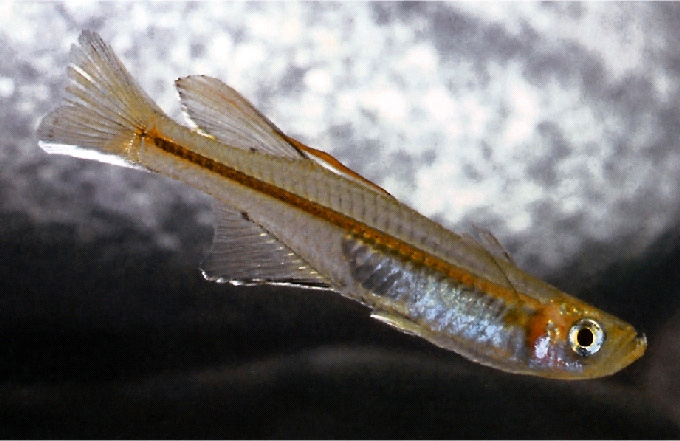
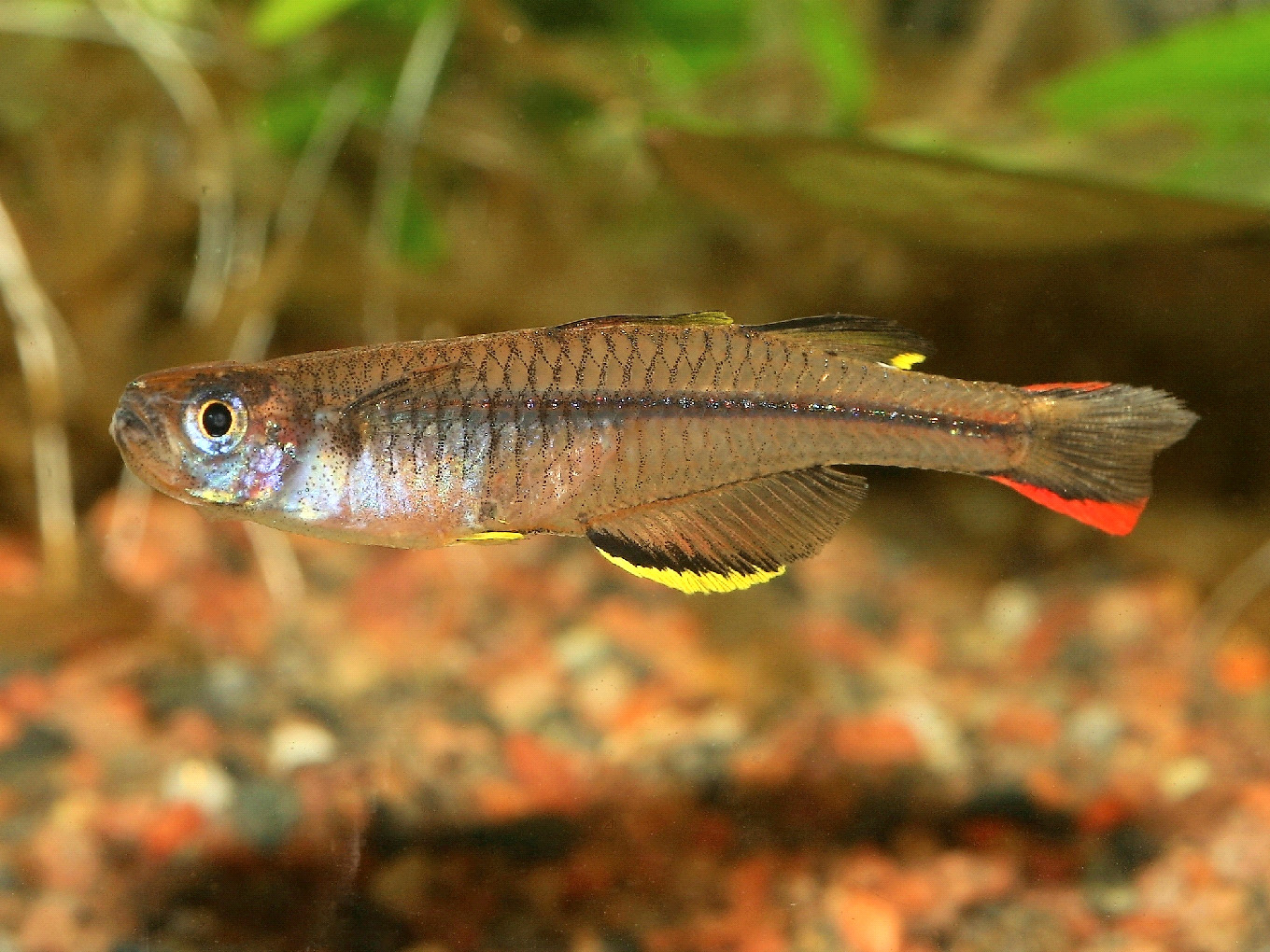
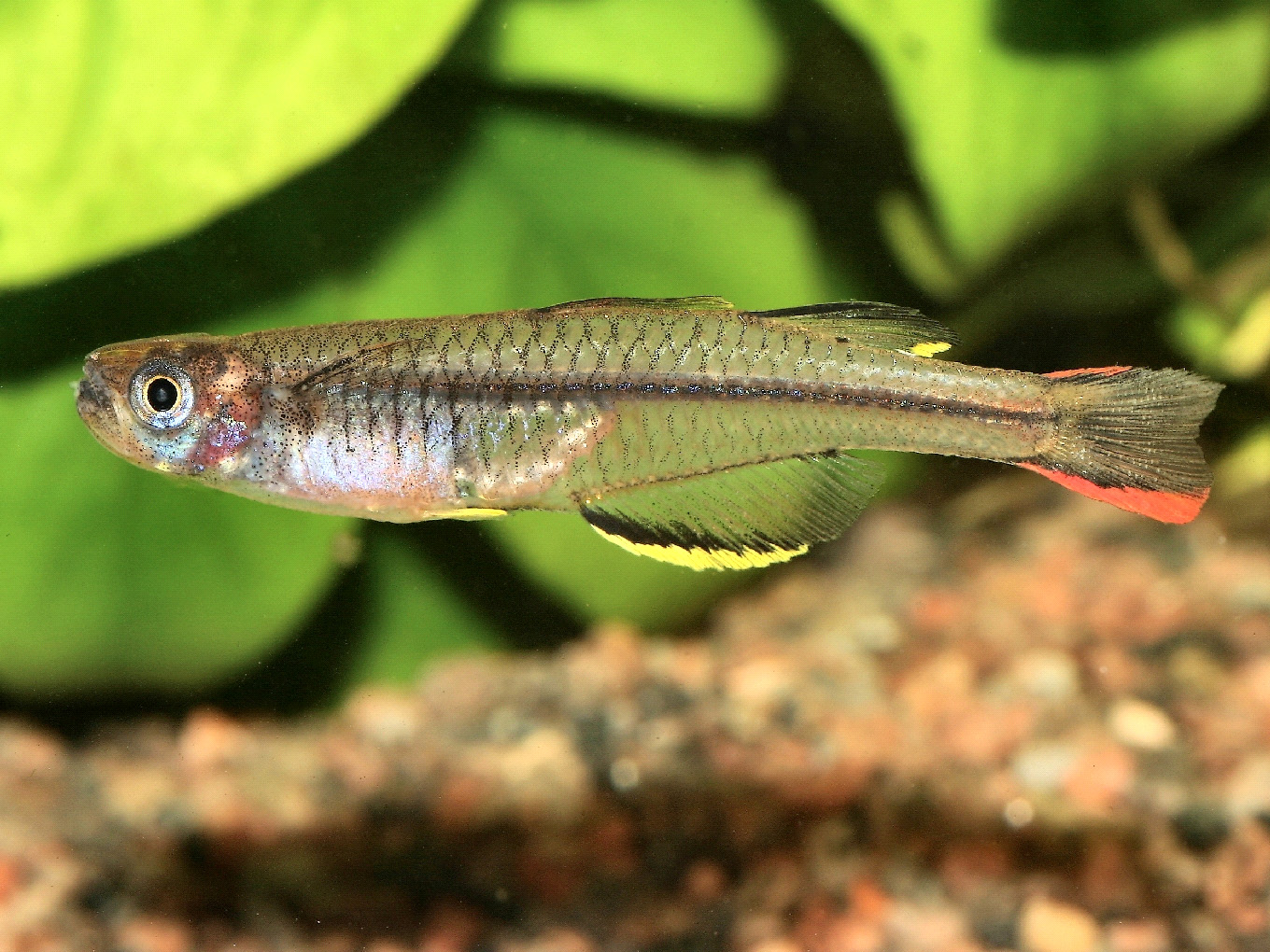
Pseudomugil novaeguineae have a yellowish semi-translucent body with a thin dark mid-lateral line on the sides. The body scales are lightly edged with black forming an attractive latticework pattern. Common maximum size for this species is about 4–5 cm SL. Males have elongated anterior first, second dorsal and anal fin rays. Adult males have a red first dorsal spine and the outer margin of the first dorsal fin is also red. The second dorsal and anal fins, as well as the lower lobe of the caudal fin have white, yellow or red margins. The colour can change rapidly back and forth. The adult male can also be recognised on the blackish anterior edge of his dorsal fin and the black streaks that adorns both the upper and the lower edge of the caudal fin.
Specimens collected from the Fly River in New Guinea have been reported as having a transparent body with glistening bluish or violet colour on the head and abdomen. The eye has a faint gold ring around the pupil with the iris silvery or faintly blue. The second dorsal fin of males is either clear, as in females or carmine red. Due to the wide geographical range of this species the colours and markings on the body and fins can be variable. Red coloured eggs are laid by Pseudomugil novaeguineae.
Etymology
The species is named for New Guinea, the island, where the type locality (Wagami River, an Urama tributary) is situated.
Etymology compiled from C. Scharpf (2024), “Fishes of Sahul: an Etymological Survey (Part 7), Pseudomugilidae and Telmatherinidae”, Fishes of Sahul 38(2): 2176–2189, and etyfish.org.
Distribution & Habitat
This species has patchy distribution in central southern New Guinea between the Fly River, Papua New Guinea and Etna Bay, West Papua. They have also been collected from the Aru (Aroe) Islands in the Arafura Sea. Scientific specimens of this species were first collected from the Lorentz (Noord) River by Hendrikus Albertus Lorentz during the Dutch Expedition to New Guinea in 1907. Lorentz participated in three expeditions to Dutch New Guinea. The first expedition was in 1903, led by A. Wichmann. Lorentz led expeditions in 1907 and 1909-1910.
Pseudomugil novaeguineae inhabit small clear rainforest streams; well shaded but with occasional open patches exposed to sunlight. A temperature of 24° Celsius and pH 7.8 were recorded at one collection site in a tributary of the Ok Smak River, about 35 kilometres north of Kiunga. Kiunga ballochi sometimes occurs in the same streams.
Remarks
Around 1976 and 1989 live specimens were collected and taken back to Europe. In 2004, Iain Wilson and Charles Nishihira collected live specimens of Pseudomugil pellucidus, P. ivanstoffi and Melanotaenia goldiei from the Iwaka River (Deky Creek), which is a tributary of the Kamora River. Melanotaenia goldiei, M. rubrostriata, P. novaeguineae, P. pellucidus and P. ivantsoffi were collected in small streams of the Kopi River, which is a tributary of the Minajerwi River in West Papua. There have been a number of other collections, but P. novaeguineae is still not widely available in the aquarium hobby.
References
- Allen G.R. (1991) Field guide to the freshwater fishes of New Guinea. Christensen Research Institute, Madang, Papua New Guinea.
- Allen G.R. (1995) Rainbowfishes in Nature and in the Aquarium. (Tetra-Verlag: Germany.)
- Allen G.R., W. Ivantsoff, M.A. Shepherd and S.J. Renyaan (1998) Pseudomugil pellucidus (Pisces: Pseudomugilidae), a newly discovered blue-eye from Timika-Tembagapura region, Irian Jaya. Aqua 3(1): 1-8.
- Weber M. (1907) Süsswasserfische von Neu-Guinea ein Beitrag zur Frage nach dem früheren Zusammenhang von Neu-Guinea und Australien. In: Nova Guinea. Résultats de l'expédition scientifique Néerlandaise à la Nouvelle-Guinée. Süsswasserfische Neu-Guinea v. 5 (Zool.) pt 2: 201-267, Pls. 11-13.