

Pseudomugil paskai
Paska's Blue Eye
Species Summary
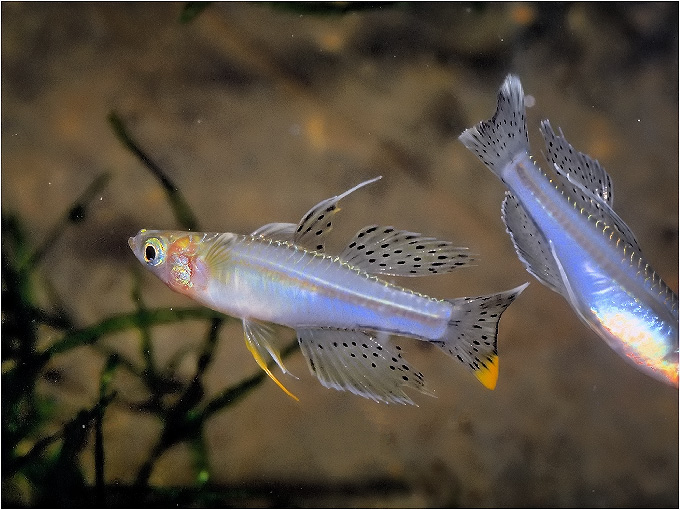
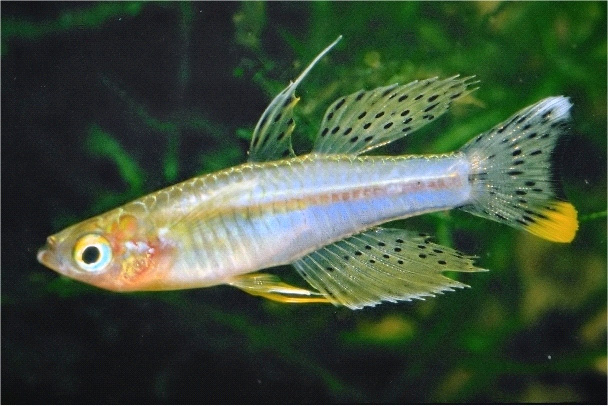
Pseudomugil paskai is a small slender-bodied species, usually not exceeding 35 mm in length. Two dorsal fins, very close together, the first much smaller than the second. Males have a semi-translucent body colour that is bluish ventrally and yellowish above the mid-lateral line, with narrow dark scale outlines. The fins are generally translucent with white or yellow margins and scattered oval black spots. Lobes of the caudal fin have either white, yellow or reddish tips. Pelvic fins are yellowish with elongated anterior rays. Females do not have spots on their fins and do not show the colours of the males.
Etymology
The species is named in honour of John Paska, a former fisheries technician with the New Guinea Ministry of Fisheries, for his assistance during Allen’s visits to Papua New Guinea; he also helped collect the holotype.
Etymology compiled from C. Scharpf (2024), “Fishes of Sahul: an Etymological Survey (Part 7), Pseudomugilidae and Telmatherinidae”, Fishes of Sahul 38(2): 2176–2189, and etyfish.org.
Distribution & Habitat
Pseudomugil paskai were first discovered by David Balloch and Gerald Allen in 1983. They are very similar to Pseudomugil gertrudae, but differ in colouration and fin shape. Known only from a few locations between Etna Bay and the Fly River system in New Guinea. However, they are probably widely distributed in coastal streams over much of southern New Guinea. They are a stream dwelling species occupying slow-flowing muddy or teacoloured rainforest streams.
Aquatic vegetation is generally abundant. The pH and temperature ranges recorded at the collection site were 6.0–6.5 and 25–26° Celsius.
Remarks
Live specimens were collected in 1983 by Gerald Allen and returned to Australia, but failed to become established in the hobby. However, further live collections were made and small populations were established in the hobby. In 1996 eggs were imported into Australia from Europe, but again, they failed to become established. Their current status in the hobby is unknown.
References
- Allen G.R. & W. Ivantsoff (1986) Deux nouvelles espèces de blue-eyes (Pseudomugil: Melanotaeniidae) de Nouvelle-Guinée. Revue française d'Aquariologie 12(3): 85-88.
- Allen G.R. (1991) Field guide to the freshwater fishes of New Guinea. Christensen Research Institute, Madang, Papua New Guinea.
- Allen G.R. (1995) Rainbowfishes in Nature and in the Aquarium. (Tetra-Verlag: Germany)
- Allen G.R., K. Hortle and S. Renyaan (2000) Freshwater Fishes of the Timika Region, New Guinea. P.T. Freeport Indonesia, Timika, Indonesia.
- Crockford B. (1998) Pseudomugil paskai. Fishes of Sahul 12(2): 561-562.