

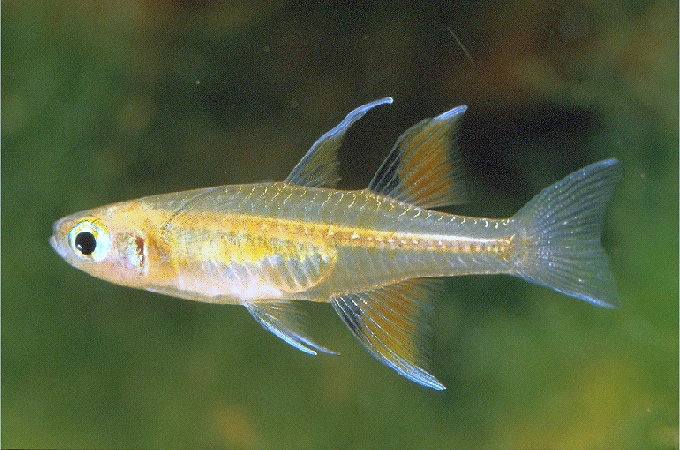
Pseudomugil signifer
Pacific Blue Eye
Synonymy
- Atherina signata Gunther, 1867
- Atherinosoma jamesoni Macleay, 1884
- Atherinosoma signata Ogilby, 1886
- Pseudomugil signata Ogilby, 1896
- Pseudomugil signatus Jordan & Hubbs, 1919
- Pseudomugil signatus affinis Whitley, 1935
- Pseudomugil affinis Munro, 1958
Species Summary
Pseudomugil signifer is a small, colourful blue-eye species inhabiting freshwater streams and brackish estuaries in coastal drainages along much of the east coast of Australia and offshore islands. They are the most common and abundant freshwater/estuarine species along the east coast of Australia.
They were first discovered near Sydney, New South Wales in the 1860’s and were the first blue-eye species to be scientifically described. A few years’ later specimens were collected from northern Queensland. Various name changes followed, and in the late nineteenth and early twentieth centuries, they were separated into two species, the northern Pseudomugil signatus and the southern Pseudomugil signifer. Also, it was suggested that a population resident on the offshore Low Isles and some northern mainland populations were distinctive and were afforded sub-specific status as Pseudomugil signatus affinis.
The various populations exhibit remarkable morphological variation throughout their range, which is evident from their confused taxonomic history. In 1979, researchers using electrophoretic analyses and a large sample of specimens taken from 14 localities along the east coast determined that all populations were scientifically indistinguishable from one another. Although they did recognise that there were some slight differences. This, however, is inconsistent with recent genetic research that indicated there are extensive differences among the various populations.
The research provided a good reason for suggesting that Pseudomugil signifer may represent at least two distinct species. Support for this contention is not only consistent with some of the previous taxonomic designations, but is also in keeping with recent behavioural studies. Breeding experiments showed that fish from opposite ends of the species range would not interbreed. In Queensland, there are two major geographical populations, those north and south of the Herbert River, with an intermediate form in the Townsville area.
It has long been the belief of native fish hobbyists in Australia that the various forms of Pseudomugil signifer are different, particularly the northern and southern populations. Also that the variety found in the Townsville region is different. I maintained and bred populations from Harvey and Lacey Creeks in north Queensland, the Ross River variety from Townsville, and a number of different populations from southeast Queensland over a period of 20 years. However, you only have to maintain these species for a very short time before you realise that they not only look different, but that they behave differently as well. Therefore, they should be maintained and bred within their own localised groups and it is wise not to interbreed the various geographical varieties.
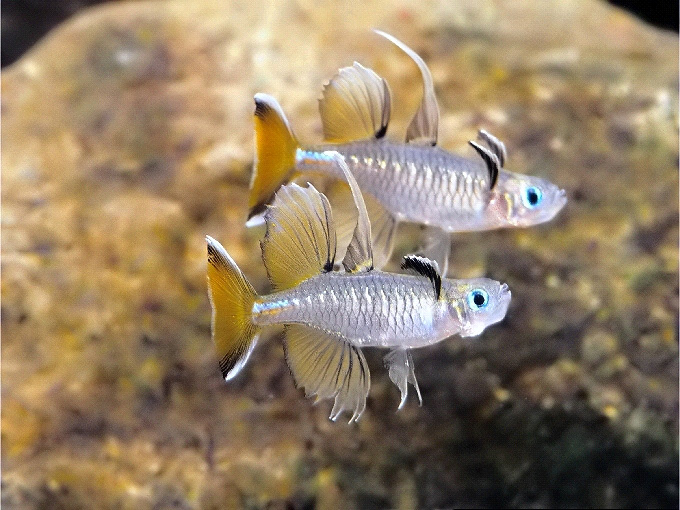
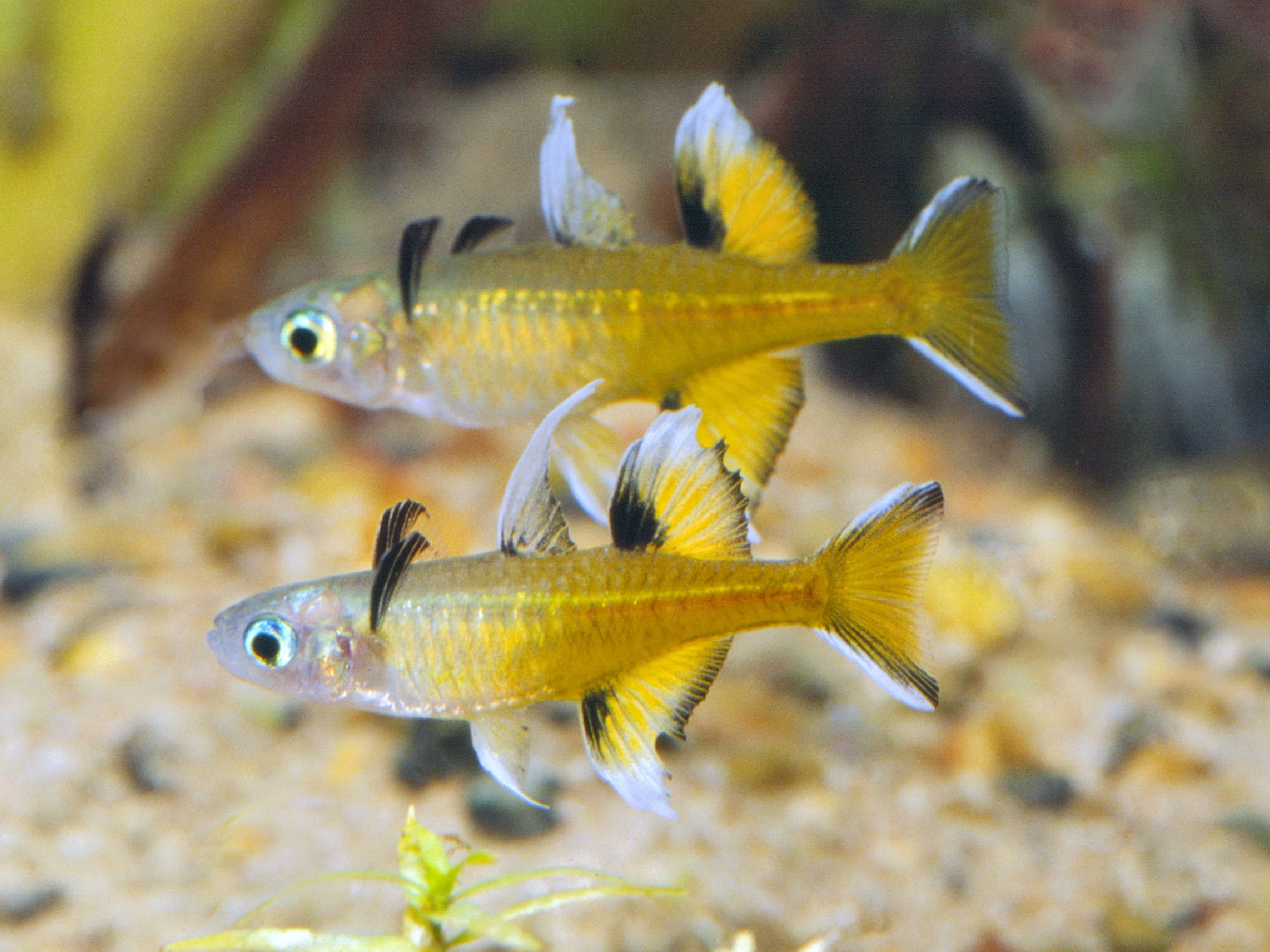
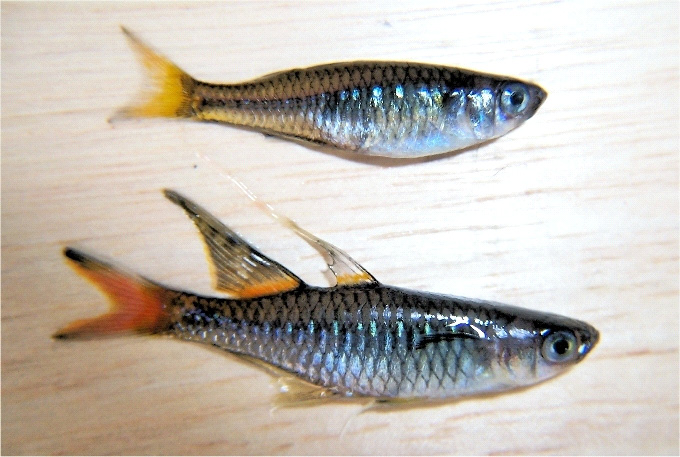
Pseudomugil signifer is one of the most readily identifiable and ubiquitous members of the Australian fish fauna. They have a moderately compressed and elongated semi-transparent body that can vary in colour from pale olive, yellow to bluish, with fine, dark coloured scale outlines on the upper body. They have two dorsal fins, very close together, the first much smaller than the second. As the common name suggests, the iris is blue. The operculum and belly region are silvery. There is often a midlateral row of 10–12 vertically-elongated white or reflective spots along the side of the body. The males are larger and more colourful than females. The males display spectacular fin embellishments that are rapidly raised and lowered during courtship and agonistic encounters with other males. Due to the wide geographical range of this species the colours and markings on the body and fins can be variable. There is also substantial inter-population variation in male body size and fin length. Male specimens from northern populations can reach 90 mm and females 65 mm, although they can be considerably smaller over much of their range. Southern populations rarely exceed 40 mm.
Male specimens from north Queensland populations (especially specimens from Harvey and Laceys Creeks) have extremely long extended filaments on both the dorsal and anal fins. These filaments are usually shed during capture and if not, once placed in the confines of an aquarium, are nipped off by the other fish. From my experience, these fin extensions never regrow or appear in captive populations. They have a silvery to yellowish body, with the elongated parts of fins blackish, also the margins of the second dorsal and anal fins. Edges of upper scales dark, and often a dark stripe along the side. The young are yellowish-brown with dark spots on the dorsal and caudal fins. A black band along the middle of sides with a similar but shorter dark band above and below it on the caudal peduncle. About six rows of dark spots along the scale rows, fading out posteriorly. Spawning males display a coppery-gold body colouration, particularly along the lower jaw region.
The first thing that is evident about the northern variety at Pseudomugil signifer is the size of these fish in comparison to the southern forms. The specimens I received from Laceys Creek in 1980 were about 60 mm in size and a number of the males had long extended filaments on both the dorsal and anal fins, extending past the tail. Another obvious difference is that northern males are also highly territorial and aggressive and will often kill sub-dominant males. Outside of breeding, aggression can be suppressed by maintaining them in reasonably sized aquaria in company with a small group of rainbowfishes.
The Ross River variety is a large, deep-bodied species with huge fins that are wide and long, but less intense in colouration. They usually have less body colour, but have a row of brilliant blue or purple reflective scales along the posterior section of the lateral line, often merging to form a continuous band, that is flashed on and off like a neon sign as they display to passing females.
They are generally found in brackish reaches of the Ross River and surrounding streams. A similar form extends south, down at least as far as Eurimbula Creek just north of the Town of 1770.
Southern populations have a body colouration of translucent to olive-greenish above, canary yellow below; the caudal peduncle is tinged with red. There is sometimes a broad dark band from pectoral to tail. The first and second dorsal spines are long and white though blackish at the base, while the rest of the fin is translucent. The second dorsal has the front and exterior margins black while the rest of the fin is yellow or orange. The anal fin is similar to the second dorsal. The caudal fin can be clear to orange or yellow with the outer rays, tips of lobes, and sometimes the central rays blackish. The pectoral fins are clear to opaque, with upper rays black. The ventral fins are usually bright yellow or orange. As the name indicates, the eyes are a beautiful blue. Females are less colourful; have smaller rounded clear dorsal and anal fins with a dark line on the anterior edge of the second dorsal fin. Specimens collected from freshwater habitats generally have deep orange coloured dorsal and anal fins whereas specimens from saltwater or brackish water habitats have yellow fins. Fish from acidic, tannin strained streams in south-eastern Queensland also show deep orange on the dorsal and anal fins. However, colour is extremely variable and will depend upon the mood of the fish, water conditions and diet.
Etymology
The species name combines the Latin signum, flag or banner (used by ichthyologists to refer to the dorsal fin), and -fer, from fero, to have or bear, referring to the elongate dorsal fin of males.
Etymology compiled from C. Scharpf (2024), “Fishes of Sahul: an Etymological Survey (Part 7), Pseudomugilidae and Telmatherinidae”, Fishes of Sahul 38(2): 2176–2189, and etyfish.org.
Distribution & Habitat
Pseudomugil signifer is the most widely distributed blue-eye in Australia. They have extensive distribution from Merimbula Lake just north of Eden on the southern coast of New South Wales to Cape York Peninsula including islands in the Torres Strait. They have also been found in the Embley and Mission rivers near Weipa on the west coast of Cape York Peninsula. They are abundant in freshwater habitats, and inhabit rainforest streams, riverine habitats and freshwater swamps, but do not usually penetrate far inland. They can tolerate brackish to fully marine conditions, being found in tidal mangrove creeks, estuaries and saltmarshes, and on several offshore islands, including Moreton Bay in south-east Queensland. They are frequently found in the waters of canal housing estate developments on the Gold Coast in south-east Queensland. Diadromous migration is not an essential requirement of the species. Rather, the species is characteristic of the estuarinefreshwater interface. They inhabit waters with a temperature range of 15–28° Celsius, and pH 5.5–8.3.
Keeping & Caring
Pseudomugil signifer has been maintained in the aquarium hobby for many years. David G. Stead published a report on Pseudomugil signifer in his book “Fishes of Australia ~ A Popular Systematic Guide to the Study of the Wealth within Our Waters” in 1905: “The Blue-eye is sprightly, vivacious and an active swimmer; being, in addition, very tenacious of life, and, therefore, embracing, in its little self, all the qualities which go to make up a desirable aquarium-fish. Its common name is derived from the blue-colour of the irides of both sexes. In general shape it is more Mullet-like than any other species of the Atherinidæ. The male is far more handsome than the female; the second-dorsal, anal and caudal fins being greatly elongated; each being beautifully barred with yellow and black. The beautiful colours are particularly noticeable during the spawning season, which is the summer-time. The body is usually of a silvery tint on the sides, the back being somewhat greenish. If in very dirty waters, the body-colour is often a yellowish-brown, and only slightly silvery. But little is known in regard to the habits, and, nothing so far, in regard to the life-history, of this entertaining little Atherinid.”
On May 31, 1911, David G. Stead exhibited examples of Pseudomugil signifer to a meeting of the Linnean Society of New South Wales. “These were part of a number obtained, during April, from Wamberal Lagoon, at a spot where the water was “sweet” or brackish. These were brought away in that water, and, on April 19th, one was placed in an aquarium of sea-water (of about three years’ standing), and the others were put into a freshwater aquarium. All had done well up to the present; the one in salt water, equally with those in fresh. This is an interesting experiment, inasmuch as it demonstrates the power of this little species to withstand sudden changes in its surrounding element. The coastal lagoons are very rich in this species, and these lagoons become practically fresh, and very salty alternately; it is, therefore, greatly to the advantage of this (and other species of aquatic life present) if they can adjust themselves to the varying conditions.”
In 1915, Albert Gale wrote in his book Aquarian Nature Studies - “One of the most beautiful indigenous aquaria fish we have in New South Wales, both in colour and markings, and at the same time the most shapely, is the little blue-eye (Pseudomugil signifer). The adults never exceed 2 inches in length, and its depth is symmetrical to its length. Among imported aquaria fish specimens, the Paradise fish and the Fighting fish are its only rivals. In spring time, the breeding season, the sexes are very readily distinguished; the male, as is always the case in the fishworld, attires himself in his wedding garb, his fins become more developed and expansive. His whole body assumes a maize tint, his fins the colour of old gold edged with black, having a very narrow margin mottled with gold and white. The eyes of the male form a very striking contrast with the general markings of the body, being azure or sky blue and bright and lively; the whole contour giving the fish the appearance of aquatic butterflies rather than that of fish. The males are far more resplendent in the breeding season than are the females. Their natural food is rotifers, and the various varieties of animalculae. They are very fond of mosquito larvae. In confinement they do well on coffee biscuit, occasionally varied with a little flesh food or gentles.” [Gentles are the larvae of blow-flies - the first stage after leaving the egg.]
Pseudomugil signifer were introduced to the international aquarium hobby as early as 1932. During 1933 the Shedd Aquarium in Chicago, dispatched an expedition to Australia, which, in addition to the larger fishes that were the object of the trip, obtained a number of smaller specimens. Notably in this collection were Hypseleotris galii, Hypseleotris compressus and Pseudomugil signifer.
Pseudomugil signifer are an attractive species that are easy to maintain and breed in captivity and are hardy aquarium fishes despite their small size. Ideally, they should share their aquarium with similar sized tankmates and be kept in small groups. Regardless of the water conditions of their natural habitat they will survive in most dechlorinated tap waters available to the home hobbyist. Even those collected from brackish and saltwater habitats will survive and breed in freshwater. For general aquarium maintenance water conditions can be as follows: pH 6.5–7.5, hardness <200 ppm and a temperature range of 20–28°C.
The natural diet of P. signifer consists primarily of small insect larvae, aquatic crustaceans, worms, zooplankton and phytoplankton. In captivity, they can be fed live or frozen foods such as daphnia, copepods, mosquito larvae or brine shrimp. Whiteworms and other small worms are also an excellent food. Flake food or small bite-sized pellets can also be fed with success however for best results some supplementary feeding with live or frozen food is required.
Pseudomugil signifer are a relatively short lived species in the wild and females may only spawn once, usually at around one year of age, rarely living to spawn a second season. Males often live around two years. In captivity, life expectancy can increase to four years or more if appropriate aquarium management procedures are employed.
Breeding
In their natural environment spawning usually occurs from October to January for southern populations, while the breeding season for northern populations can be year round. They are an egg-scatterer, generally spawning amongst aquatic plants and grasses.
Males are territorial and engage in spectacular fin-flashing displays during contests with rivals over the acquisition and defence of spawning sites. In the wild, males maintain and guard these sites while females move between them, inspecting the males along the way. Females may swim along in small shoals or also swim past alone. Males do not venture far from their territories and rely on the females to swim past. Males will actively swim over and try and entice the females with conspicuous courtship displays (body tilted in a head-down position, raising and lowering his fins). If successful, the female will follow the male to his territory and spawn. In the wild they tend to spawn amongst stems and roots of marginal aquatic vegetation close to the water’s edge. In laboratory research, males were found to prefer courting larger females presumably because female fecundity increases with body size.
Group spawning with multiple males and females is probably the preferred method for breeding. Several spawning mops should be provided for egg placement. It is advisable to provide a spawning mop for each male in the group. In addition, this method should provide you with more eggs. Spawning pairs or trios is possible but you may end up with damaged or dead females due to the male’s aggression. Group spawning spreads this aggression.
In captivity pre-spawning behaviour is initiated adjacent to the chosen spawning site by the male actively pursuing a female with raised fins and swimming in a zigzag pattern to block the female's retreat. When receptive, the female will enter the spawning site first, closely followed by the male. Disinterested or non-gravid females move away and swim to the surface or hide amongst aquatic plants. Females do not always choose the dominant male/s and will usually achieve higher spawning success when they mate with their preferred choice. In the wild, a female has the choice of either spawning or fleeing. In captivity, the flight of the female is reduced or confined to the size of the breeding aquarium. Therefore, the size of the breeding aquarium is vitally important and should be appropriate for the variety being bred.
Males exhibit territorial behaviour towards conspecifics such as lateral fin-flaring displays and pursuits. They do not actively care for the eggs other than through defence of the spawning site. A male might cannibalise his own eggs, or defend his spawning site badly against other egg predators. During spawning the males colour intensifies with the fins becoming brighter and the body turning from silvery to a golden bronze colour. The females body darkens with the scales edged in black. Females usually shed 2 to 3 eggs (1.1–1.8 mm) each spawning with up to 18 eggs being laid per day. Eggs have adhesive filaments that attach to plants or spawning mops.
Spawning usually occurs in late morning or early afternoon. After spawning, the male will continue to display, defending his territory and thus the fertilised eggs. The eggs can be difficult to find in large mops and if the eggs are being “picked” from the mops, thorough checking is required if all the eggs are to be found. Eggs were usually found singularly or in groups of 2 or 3.
I found that Pseudomugil signifer seem to prefer a dimly lit aquarium for breeding. The number of eggs being laid was not as high as I expected. Perhaps some were being eaten, although this was never observed. Also free hatching larvae were never observed in the breeding aquarium. If your floating mops are not producing eggs, try mops without floats, and if you still can’t find any eggs you might find that the fish are spawning in the gravel. You might be surprised how many larvae actually hatch out from the gravel.
Eggs were collected daily and placed in a 4 litre plastic container with the addition of methylene blue as a fungicide. Upon hatching the fry were carefully transferred to a 135 litre raising tub. I found that the larvae nearly always emerge from the eggs during the night or early morning. Water conditions of the fry raising tub were maintained at around the same chemistry of the breeding tank. Weekly water changes of 20% were provided.
Eggs will take around 12–17 days to hatch at a temperature range of 22–28° Celsius. Although P. signifer are only small their newly hatched larvae are rather large. The hatching size of the larvae is around 4–5 mm. At around 15–20 mm the males began to show some fin colouration but the fins were still the same shape as the females. By 20–25 mm the elongated anal and dorsal fins are developed and the sexes should readily be distinguished. Rapid development of larvae continues with maturity being reached within 6 months with males at about 30 mm and 25 mm for females. Males show slender elongated dorsal and anal fins with yellow, orange and red markings, while the females and juveniles have short rounded clear dorsal and anal fins with the only colouration being a dark line on the anterior edge of the second dorsal fin.
References
- Gale A. (1915) Aquarian Nature Studies and Economic Fish Farming. W.A. Gullick, Government Printer, 86pp.
- Hadfield A.J., Ivantsoff V., Johnston P.G. (1979) Clinal variation in electrophoretic and morphological characters between two nominal species of the genus Pseudomugil (Pisces: Atheriniformes: Pseudomugilidae). Australian Journal of Marine and Freshwater Research 30: 375-386.
- Hurst T, Ryan P, Brown M and Kay B (2005) Fishing for a mosquito control agent. Arbovirus Research in Australia 9: 143-147.
- Kner R. (1866) Specielles Verzeichniss der während der Reise der kaiserlichen Fregatte "Novara" gesammelten Fische. III. und Schlussabtheilung. Sitzungsberichte der Kaiserlichen Akademie der Wissenschaften. Mathematisch-Naturwissenschaften Classe. v. 53: 543-550.
- McGlashan D.J. (2000) Consequences of dispersal, stream structure and earth history on patterns of allozyme and mitochondrial DNA variation of three species of Australian freshwater fish. Ph.D. thesis, Griffith University, Brisbane, Australia.
- McGlashan D.J., J.M. Hughes, and S.E. Bunn (2001) Within-drainage population genetic structure of the freshwater fish Pseudomugil signifer (Pseudomugilidae) in northern Australia. Canadian Journal of Fisheries and Aquatic Sciences 58: 1842-1852.
- McGlashan D.J. and Hughes J.M. (2002) Extensive genetic divergence among populations of the Australian freshwater fish, Pseudomugil signifer (Pseudomugilidae), at different hierarchical scales. Marine and Freshwater Research 53: 897-907.
- Moffat R., Cliff L., Thomas D., Breitfuss M. and Hurst T. (2005) A local government perspective: benefits of native fish for mosquito control and public relations opportunities. Arbovirus Research in Australia 9: 252-254.
- Morton R.M., Beumer J.P. and Pollock B.R. (1988) Fishes of a subtropical Australian saltmarsh and their predation upon mosquitoes. Environmental Biology of Fishes 21: 185-94.
- Saeed B., Ivantsoff W. and Allen G.R. (1989) Taxonomic review of the family Pseudomugilidae (Order Atheriniformes). Australian Journal of Marine and Freshwater Research 40: 719-787.
- Semple G.P. (1986) Pseudomugil signifer - maintenance, reproduction and early development of the Pacific blue-eye. Fishes of Sahul 3(3): 121-125.
- Stead D.G. (1906) Fishes of Australia - A Popular Systematic Guide to the Study of the Wealth within Our Waters. William Brooks & Co., Limited, Sydney.
- Stead D.G. (1911) The Proceedings of the Linnean Society of New South Wales (May 31, 1911).
- Unmack P.J. (2001) Biogeography of Australian freshwater fishes. Journal of Biogeography 28: 1053-1089.
- West R.J. and Jones M.V. (2001) FRDC 97/204 Final Report: Shallow water fish communities of New South Wales south coast estuaries. Report Series Nos. 2001/1. Ocean and Coastal Research Centre, University of Wollongong, Australia.
- Wong B.B.M., J.S. Keogh and M.D. Jennions (2004) Mate recognition in a freshwater fish: geographical distance, genetic differentiation, and variation in female preference for local over foreign males. Journal of Evolutionary Biology 17(3): 701-708.
- Wong B.B.M., J.S. Keogh and D.J. McGlashan (2004) Current and historical patterns of drainage connectivity in eastern Australia inferred from population genetic structuring in a widespread freshwater fish Pseudomugil signifer (Pseudomugilidae). Molecular Ecology 13: 391-401.