
Artificial Incubation of Eggs
Whether you have an unintentional spawning in your aquarium or a well-planned breeding program, to raise rainbowfishes successfully you must be able to provide the right conditions. Excellent water quality is always a must. Developing embryos and newly hatched larvae (fry) are the most sensitive and delicate of the developmental stages in the life of a rainbowfish. Therefore, great care must be taken to provide them with a proper incubating and hatching environment.
High mortality rates can often occur, especially during the early stages. Mortality can be the result of several factors including inbreeding, inferior water conditions, improper incubation conditions and poor nutrition. However, hatching rates and survival can be increased using artificial incubation.
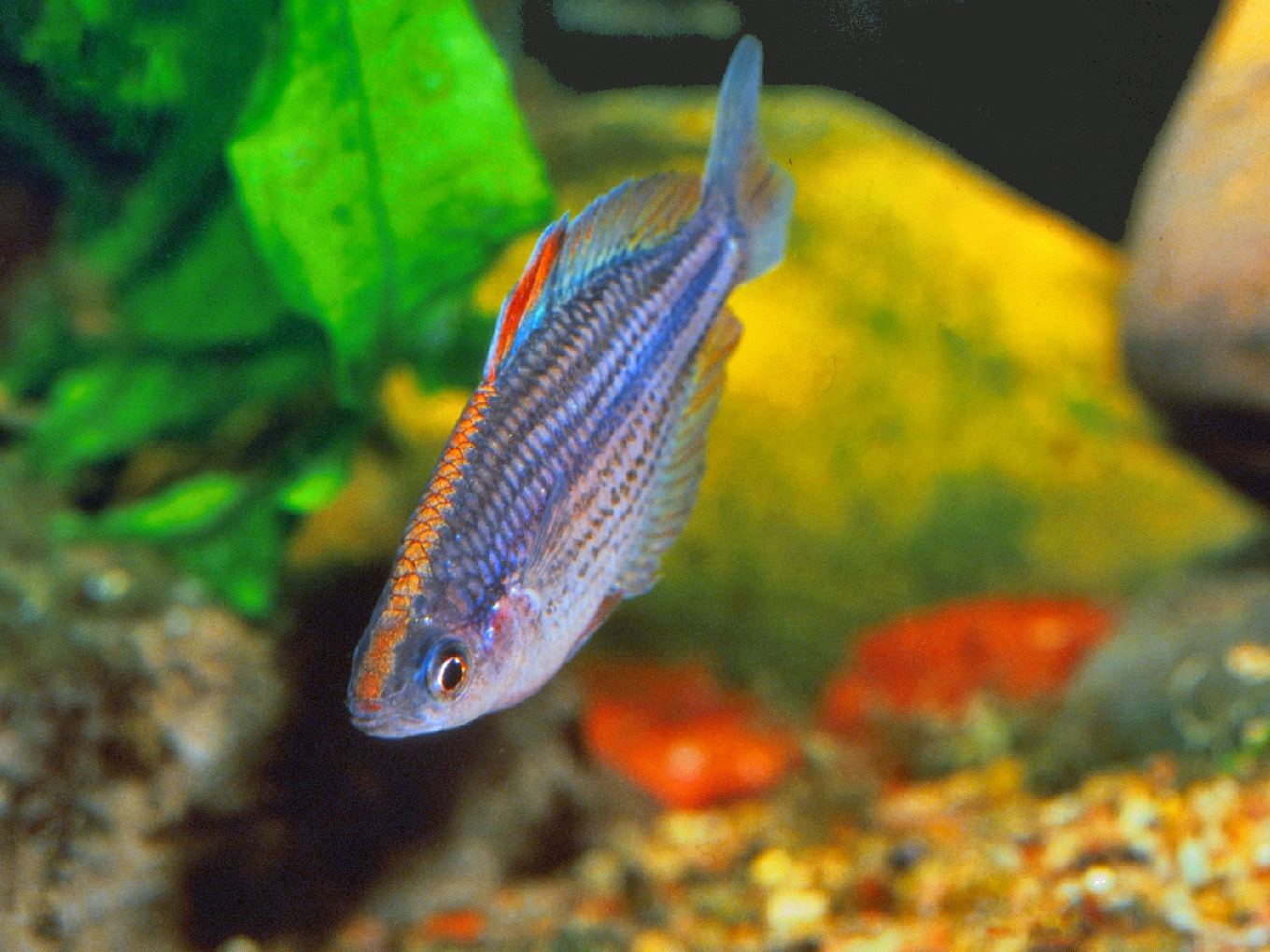
Depending on species, males frequently “flash” an instantaneous brightly coloured band that runs from the upper lip to the first dorsal fin, which they flash on and off like a neon sign. The colours can range from white to yellow, orange, rustic red and light blue.
Collecting eggs from the breeding aquarium is the best way to ensue the largest number of offspring from your selected breeders. Also, removal of the eggs may increase egg production by shortening the time for another spawning to occur.
For those species that spawn a large number of eggs each day, best results will be achieved by providing them with spawning mops and then moving the egg-laden mops to a previously established nursery aquarium for incubation and larval rearing. Alternatively, for those species that only spawn a small number of eggs each day the simplest method would be to just hand-pick the eggs from the spawning mops. Fertile, water-hardened eggs are reasonably hardshelled and can easily be collected from the spawning mop with clean fingertips. You will find that they can be rolled between your fingers without damage. Any eggs that burst while being collected will most likely be infertile.
Spawn-laden mops should be softly squeezed or allowed to drip dry. Individual eggs will stand out like tiny glass beads against the darker-coloured strands of the spawning mop. Place the eggs into clean plastic hatching containers for incubation. Aeration is important but must be moderated to avoid damage to the developing embryos. Once hatched and after the period of yolk absorption, the larvae move to the surface to feed. The larvae should then be transferred into the nursery aquarium immediately. Carefully removed them to a previously set-up nursery aquarium as soon as possible. Alternatively, the hatching container can be floated in the aquarium in which the larval fish will be reared. The larvae will swim at the water surface of the container after hatching and can be gently poured out of the hatching container into the surrounding water in the aquarium. This way you won’t have to collect the newlyhatched larvae, which can sometimes be a bit tedious, and it eliminates the need for any physical handling of the larvae.
A wide variety of devices and methods are used for incubating rainbowfish eggs. Depending on your needs, you can utilise a system of several small containers attached to a common recirculating system or a few small individual hatching aquariums. The simplest method is to just place them in a small shallow tray or container filled with pre-conditioned water. A gently movement of the hatching water with an airstone should be provided to insure adequate water circulation to all the eggs. This will prevent the accumulation of waste products, and allow gas exchange between the egg and the surrounding water. Because of their size and permeability, fish embryos and larvae are susceptible to many types of organic or inorganic materials dissolved or suspended in the water. Therefore, it is essential to provide good water quality for the embryos and larvae.
The amount and incidence of light received during incubation can affect both fish development and larval survival. Therefore, all types of egg incubating containers should be stored in such a manner to protect developing embryos from direct light.
The spawning of rainbowfishes, embryo development, survival, and growth of larvae all occur within a narrow range of water temperatures. Temperature is one of the major factors in determining the embryonic period for rainbowfishes. The development and hatching is delayed at low temperatures, and accelerated at high temperatures. Incubating temperatures are also known to modify the behaviour of larvae and determine certain morphological characteristics. There is an optimum temperature range required for each developmental life stage.
Water temperatures should be maintained with minimal fluctuations ± 1°C. In general, optimum temperatures for hatching and rearing all rainbowfish species are within the temperature range of 24-28°C. Avoid temperatures above or below this range. Poor embryo survival, low hatch success, reduced growth rates, larval deformities, and increase in larvae diseases may result from temperature fluctuations or temperatures outside the optimum range for the species. If needed, the hatching container can be floated in a heated aquarium to maintain the correct temperature.
Depending on species, the hatching time for rainbowfishes and blue-eyes is around 6 to 21 days within the temperature range of 24-28°C. Fully developed embryos display prominent eyespots, and are usually referred to as being ‘eyed-up’. At hatching, when the rainbowfish larva leaves the egg it is provided with a yolk sac, and from this, it derives sufficient nourishment to tide it over the first few hours or days of its freeliving existence. This means that there is a certain period of time where it is not necessary for a larval fish to obtain their nutrition from external sources.
Rainbowfish larvae can survive for as long as 8–10 days without external food sources providing that the yolk sac contained enough nutrients. However, if an egg does not hold adequate nutrients, larvae hatching from that egg would have a shorter period of unfed larval life than larvae hatching from an egg with a good supply of nutrients.
At hatching, rainbowfish larvae measure around 3 to 4 mm, and are reasonably well developed. They are competent swimmers with well-developed pectoral fins and a continuous median fin fold, beginning dorsally and continuing around the tail. The larvae swim at the surface of the water, generally within the upper 1-cm water layer. The mouth is well developed and functional, and they usually begin feeding within hours of hatching. Therefore, you will have to commence feeding them as soon as possible.