

Hybridisation
Hybridisation is the interbreeding of individuals from two populations, or groups of populations, which are distinguishable on the basis of one or more heritable characters. When two populations of distinct but closely related rainbowfishes come into contact, members of those populations may spawn with each other and successfully reproduce. The process of hybridisation can create problems for taxonomists, but it can also be a sign of the continuous nature of the process of speciation — the evolutionary formation of new species. The recognition of taxonomic diversity is a key issue underlying the problems associated with assigning species status to this group of fishes.
If hybrids are formed between two populations that are barely differentiated, they may remain undetected, since their features may fall within the range of variability of one or both of the populations. One would expect, if those populations were to remain in contact, that they would blend together and lose their distinctness. On the other hand, two populations may each have diverged so far from their common ancestor that their individuals no longer recognise each other as potential mates. In that case, biologists are agreed that the two populations should be considered separate species. They will not fuse back into a single species.
It is between those two extremes of complete blending and total distinctness that hybridisation can provide glimpses of the complex process of differentiation — of evolution in action. Speciation normally occurs in geographic isolation, but the past distribution of rainbowfishes is complicated. Populations once isolated may come into contact, and when they do, the amount, duration, and results of hybridisation will vary from instance to instance.
It has long been thought that streams straddling the Great Dividing Range, which extends down the east coast of Australia, have captured drainages on the opposite side. Captures of western flowing streams by those flowing east and vice versa have been variously debated over the last fifty years or more. For example, it has been suggested that the Barron and the Burdekin Rivers in northern Queensland captured previously western flowing streams. The Clarence River area of north-eastern New South Wales has also characteristics which suggest that drainage rearrangements may have occurred, although the precise nature and timing of these events is still uncertain. The Fitzroy/Dawson system is believed to have drained a coastal area spanning latitudes 20°S to 23°S. Presently, much of the coastal area near the mouth of the Fitzroy River is drained by short coastal streams, although the Fitzroy River drains a large inland area.
Climate has also had a significant affect on the landscape in Australia, particularly freshwater environments. In the distant past Australia experienced very wet and humid conditions. Much of the inland was inundated by large freshwater lakes. The climate then developed more extreme and frequent periods of aridity. Much of the coastal regions inhabited by rainbowfishes probably experienced alternating cycles of wet and dry conditions. The outcome for river drainages was periods of drying and isolation followed by extensive flooding and connectivity.
These climate changes and related environmental changes have probably shaped the distribution of rainbowfishes. During the extreme wet conditions it is plausible that rainbowfishes were able to disperse across these river drainage boundaries. In contrast, the drier conditions may have prevented dispersal. These periodic connections and disconnections among catchments are predicted to have facilitated expansion and subsequent isolation of rainbowfish populations in new habitats.
There are numerous reports in the aquarium hobby that rainbowfishes which share the same habitat in the wild are quite capable of producing fertile hybrids in aquaria, but because of behavioural or colour differences they generally won’t hybridise in nature. Kin recognition in many fishes has been demonstrated by laboratory experimentation. For example, Arnold (2000) examined shoaling behaviour in rainbowfish (Melanotaenia eachamensis) and found that females preferentially spend time associating with relatives when in an all female shoal, but avoided male relatives in a mixed shoal. The former result is consistent with the expectation of kin-biased behaviour, whereas the latter is suggestive of an innate tendency towards inbreeding avoidance.
Hybridisation among rainbowfishes in their natural environment has traditionally been viewed as an unusual event. Allen & Cross (1982) previously recorded only two hybrids between Chilatherina campsi and Melanotaenia affinis in their study of rainbowfish taxonomy covering all species known at that time. However, hybrids are not easy to detect. They are much easier to identify and are generally recorded more often if the hybridising species are distinctively coloured.
Rainbowfishes are highly variable in form and recent efforts at distinguishing them have required genetic techniques to determine differences between them. Recent genetic studies have shown that hybridisation between rainbowfishes in their natural environment occurs more commonly than originally believed.
Zhu et al. (1994) and McGuigan et al. (2000) tentatively identified hybrids using mtDNA data for two Melanotaenia australis populations in the Northern Territory (Blackmore and South Alligator Rivers). Further evidence for hybridisation was found in Lake Tinaroo between Melanotaenia eachamensis and Melanotaenia splendida (Zhu et al., 1998), and other populations were found containing a mix of mtDNA genotypes and morphologies (Pusey et al., 1997; Zhu et al., 1998; McGuigan, 2001).
There is also some evidence that natural hybridisation has occurred between Melanotaenia splendida tatei / Melanotaenia fluviatilis; Melanotaenia duboulayi / Melanotaenia splendida splendida; Melanotaenia nigrans / Melanotaenia australis;
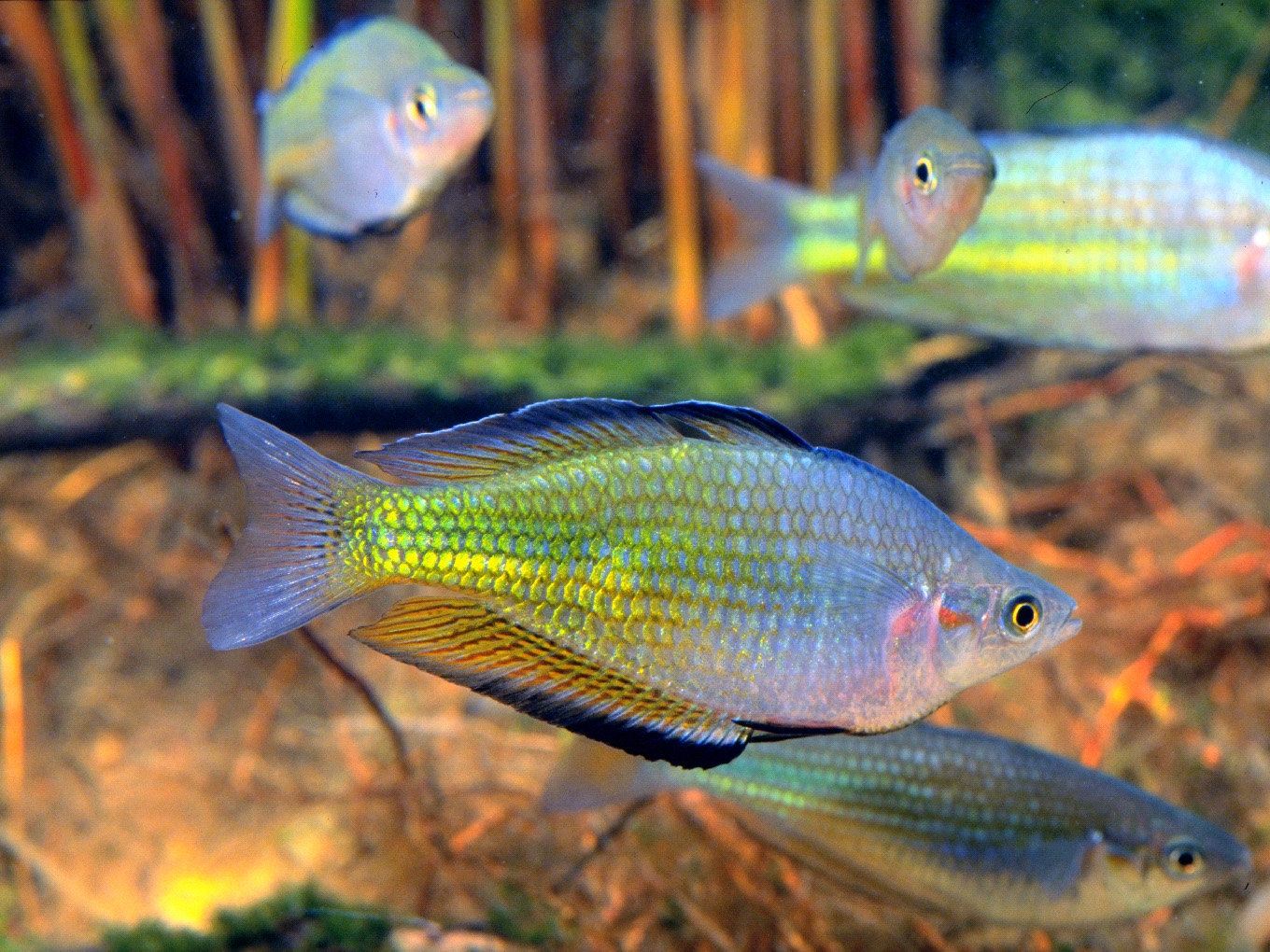
Melanotaenia australis / Melanotaenia exquisita; and Melanotaenia exquisita / Melanotaenia splendida inornata. However, it remains unclear whether these hybridisations represent sympatry, ongoing hybridisation, or historical introgression.
Based on mtDNA, nDNA and allozyme data it would appear that hybridisation and introgression has been common and has involved nearly all Australian rainbowfishes. Studies have shown that at least ten rainbowfish species in Australia have been involved in some degree of introgressive hybridisation. In some cases this was between sympatric species, but in others it occurred at the boundaries between more closely related species (P. J. Unmack 2005, pers. comm.).
The “Eachamensis” complex is north Queensland is really confusing, and even the “experts” can’t seem to agree. One study reported that while Melanotaenia eachamensis and Melanotaenia splendida were shown to be genetically, meristically and morphologically distinct, many specimens in the study exhibited an intermediate set of characters suggesting that hybridisation between these species may be common place if intermediate body morphologies are indicative of hybrids. Despite the research that has been undertaken to date, the specific status and distribution of Melanotaenia eachamensis and Melanotaenia splendida still remains unclear.
Four rainbowfish populations were sampled from the Fitzroy River in Queensland. Two populations from the upper reaches of the Comet and Dawson river tributaries, and two populations from the lower portion of the Fitzroy River drainage from the upper Connor River and a lowland tributary of the Fitzroy River were sampled.
Based on allozymes and mtDNA, the lower two populations were consistent with Melanotaenia splendida. The populations from the upper reaches were both consistent with Melanotaenia fluviatilis, with some Melanotaenia splendida alleles based on allozyme data, although they did have Melanotaenia duboulayi mtDNA. However this mtDNA type is common in Melanotaenia fluviatilis populations in the northern Murray-Darling catchment, the most likely source of these populations.
Each of these populations represents extremes in terms of separation by river distance within this drainage. At some point(s) within this system both species likely came into contact. No information currently exists relative to where this contact is likely to be! (P. J. Unmack pers. comm.).
Considering all the reported hybridisation events known so far between rainbowfishes in the wild, hybridisation might also have played an important role in the success of the spread of rainbowfishes across Australia and New Guinea.
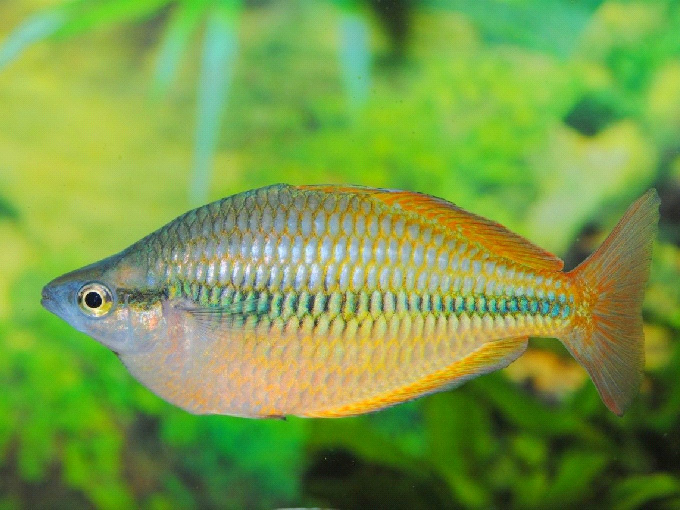
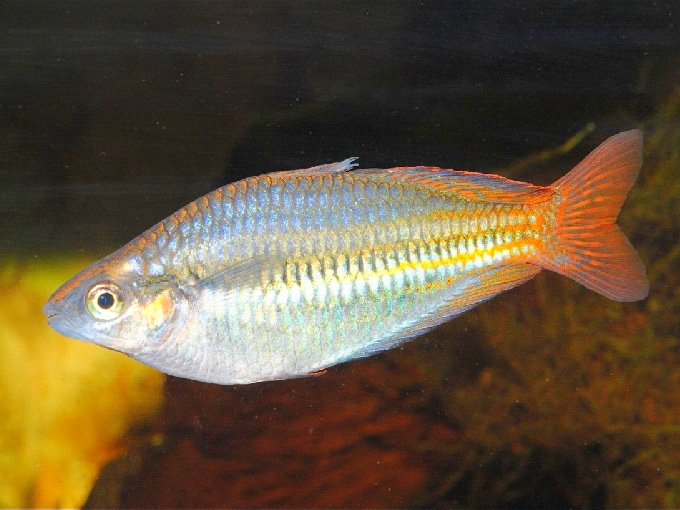
There are several possible evolutionary consequences of hybridisation. Hybridisation may occur due to human impact, such as between wild and translocated species. Hybridisation due to human disturbances can compromise the genetic integrity of existing species to the point of causing extinctions. In extreme cases, parental taxa may be lost in the process and/or new taxa formed. A third possibility is that a stable hybrid species will form, with limited introgression. Introgressive hybridisation among taxa is known to quickly increase levels of variation, allowing more rapid responses to environmental changes.
Although, for the most part, the different species of rainbowfishes can be distinguished from one another, there is the possibility that many species may only be examples of population variation within a single species. There is much argument and discussion amongst biologists as to what a species actually is. The classic definition of a “species” is related organisms that share common characteristics and are capable of interbreeding. For a long time, biologists have almost universally used the biological species concept. This definition of “species” is based on species being reproductively isolated from each other. Reproductive isolation is the failure of populations to interbreed or to form viable or fertile hybrids.
Some years ago a controlled breeding trial demonstrated that Melanotaenia fluviatilis and Melanotaenia duboulayi could interbreed and produce viable offspring. Therefore, should these fish be considered different species or just different subspecies? Subspecies are simply populations within a species that are sufficiently distinct that taxonomists have found it convenient to formally name them, but not distinct enough to prevent hybridisation where two populations come into contact.
Under the biological species concept, distinctive geographical forms of the same sort of fish are usually grouped together as one species. This is because the geographic forms interbreed (or probably would, if they had the chance). Thus, they should be considered the same species. The phylogenetic species concept says that diagnosable geographic forms of the same sort of fish should be treated as distinct species. This is because these forms have evolved separately, and have unique evolutionary histories.
Obviously, the phylogenetic species concept is less restrictive than the biological species concept. There would be many more species of fish under the phylogenetic species concept than under the biological species concept. These complications are a natural result of applying a hierarchical taxonomic system to the results of a continuous evolutionary process. It is possible that neither definition can be applied consistently in nature.
Fish of one species are, under most circumstances, incapable of interbreeding with individuals of other species. Indeed, the “biological species concept” centres on this inability to successfully hybridise, and is what most biologists mean by “distinctly different”. However, the debate over how species should be defined will continue.
Most rainbowfishes show distinct geographic variation both in colouration and characteristics. This is inevitable among populations of any species with extensive distributions. It is largely the result of populations responding to different pressures of natural selection in different habitats. If populations of a single species become geographically isolated, those different selection pressures may, given enough time, cause the populations to differentiate sufficiently to prevent interbreeding if contact is re-established.
In nature, degrees of differentiation and of abilities to hybridise fall along a continuum, so one finds what is expected in an evolving fish fauna — some populations intermediate between subspecies and species, populations that have differentiated to the point where they will not hybridise but have not yet regained full contact, and populations so distinct that they can be recognised as full species whether or not they occur together.
Because of this great variation in colours and body forms in many species of rainbowfishes, especially in Australia, all rainbowfishes should be bred within their own localised group. Regardless of their various colour patterns, they are capable and willing to breed together if permitted to do so.
The serious hobbyist intent on maintaining pure lines must keep every variety in separate aquariums. Unless this is done, members of the different varieties will interbreed and complicate future breeding programs and identification. Also, females of many rainbowfish species are very similar and can easily be confused for one another.
I kept rainbowfishes for more than 30 years and always kept populations, even if they went by the same species name, separated for breeding. History has shown that this is the prudent thing to do. In the 1970s and 80s, many populations of rainbowfishes found their way into the aquarium hobby. As time went on and the various populations were more carefully studied, we learned that several of these populations were, in reality, separate species.
Rainbowfish are highly variable in form and recent efforts at distinguishing them have required genetic techniques to determine differences between them. Therefore, it is important to maintain the various populations separately, as future genetic and morphological studies may confirm the presence of new species.
Most experienced rainbowfish keepers will not bring new fish into their breeding program unless the breeder/collector has retained the location details. These hobbyists, for example, would not obtain a species with the name given only as Melanotaenia trifasciata, because the buyer does not know what he/she is getting. We may learn in the future that the different populations have some significant genetic or morphological differences that justify their recognition as a new species. Breeding such fish would have diminished the long-term viability and integrity of the species. Therefore, it is important to include a location name, such as Wonga Creek, Goyder River, etc. If the location name is lost, the fish should be distributed as an “aquarium strain”.
Before being used for different rainbowfish species, spawning mops should always be boiled to destroy any eggs, which may still be attached to the mops. This procedure effectively precludes inadvertent hybridisation resulting from accidental carryover of eggs from the breeding set-up of one species to another, and demonstrates a significant advantage of using artificial spawning medium rather than living plants.
Most rainbowfish hybrids that hobbyists will come in contact with will just be unintended crossings. Although there are a number of “commercial” hybrids available, they are usually sold and distributed under trade names such as “Red Boesemani” etc. However, there are some hybrids being sold as true species. “M. marcii”, “M. hammeri” and “M. greetii” are such examples of commercial hybrids. These three hybrids were originally bred by a commercial aquarium dealer and breeder in the Netherlands. These hybrids, particularly “marcii”, often sold as the Marci Rainbowfish, have been widely distributed in Europe and North America.
Aquarium Hybrid (C. fasciata x C. bleheri) known in the hobby as Chilatherina fasciata “Kali Biru”
Taxonomy has traditionally used morphological characters to delimit species where a holotype is used as a reference specimen. However, the propensity of some rainbowfishes to hybridise with other species can result in difficulties. Allozyme, nuclear DNA (nDNA) and mitochondrial DNA (mtDNA) analyses has revealed that some “taxa” are not representative of species but rather they were distinct morphological forms resulting from hybridisation events. Hybridisation and introgression seem to be fairly common in rainbowfishes.
Extracted mtDNA allows us to map the genes on the mitochondrial DNA molecule. Animals having the same map were related in the past. Mitochondrial DNA does not recombine with other DNA as does nuclear DNA, thus allowing for a static means of identification. Mitochondrial DNA only comes from your mother and passes via a maternal line. While male offspring possess mtDNA it is not passed to offspring. Even though passed mtDNA is indistinguishable from generation to generation it is modified by mutation over extreme periods of time. Therefore, it is possible for rainbowfishes deriving from the same source to have different genes when separated for any length of time.
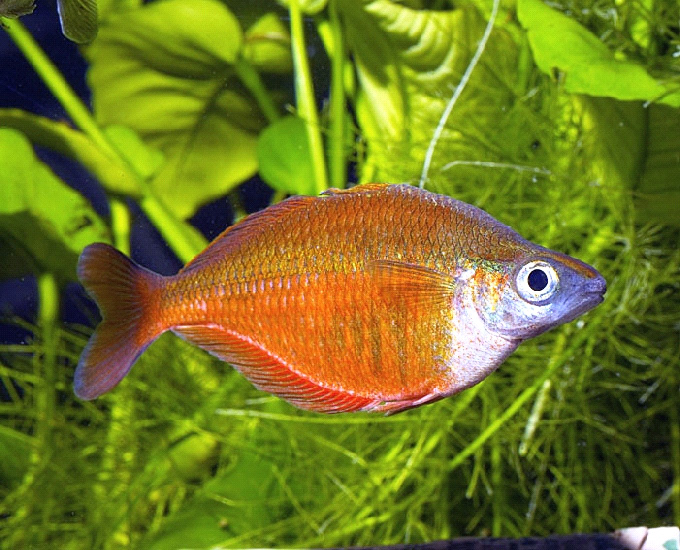
Although not generally well know, Australian rainbowfishes have been maintained in home aquaria at least since the beginning of the last century. On the other hand, New Guinea rainbowfishes have only been available since the mid 1950’s. They were being maintained by only a handful of enthusiasts and were virtually unknown to the international hobby. During the 1960’s and 70’s a small trickle continued to arrive in Australia from New Guinea. The importation of New Guinea rainbowfishes into Australia during this period did not have any significant restrictions and a number of different species were brought into the country by private collectors, which were subsequently distributed in the hobby.
Unfortunately, the initial number of wild-caught fishes that came in to the hobby was very small. This resulted in a very small genetic base from which to establish larger aquarium populations. The problem with having such a small genetic base is that most of the aquarium populations are closely related. Since the initial population was small, they are likely to have a higher prevalence of recessive genetic disorders, as the parents are likely to share many genes. In addition, a small population base may not be truly representative of the original wild population.
For the most part, aquarists maintain small populations of rainbowfish species. When a new species is obtained, the number of fish acquired is usually low. In many cases the fish that are acquired come from one or two spawnings, or more often, offspring that have been produced by a single spawning. In these situations, it is more likely that related individuals will breed, simply due to the lack of alternative mates. Breeding closely related rainbowfishes in captivity increases the likelihood of the population suffering from inbreeding problems. In aquarium populations the effect of inbreeding may be severe and should be a concern to breeders. While inbreeding can be used to improve a population when it is planned and directed, unplanned and uncontrolled inbreeding can ruin a population through a process known as ‘homozygosity’ (inbreeding depression), i.e., less variation in genes.
Another problem with rainbowfishes kept in captivity is that instead of natural selection, selection is done by the aquarist; because only a relatively small number of fish can be kept, the aquarist tends to select for those which grow best and look best under aquarium conditions. This can be clearly seen in a number of New Guinea species where the quality and colouration has diminished greatly, as well as increases in breeding failure. This also applies to Australian species collected from remote locations where the initial numbers of wild-caught specimens was low. Almost every day I see photos of rainbowfishes posted on Internet forums asking for identification. Most replies given are in the negative, suggesting that they are hybrids. This may well be true; however, what is happening for the most part is that continuous inbreeding or selective breeding has effectively resulted in domesticated strains of rainbowfishes that no longer resemble their congeners from their natural state.