
Shipping Rainbowfishes
Shipping live fishes is another feature of the rainbowfish hobby, with enthusiasts exchanging fishes with each other. Rainbowfishes are usually transported in sealed plastic bags containing small quantities of water and pure oxygen. Excess air is removed from the bag and replaced with pure oxygen. The bag is sealed, placed in an insulated container and finally into a cardboard shipping box and shipped.
During the 1920-30s fish shipments were in old-fashioned flat “German” cans, with a small neck and very wide body to give maximum air surface. Other shipping containers used in the 1920-30s were merely a straight-sided metal pail with a tight fitting lid that was packed into a wooden shipping box. The wooden shipping box was lined with cane fibre-board for insulation and the metal container was packed inside it in sawdust. As sea voyages were long and no oxygen was used, the fish generally arrived in poor condition. However, some survived the journey and were bred by experienced hobbyists.
The hobby went into recess during the following war years, and very few aquarium specimens survived that period. The aquarium hobby didn’t really recover until the 1950’s when shipment with plastic polyethylene bags and oxygen, in insulated containers was developed. This, together with faster air travel, which allowed a much wider variety of fish to be successfully imported from distant regions of the world, consequently attracted new hobbyists and enabled the aquarium hobby to flourish. The polyethylene-bag transport system had greatly reduced the shipping weight of aquarium fish consignments, and made them a feasible option for air transport. Nevertheless, the freight cost of fish consignments is still a major cost of the aquarium hobby. For consignments from Asia to Europe and the USA, shipping cost is often more than the fish in the consignment.
The key limiting factor for the live-fish transport system is the deterioration of the water quality due to accumulation of metabolic wastes. However, a variety of techniques have been developed to manage the quality of transport water during transport. These include fasting fish before packaging, lowering the temperature of transport water, and the addition of anaesthetics, ion exchange resin, buffers or drugs in the transport water.
Airfreight shipments have to comply with the IATA Live Animal Regulations. Shipping boxes used must be an approved type. Boxes are available in standardised sizes made specifically for transporting fish. They are usually small enough for an individual to easily grip and lift during the handling process. The outer container should be made of sturdy expanded polystyrene or styrofoam with an inner plastic liner. The inner bags should be plastic (polyethylene) and fastened by twisting the top and folding the twisted part so that it can be sealed with elastic bands or other sealing device. Each bag is then doubled bagged with a similar size bag to prevent leakage of water.
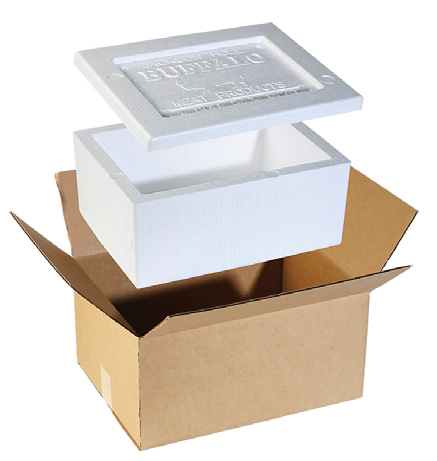
Care must be taken to ensure no sharp edge punctures the inner plastic bags that can expand from changes in altitude. Bags may be double or triple layered, with newspaper between the layers to prevent punctures and leakage from fish spines. Fish boxes are typically insulated to keep the temperature relatively constant during transport. Most are made from expanded polystyrene. Froese (1998) recommended that Styrofoam boxes with at least 2.5cm wall thickness should be used for ornamental fish packaging to reduce heat loss during transport.
While expanded polystyrene is watertight and provides good insulation; it is not a rugged material and can be easily punctured, chipped or broken during the shipment. Therefore the insulated box must be placed in a suitable outer container. Usually this is a corrugated cardboard box that will protect the Styrofoam or other insulation from damage. The inner, insulated box should fit snugly inside the outer box to give the best protection possible. A good quality packing tape should be used to seal the outer box. Like bags and expanded polystyrene boxes, outer cardboard boxes specifically designed for shipping fish are available from several sources.
Square-bottom bags are ideal for shipping fish because they sit upright in shipping boxes and do not have “folds” where fish can concentrate and become trapped. Another benefit of the square-bottom bag is that it allows for a larger surface area between the oxygen and the water, maximising oxygen diffusion into the water reducing localised zones of oxygen depletion. The size of the bag that is used depends on the number, size, and species of the fish being shipped. In squarebottom shipping bags, the oxygen gas volume to water volume ratio is generally 60% oxygen to 40% water.
The system used for packaging rainbowfishes is a closed one in which all factors to meet the requirements of the fish for survival is self-sustained. The fish can be bagged singly or in small groups, depending on the species and the relative sizes of the specimens. The bags can contain trapped atmospheric air or you can use bottled oxygen - with just enough water to completely cover the fish. The addition of pure oxygen to the shipping bag will allow a greater number of fish in each bag for a longer period of time. If the sealed bag contains only ambient air, the fish quickly consume all of the available oxygen and may result in mortalities. If a shipping additive is to be used, it is placed into the bag water prior to the addition of fish.
If properly packaged, rainbowfishes can be expected to survive for at least 48 hours in the shipping box. Common packing densities used in the commercial shipping of rainbowfishes and based on a single seven-litre capacity size bag is 150 individuals at 25 mm size, 100 at 50 mm, and 50 at 65 mm.
After packing, the bags with fish are placed in an expanded polystyrene foam box, usually four to eight bags to a box, to provide thermal insulation to prevent sudden changes in temperature of the transport water, especially when the consignments are in the cargo hold of aircraft during air transport.
The health of the fish can be affected by changes in water quality parameters while in the plastic bags during the shipping process. The parameters to be considered are temperature, dissolved oxygen, pH, carbon dioxide, ammonia, and osmoregulatory dysfunction. The rate of change of each parameter is affected by the weight and size of fish to be transported and the duration of transport. In order to implement a successful shipment you must first have an understanding of what changes will take place, chemically and physically, inside the shipping bag during the transport period.
The most important single factor in transporting rainbowfishes is the provision of adequate concentrations of dissolved oxygen. The only source of dissolved oxygen during shipment is the diffusion of oxygen from the air overlying the water within the bag. The importance of supplying adequate levels of dissolved oxygen cannot be over emphasised. The volume of pure oxygen supplied to the transport bag by commercial operators used to be up to six times the volume of transport water, but it has now been reduced to three or four times the volume of water. Even at these reduced volumes, dissolved oxygen content is never a limiting factor. Several fish packaging experiments have recorded over-saturated oxygen content of above 10 mg/L @ 25°C (100% saturation = 8.26 mg/L) after 24-48 hours shipment, even then there were high fish mortalities of up to 20%.
The amount of oxygen that can be dissolved in fresh water is based primarily on water temperature. Dissolved oxygen saturation is higher for cool water than for warm water. If pure oxygen is used during bag transport, then low oxygen levels usually should not be a problem unless the bag is improperly sealed or develops holes caused by the spines of large fish. Nevertheless, it is important to have a 75 percent volume of oxygen in the bag to insure adequate diffusion of oxygen at the surface of the water.
Once a bag has water, fish and oxygen sealed inside it, certain chemical changes take place due to the metabolism of the fish. When fish breathe, they absorb oxygen and excrete other gases and metabolites, primarily carbon dioxide (CO2) and nitrogen in the form of ammonia. Total ammonia nitrogen consists of two forms that exist in a pH and temperature dependent equilibrium of unionised ammonia (NH3) and the ammonium ion (NH4+). The unionised form (NH3) is toxic to fish while the ammonium ion (NH4+) is relatively non-toxic to fish. It can, however, in high concentrations, produce external burns that are identical to acid burns. This is often seen when fish are crowded in shipping bags.
The proportion of NH4+ to NH3 increases with decreasing pH and decreases with increasing pH. The percentage of NH3 also rises with increasing temperatures - so conditions with both relatively high pH and elevated temperature are especially dangerous. Since NH3 cannot be measured directly, several tables have been created based on an equilibrium formula that predicts the relative percentages of unionised ammonia at different temperatures and pH. Total ammonia concentrations may reach more than 14 ppm during transport. However, the easiest way to reduce toxic ammonia build-up in transport water is to lower the temperature of the transport water and to stop feeding 48 to 96 hours prior to shipment. Fasting prior to transport diminishes the amount of food in the digestive tract and reduces ammonia excretion.
A common technique for removing ammonia from the transport water is to use cation exchange resins such as clinoptilolite, a natural zeolite that has the ability to absorb ammonia by selective ion exchange. Zeolite specifically selected for aquarium purposes is available from several sources. Although small clinoptilolite particles remove ammonia more effectively than large particles because of their greater surface area, large 2-5 mm diameter particles are recommended because the fine clinoptilolite particles in the water may clog the gills of the fish, causing asphyxiation. To prevent this problem, the zeolite chips are rinsed thoroughly to eliminate the surface powder before use. They are either wrapped in a net bag or added directly to the transport water at 15 - 20 g/L of water. Most commercial shippers put it in small mesh bags so it will not be loose in the bottom of the fish bag. This makes it much more convenient at the receiving end of the shipment, as the recipient does not have to separate the loose granules from the water. There are several other products that claim to chemically bind with, or “remove”, ammonia from water in shipping bags.
As the fish respire they produce carbon dioxide as a byproduct. Carbon dioxide reacts with water reducing the pH. If the alkalinity of the transport water is less than 100 ppm, some type of buffering compound should be added to the water. Properly buffered water will help remove free carbon dioxide, which causes drops in pH. High levels of carbon dioxide (greater than 20 ppm) will interfere with the fishes’ oxygen uptake.
Osmoregulatory dysfunction is common in fish that are exposed to transport stress. Physiological changes might vary among fish species, but generally all fishes exhibit a similar pattern concerning hormones releases and electrolyte disturbances, mainly Na+, Cl- and Ca2+. Understanding these osmoregulatory changes during transportation can help diminish mortality. The use of substances such as common salt and calcium sulphate in the transport water, as well as adopting practices like handling fish carefully and fasting them before transport will help the fish to cope with osmoregulatory disturbances and other physiological responses to stress factors caused by transportation. Freshwater fish have a blood salt concentration higher than the salts of the transport water. Therefore, the fish are continually losing salts to the surrounding water. Commercial exporters commonly use coarse salt containing 95-98% sodium chloride to reduce the effects of stress on the fish.
While there is clear evidence on the beneficial effects of adding salt in live-fish transport, there is considerable variation in the recommended amounts of salt used for different species. However, a difference as small as 0.5 to 3.0 g/L will help during shipping. Some species of fish show no apparent problems if the salinity is changed quickly by as much as 3 g/L, so salt is often added directly to the shipping water. However, some experts recommend slowly acclimatising all fish to changes in salinity over a period of several days before shipping, and then again at the receiving end.
Bacteria can be another major problem in shipping rainbowfishes. Even the clearest and cleanest water is home to bacteria and fungi that can cause primary or secondary infections. Fish secrete a protective “slime” or mucus from glands in their skin as an effective barrier to disease. However, disrupting or removing the mucus when you handle a fish makes it more susceptible to these everpresent pathogens. Handling a fish with dry hands or abrasion from a net will remove its protective mucus coat.
Bacteria not only increase the ammonia load and compete with fish for oxygen in the transport water, but also weaken or cause diseases. Drugs such as antibiotics, methylene blue and acriflavine are commonly added to the transport water to control bacterial growth. Methylene blue and salt can be used to prevent the proliferation of bacteria during fish transport. Research has shown that both methylene blue and sodium chloride were effective in reducing bacterial load during transport of fish. Methylene blue is a redox dye which raises the oxygen consumption of cells. This means that the hydrogen to be oxidised is passed on to the oxygen. Each molecule of the dye is oxidised and reduced about 100 times per seconds. Thus, while disinfection results from this, methylene blue is also excellent against methaemoglobin intoxication (methemoglobinemia) during transport. Dosages rates of 2 g/L sodium chloride and 1 mg/L methylene blue are generally recommended, while 1 g/L sodium chloride and 3 mg/L methylene blue have also been used.
There are a number of water conditioners that are reported to calm the fish, reduce stress, replace lost mucus coating, help regulate salt balance, and fight infections. Some do not list their active ingredients so it is impossible to make any kind of recommendation on their use or efficacy. Antibiotics used as bag additives have their own problems. Using a single antibiotic may have no effect, as it may not be effective against the existing strain of bacteria. The mixing of antibiotics is not really desirable either and is not recommended. The most effective way of introducing antibiotics to fish is either by feed or injection and not usually as substances dissolved into the water. Although a common practice, water borne antibiotics are inappropriately used in the aquarium trade. Bioavailability varies from drug to drug and where absorption through the gills does occur, it can be affected by water chemistry and temperature making the delivery of the drug unpredictable. There are good bacteria that exist as well, and antibiotics are indiscriminate killers of all susceptible bacteria – both good and bad.
On receipt of the fish the plastic bags containing the fish should not be floated in the aquarium despite popular belief. Polyethylene bags do not allow the transfer of liquid-toliquid or air-to-air. Apart from temperature, a plastic bag floating in the aquarium does not allow the fish to become adjusted to the water conditions of the aquarium. When the fish are released from the bag, they will still be subjected to the stress of differing water conditions.
The best way to reduce the harmful effects of differing water conditions is to empty the contents of the bag into a clean bucket or other suitable container especially kept for aquarium use. Then, add small amounts of water, at intervals of 5 minutes, from the aquarium into which the fish will be placed, into the bucket or container until a 50-50 water ratio is achieved. Place the fish into the aquarium and dispose of the water in the container. Do not add the container water into your aquarium.
Delayed mortality syndrome (DMS) is a term used to define fish mortality that is associated with transport and introduction to a new environment. Delayed mortality might occur days or even weeks after transport depending on the underlying cause and severity. The direct cause of delayed mortality has not been established conclusively, but is thought to be at least partially a result of prolonged watersalt (osmotic) imbalance - salt concentrations in body fluids drop below the levels necessary for survival. Freshwater fish are hypertonic, therefore gaining water and losing electrolytes. During excitement and in stressful conditions (which typically occur in transport), epinephrine (adrenaline) is released into the bloodstream, thus affecting the permeability of water across the gill epithelia in fish. This increases the water gain and blood ion loss in freshwater fish resulting in a disturbance of osmoregulatory homeostasis. A critical period of about 2 to 3 weeks after the acute stress is the most likely time that fish will become sick because of DMS; thus close observation is warranted. Stress should be considered cumulative - becoming greater by stages or additions.
Delayed mortality syndrome is also often associated with opportunistic infections which take advantage of the fishes’ diminished immune system caused by osmoregulatory dysfunction. While infections that are caused by delayed mortality syndrome are usually evident within 2−5 days of the stressful event, they may not appear until over 1 week later. 5 g/L sodium chloride and 2 mg/L methylene blue has been used successfully as a prophylactic treatment to aid recovery of the fish.
Many factors affect the survival of fish during transportation and there is no substitute for careful handling and good water quality.