
Neosiluroides cooperensis
Cooper Creek Catfish (also Cooper Creek Tandan)
Species Summary
Endemic to the Cooper Creek system of central Queensland and South Australia, part of the internal Lake Eyre drainage, Neosiluroides cooperensis went unrecognised as a distinct species for decades after the first museum specimens were collected in 1918 and 1938 — it wasn’t picked out as something different until the late 1960s, when naturalist Hamar Midgley collected further material. It was still undescribed when Peter Unmack wrote it up for Fishes of Sahul in 1996, and was only formally named two years later. Specimens remain scarce in museum collections and the species has rarely been kept in aquaria.
Etymology
The genus name Neosiluroides uses the suffix -oides, “having the form of”, referring to this catfish’s superficial resemblance to Neosilurus. The species name cooperensis uses the place-name suffix -ensis, referring to Cooper Creek and its tributaries in South Australia, where the species lives.
Etymology compiled from C. Scharpf (2019), “Fishes of Sahul: An Etymological Survey (Part 2)”, Fishes of Sahul 33(2): 1417–1439, and etyfish.org.
Distribution & Habitat
Neosiluroides cooperensis is common, though not abundant, throughout the Cooper Creek system, generally in larger, more permanent waterholes with an earthen or clay substrate — very few central Australian waterholes qualify as strictly permanent, and this species is one of only two riverine fish (the other being Welch’s Grunter) that has never been recorded from truly ephemeral waterholes in the region. The water is almost always turbid with essentially no visibility, though it occasionally runs clear after major flooding, as happened on the Barcoo River after the massive floods of 1990. Once turbid runoff passes, the river is topped up by ephemeral springs releasing clear water until their supply runs out and turbidity returns.
Description
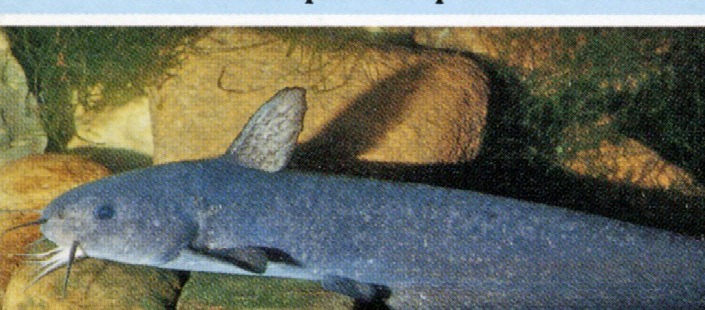
Grows to at least 600 mm, with a notably blunt head and relatively small eyes for a plotosid — and yet, unusually, the best eyesight of any Australian eeltailed catfish kept in aquaria, rising off the bottom to intercept food as it falls through the water and catching live fish and shrimp far more efficiently than other plotosids do. Its underslung mouth carries bony tooth plates capable of drawing blood from an unwary finger. Wild colouration is creamy brown with dark speckles along the upper body and tail; in captivity it ranges from light to dark blue-grey depending on light levels and the fish’s mood, with speckling varying from barely lighter than the background to strikingly white against a dark body.
Keeping & Caring
Despite considerable seine-netting effort, Neosiluroides cooperensis has only ever been taken by angling. It travels well in large drums of water (around 70 litres, two large fish per drum) at temperatures up to 32 °C, needing no aeration unless the vehicle is stationary for more than an hour or so. In the aquarium it does well between 12–32 °C (preferring roughly 24–28 °C) and pH 6.8–7.5, tolerating more acidic water than that if needed. Stomach-content examination of wild fish points to a diet mostly of snails; in captivity it takes small live fish, fish fillets, shrimp, earthworms and artificial pellets without fuss. Unlike most plotosids, though, this species must be kept entirely alone — it is highly aggressive both toward its own kind and toward anything else sharing the tank, usually killing other fish in short order, and is inclined to attack siphon hoses, fingers and anything else placed within reach.
Breeding
Virtually nothing is known of its breeding biology, and no specimen under 160 mm has ever turned up in a museum collection. Sexes are told apart by urogenital papilla shape, as in most plotosids — longer, thinner and pointed in males, shorter, broader and flatter in females. A December 1993 breeding attempt (by Rob Lewis, Peter Unmack, Craig Brumley and Andrew Moore) extracted two eggs by catheter from a 460 mm female: cloudy, yellowish, non-adhesive and not sufficiently developed to attempt fertilising, with no sperm obtainable from the male, so the attempt was abandoned. What is clear from comparison with other Australian plotosids is that this species carries by far the lowest fecundity and largest eggs of any of them — roughly a thousand eggs of 2.75–3.75 mm from a 460 mm female, against tens of thousands of much smaller eggs in species such as the Freshwater Catfish. Low fecundity paired with large eggs is a combination more typical of fish from stable, seasonal environments than desert rivers, and it has led to speculation that the species spawns annually around 26 °C and may guard or even mouth-brood its small clutch of unusually large, well-developed young.
Remarks
Based on its general form and what little else is known of it, Neosiluroides cooperensis doesn’t appear to have any close relatives, at least not at the generic level — prompting speculation that it is a relict of a wetter period in central Australia, when the ancestral Lake Eyre, Lake Dieri, is thought to have held a permanent body of freshwater somewhere in the last 20,000–45,000 years. In that wetter world the species may have been a top predator alongside Golden Perch, before increasing aridity restricted it to the more permanent waterholes of Cooper Creek that it still occupies today.
Compiled for Home of the Rainbowfish from ANGFA sources: P. J. Unmack, “The unique Cooper Creek catfish from central Australia”, Fishes of Sahul 10(2), 1996, pp. 460–464.