

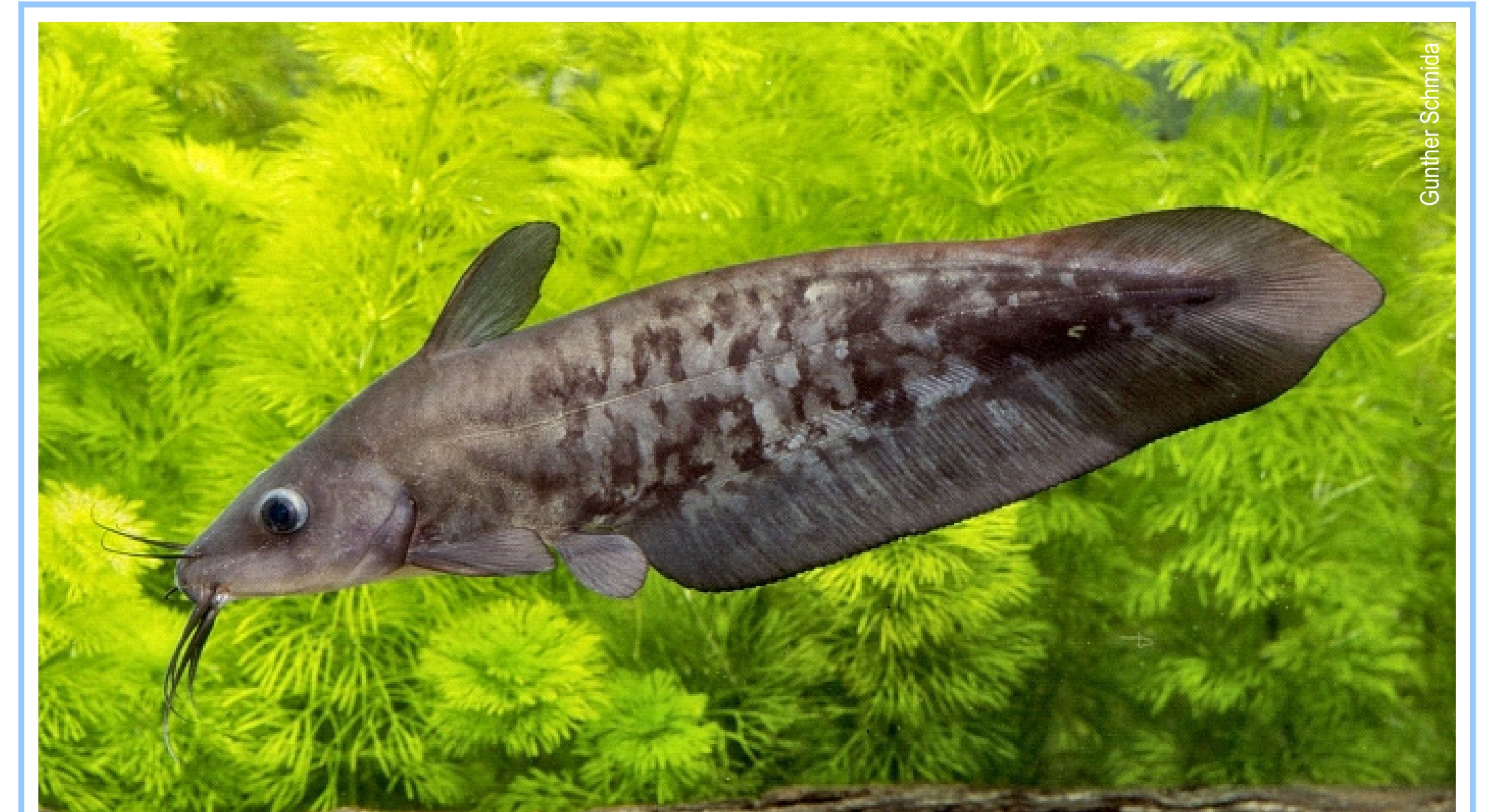
Neosilurus ater
Black Catfish
Species Summary
A light-grey-to-black eeltailed catfish, often with darker mottling or flecking, Neosilurus ater can be told apart from other Neosilurus species by its elongated snout and straight upper head profile. It grows to a maximum of around 47 cm total length, and both sexes can develop a bright golden-orange breeding hue over an otherwise dark body.
Etymology
The genus name Neosilurus combines the Greek neo-, new, with silurus, catfish (itself from Greek silouros) — simply “a new catfish.” Franz Steindachner proposed the genus and its type species, N. hyrtlii, in 1867 from a Fitzroy River specimen; French naturalist François de Castelnau coined the identical genus name independently eleven years later, apparently unaware Steindachner had already done so. The species name ater is Latin for “black,” referring to this species’ uniformly dark body and fins (the throat is whitish by contrast).
Etymology compiled from C. Scharpf (2019), “Fishes of Sahul: An Etymological Survey (Part 2)”, Fishes of Sahul 33(2): 1417–1439, and etyfish.org.
Distribution & Habitat
A bottom-dwelling fish of main-channel waterbodies, creeks and large floodplain billabongs, Neosilurus ater has a wide range across northern Australia from the Fitzroy River in Western Australia to the Fitzroy River in Queensland. It has been recorded in water from 23–35 °C (possibly a seasonal effect rather than a true tolerance range), pH 4.0–8.1 and conductivity 2–790 µS/cm.
Breeding
Neosilurus ater undertakes upstream spawning migrations during peak flooding, building nests in which to brood its eggs; adults and juveniles then disperse back downstream once breeding is done. The season usually runs from November to December, sometimes stretching from October to January, with spawning recorded in water around half a metre deep among aquatic grasses and woody debris, or in shallow riffles between flood peaks — a strategy thought to suit a highly seasonal, unpredictable environment where rain brings the best conditions for growth and survival, food is most available, and upstream migration eases predation pressure on young fish. Sexes differ in urogenital papilla shape (swollen and cylindrical in females, triangular in males), and temperature is thought to be the main spawning cue, with day-length and flooding also implicated. Fecundity ranges from 2,540 to 26,070 eggs, 0.85–1.64 mm in diameter (mean 1.40 mm); the large, non-adhesive, demersal eggs settle into the interstices of the gravel, and one parent stays in attendance until they hatch. Hatching takes about seven days at 19–25 °C, producing 7 mm larvae with pigmented eyes and bodies but no barbels or pectoral fins yet; barbels appear within three days, and by three weeks the larvae carry most adult characteristics. Length at first maturity is around 255 mm in males and 275 mm in females.
Diet
Mainly aquatic insects, microcrustaceans and unidentified organic material, supplemented with algae, aquatic plants, oligochaete worms, gastropods, bivalves, larger crustaceans, small fishes, terrestrial plant material, arachnids and insects.
Compiled for Home of the Rainbowfish from ANGFA sources: “Neosilurus ater (Perugia 1894) Common Name: Black Catfish”, In-Stream 23(6), June 2014, pp. 26–28.
References
- Orr T.M. and N.E. Milward (1984) Reproduction and development of Neosilurus ater (Perugia) and Neosilurus hyrtlii Steindachner (Teleostei: Plotosidae) in a tropical Queensland stream. Australian Journal of Marine and Freshwater Research 35: 187-195.