

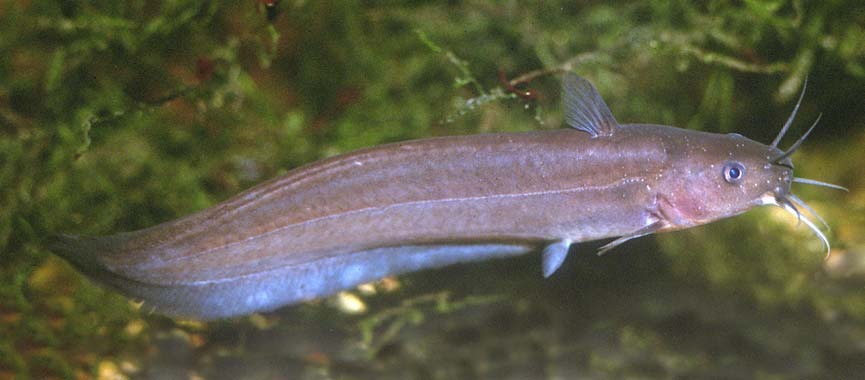
Neosilurus gloveri
Dalhousie Catfish
Species Summary
Endemic to the remote Dalhousie Springs complex in far northern South Australia — around 80 active artesian springs fed by the Great Artesian Basin — Neosilurus gloveri occurs in about ten of those springs and their outflow streams. It shares this isolated system with the Spangled Grunter, the Dalhousie Purple-spotted Gudgeon, the Dalhousie Goby and two closely related hardyheads, several of which, like this catfish, are found nowhere else on Earth.
Etymology
The species name honours the late John Glover (1935–1992), former Curator of Fishes at the South Australian Museum, who collected many of the type specimens described from Dalhousie Springs. Three of the springs’ endemic fishes are named for him: this catfish, the Dalhousie Goby (Chlamydogobius gloveri) and Glover’s Hardyhead (Craterocephalus gloveri).
Etymology compiled from C. Scharpf (2019), “Fishes of Sahul: An Etymological Survey (Part 2)”, Fishes of Sahul 33(2): 1417–1439, and etyfish.org.
Distribution & Habitat
A small, largely nocturnal fish with the typical tapering Neosilurus shape, only fairly stout, Neosilurus gloveri reaches a wild maximum of about 12 cm total length (up to 17 cm in aquaria), most commonly encountered at 6–8 cm. It is constantly on the move, probably a response to the warm water driving a high metabolism, peaking in activity after nightfall but remaining active around shaded pool edges through the day. It occupies open water, littoral zones and fast-flowing outflow creeks near cover within the larger spring pools, with little aquatic vegetation available — cover instead comes from tea-tree roots and fallen branches and from beds of reeds, over a substrate that is always soft, whether sand, fine silt or organic sludge. Thermal tolerance is extreme: fish can be seen swimming happily in water at 40 °C where a hot spring outflow meets the main spring pool, retreating sharply once they hit a sharp gradient to 41.8 °C “as if stung by a bee,” and are known to survive up to two hours at that temperature when confined in traps. In the wild they have also been found at temperatures as low as 24 °C, and in captivity feed and show no distress at 16 °C. Water chemistry at the main spring measures around pH 6.9, conductivity 1.73 mS and hardness about 700 ppm, though conditions vary considerably between the springs the species occupies.
Diet & Conservation
A benthic and mid-water forager using four pairs of barbels to probe the substrate, taking ostracods, terrestrial insects, small fish such as hardyheads, gastropods and some plant matter. The springs today lie within Witjira National Park (declared 1985), with revegetation and fencing programs in place to limit further disturbance; the species is protected under South Australia’s National Parks and Wildlife Act 1972 and the Commonwealth Environment Protection and Biodiversity Conservation Act 1999, so permits are required for research or collection.
Breeding
Gavin Rich, a South Australian hobbyist, achieved the first captive spawning of this species in 1991 from three adults he had received from Bryan Pierce. A decade on, Michael Hammer borrowed three of Rich’s remaining offspring — large, ageing fish 16–17 cm long — and worked through several attempts to spawn and rear the species himself. Housed in a 120-litre tank at 29–31 °C and pH 7.4–7.5 with wool mops and sponge filters, the pair (with a second, subordinate male removed after persistent fighting) were conditioned on live blackworm and frozen bloodworm for about ten days before the female developed a visibly bulging belly. Two early spawnings, of 500–600 eggs each, mostly turned opaque and failed, but courtship was well observed on the second attempt: the male followed and pushed the female around, mouthing her belly and papilla from below, while she occasionally turned to mouth him back; eventually the pair flanked head to tail, flexed into an “S” shape and spun together as eggs were released in small batches of 20–50. A third attempt, with the pH lowered to neutral or slightly below, a different male, and a divider laid flat across the tank floor to shield the eggs from the adults, finally succeeded on 9 August 2000: over 600 eggs, most of them staying healthily transparent.
Rearing
Eggs hatched in under 48 hours at 27 °C, and free-swimming fry — thin, white, only 3–5 mm long and strongly cryptic, with barbels disproportionately large for their body length — were later found hiding around the sponge filter on the female’s side of the tank and moved to a separate rearing tank. Being nocturnal, they were fed infusoria (mostly Paramecium) three times between dusk and dawn, with microwaved lettuce added to keep the infusoria culture going. It was a nervous week before the first attempt to feed newly hatched brine shrimp, but fat orange bellies soon confirmed the fry were feeding; growth was variable, with some losses, until frozen bloodworm sliced finely with a razor blade was added after a further two weeks and produced a rapid growth response. In the end, 32 juvenile catfish were raised from the spawning. At 28 °C with plentiful food, the largest juvenile reached 45 mm in three months, and spawning behaviour among the young fish was observed within six months of hatching — broadly in line with a separate report of maturity at 44 mm. At this stage the species appears to spawn continuously year-round in captivity.
Keeping & Caring
General care follows the pattern established during this rearing effort: a bare-bottomed tank or one furnished with fine sand or smooth gravel (the skin is scaleless, so sharp objects are best avoided), with hiding spots such as mops or java moss. The species adapts well to ordinary tap water and tolerates a wide range of pH and temperature — one heater failure that let the tank drop to 19 °C caused no visible distress — and there is no need to keep it above 28 °C. It does best kept in groups of five or more, since fish held alone become shy while a group spreads out any aggression, and it eats readily and in quantity, taking all the usual live, frozen and dried foods; several small feeds through the day suit it better than one large one.
Compiled for Home of the Rainbowfish from ANGFA sources: M. Hammer, “Natural habitat, spawning & rearing of the Dalhousie catfish”, Fishes of Sahul 16(1), 2002, pp. 820–827.