
Neosilurus hyrtlii
Hyrtl’s Catfish
Species Summary
Neosilurus hyrtlii has had a particularly confused taxonomic history, appearing under five different species accounts in Merrick & Schmida’s influential 1984 field guide (Neosilurus glencoensis, N. hyrtlii, N. sp. 1, N. sp. 8 and N. sp. 9). That confusion left it with a string of old common names — Yellow Fin Catfish, Glencoe Catfish — and in western Queensland it is still often called “Moony” or “Moonfish” by local fishermen.
Etymology
Steindachner never explained the meaning of the patronymic species name hyrtlii, which was nothing unusual for him — he often honoured colleagues and scientific leaders of his day without stating who they were. The best guess is that it honours his Vienna contemporary, the anatomist Josef Hyrtl (1810–1894), who in his day was famous enough across Europe that naming a fish after him without explanation may simply not have seemed necessary.
Etymology compiled from C. Scharpf (2019), “Fishes of Sahul: An Etymological Survey (Part 2)”, Fishes of Sahul 33(2): 1417–1439, and etyfish.org.
Distribution & Description
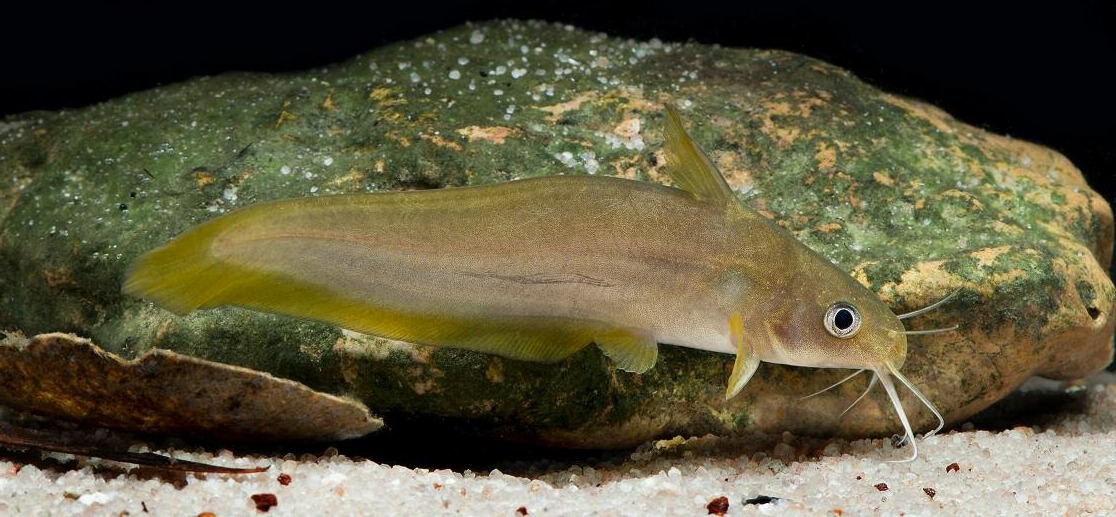
As currently recognised, Neosilurus hyrtlii is the third most widespread freshwater fish in Australia, after Spangled Perch and Bony Herring, occupying virtually every type of freshwater habitat across the continent’s north and centre, including floodplains and lakes, though it thins out in the Queensland Wet Tropics and south-east Queensland below the Fitzroy River. Genetic data suggests as many as four cryptic species may be hiding under the one name. Colouration is highly variable depending on water clarity: pale with yellow-edged fins in turbid water, plain or speckled brown in clear water, with a range of striking local forms — yellow fish on Cape York, heavily mottled fish near Bundaberg, bigger golden fish in the Fitzroy River (Qld), and Lake Eyre Basin fish that are gold on capture but brown up over time in a clear aquarium. It reaches a recorded maximum of 454 mm standard length in the wild, though anything over 300 mm is uncommon.
Keeping & Caring
An easy species to keep, doing best in small groups reflecting its schooling habits in the wild and generally preferring less brightly lit tanks. Its small mouth limits any threat to tankmates, and it is never aggressive toward other fish. It is not fussy about pH or hardness, is comfortable from 20–30 °C and tolerates up to 36 °C or down to around 10 °C depending on the source population, and lives at least five years in captivity, likely longer. It readily eats most foods dead or alive — shrimp, earthworm, fish fillet, sinking pellets — though its wild diet is mostly aquatic insect larvae, detritus, molluscs and microcrustaceans, notably not fish or larger crustaceans despite its reputation as an opportunistic feeder. Sexes show no obvious external colour or fin differences, though the urogenital papilla differs (longer and thinner in males, shorter and stubbier in females), and slender, presumed-male fish have been observed chasing larger, presumed-female fish through vegetation.
Breeding
Maturity is reached from about 135 mm total length, though larger fish are typically involved in wild spawning events. No natural spawning has been documented in captivity, but Bruce Sambell of Ausyfish induced spawning with hormone injection after conditioning fish on natural food above 25 °C. In the wild the species breeds primarily in the wet season, with evidence of migration into smaller tributaries to spawn, and fecundity is high — a 205 mm female was recorded carrying 3,630 eggs. Eggs hatch after about 60 hours at 26–27 °C into larvae around 6 mm long; maturity is estimated at one year and wild lifespan at around five years.
Remarks
After April 2007 flooding, a mass upstream migration of Neosilurus hyrtlii was documented at weirs on the Paroo River in southern Queensland — fish swimming and even crawling through water only 20–60 mm deep, schooling so tightly in the eddies below the weirs that “space seemed over 50% fish,” and picked off along the way by White-necked Herons and Whistling Kites. At the same time, on the nearby Bulloo River at Thargomindah, Silver Catfish (Porochilus argenteus) were found abundant at the base of a weir but unable to cross it at all — a contrast that raised concern about weirs as migration barriers for the region’s eeltailed catfishes more broadly.
Compiled for Home of the Rainbowfish from ANGFA sources: P. J. Unmack, B. Sambell, D. Wilson, M. Lach & C. Scharpf, “Fish in focus: Hyrtl’s Catfish Neosilurus hyrtlii (Plotosidae)”, Fishes of Sahul 31(1), March 2017, pp. 1081–1093; and M. Stanton & G. Turner, “Observations of eel-tailed catfish migrating”, Fishes of Sahul 23(2), 2009, pp. 513–517.