

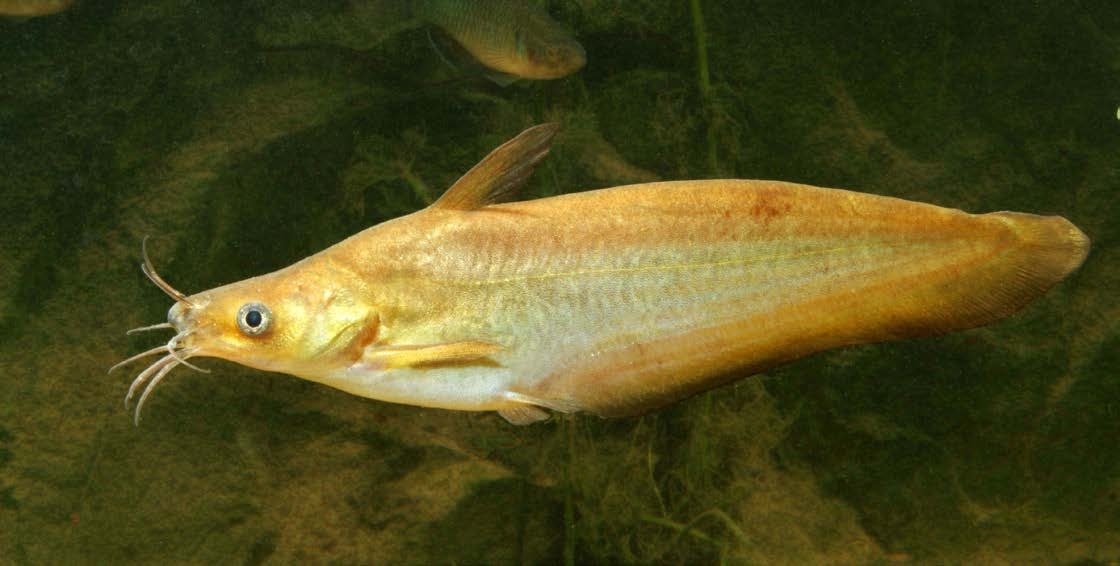
Porochilus argenteus
Silver Catfish (also Silver Tandan)
Species Summary
There is very limited information about Porochilus argenteus, but it often gets captured alongside the better-studied relative Hyrtl’s Catfish. It is widespread across the inland Lake Eyre Basin as well as part of northern Australia’s Gulf of Carpentaria systems and the Barkly Tableland.
Etymology
The genus name Porochilus combines the Greek poro-, hole or passage, with cheilos, lip — referring to the interior of the upper lip border being perforated by the anterior nostrils. The species name argenteus is Latin for “silvery,” describing this species’ pale, silvery-white colouring.
Etymology compiled from C. Scharpf (2019), “Fishes of Sahul: An Etymological Survey (Part 2)”, Fishes of Sahul 33(2): 1417–1439, and etyfish.org.
Description & Remarks
Based on aquarium observations, Porochilus argenteus appears to have relatively poor eyesight compared with some of its relatives — alongside Hyrtl’s Catfish, it seems to find food by chance or smell rather than sight, stumbling across food dropped into the tank rather than rising to meet it. Following heavy flooding on the Paroo and Bulloo Rivers of southern Queensland in April 2007, the species was found in abundance at the base of a weir on the Bulloo River at Thargomindah, but unable to cross it — the flow was too weak and the drop ended in a short free-fall — in contrast to Hyrtl’s Catfish, which was successfully migrating upstream at nearby Paroo River sites over the same period. The observers raised concern that the weir could act as a permanent barrier to this species’ movement except in the most extreme floods. The two species have also been photographed sharing a large population at Brunette Creek on the Barkly Tableland, Northern Territory.
Compiled for Home of the Rainbowfish from ANGFA sources: M. Stanton & G. Turner, “Observations of eel-tailed catfish migrating”, Fishes of Sahul 23(2), 2009, pp. 513–517; and P. J. Unmack, “The unique Cooper Creek catfish from central Australia”, Fishes of Sahul 10(2), 1996, pp. 460–464.