
Porochilus rendahli
Rendahl’s Catfish
Species Summary
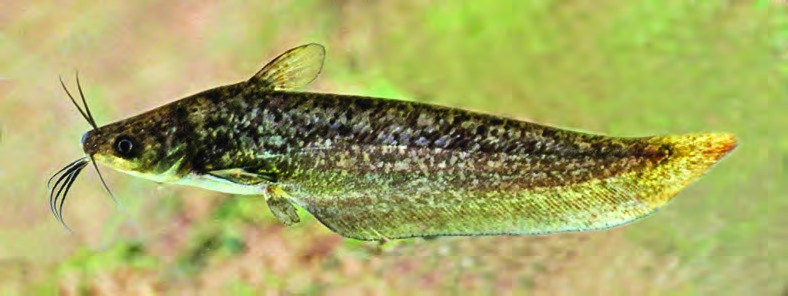
During 2003 Queensland Sustainable Rivers Audit surveys, funded by the Murray-Darling Basin Commission, Porochilus rendahli turned up unexpectedly at Branch Creek north of Chinchilla — a new genus for the Murray-Darling system entirely, confirmed by Jeff Johnson of the Queensland Museum. Subsequent records extended the find through the Condamine and Balonne River sub-catchments: the Balonne River near St George, the Condamine township, Dogwood Creek and Beardmore Dam. Preliminary DNA sequencing showed this population to be distinct from east-coast P. rendahli, though still within the species’ genetic parameters, and it differs subtly in colour and fin-ray counts from the mottled populations typical elsewhere — Murray-Darling fish run more bronze or silver, with uniformly dark barbels relatively long enough to extend past the eye when folded back.
Etymology
The species name honours Hjalmar Rendahl (1891–1969), a Swedish zoologist and artist who first described this catfish in 1922 — under the name Copidoglanis obscurus, which turned out to already be in use for a different species, requiring Gilbert Whitley to give it its current name in 1928.
Etymology compiled from C. Scharpf (2019), “Fishes of Sahul: An Etymological Survey (Part 2)”, Fishes of Sahul 33(2): 1417–1439, and etyfish.org.
Distribution & Habitat
Outside the Murray-Darling records above, Porochilus rendahli is more broadly known from northern Australian coastal drainages such as the Mitchell River, Queensland. There it shows a distinct preference for pool habitat with undercut banks, snag piles and root-mass cover over run or riffle habitat — in one Sustainable Rivers Audit site with a full range of cover types on offer, every capture came from the single fyke net set closest to an undercut bank and root mass, with nets near bare snags, open macrophyte beds or no cover at all catching none (though they did catch Hyrtl’s Catfish).
Remarks
Porochilus rendahli has proved a genuinely difficult species to survey. Across these Sustainable Rivers Audit surveys it was caught almost exclusively by fyke net — electrofishing consistently fails on eeltailed catfishes throughout northern Australia, since they simply aren’t drawn toward the anode during the muscular-contraction phase that immobilises other fish, a problem made worse by turbid water and their bottom-dwelling habits. Bait trapping has never worked either, and gill netting has not been attempted given the small mesh size it would require and the high mortality expected among non-target species.
Compiled for Home of the Rainbowfish from ANGFA sources: G. Aland, “Range extension for Porochilus rendahli and new record for the Murray Darling catchment”, Fishes of Sahul 24(3), 2010, pp. 593–595.