

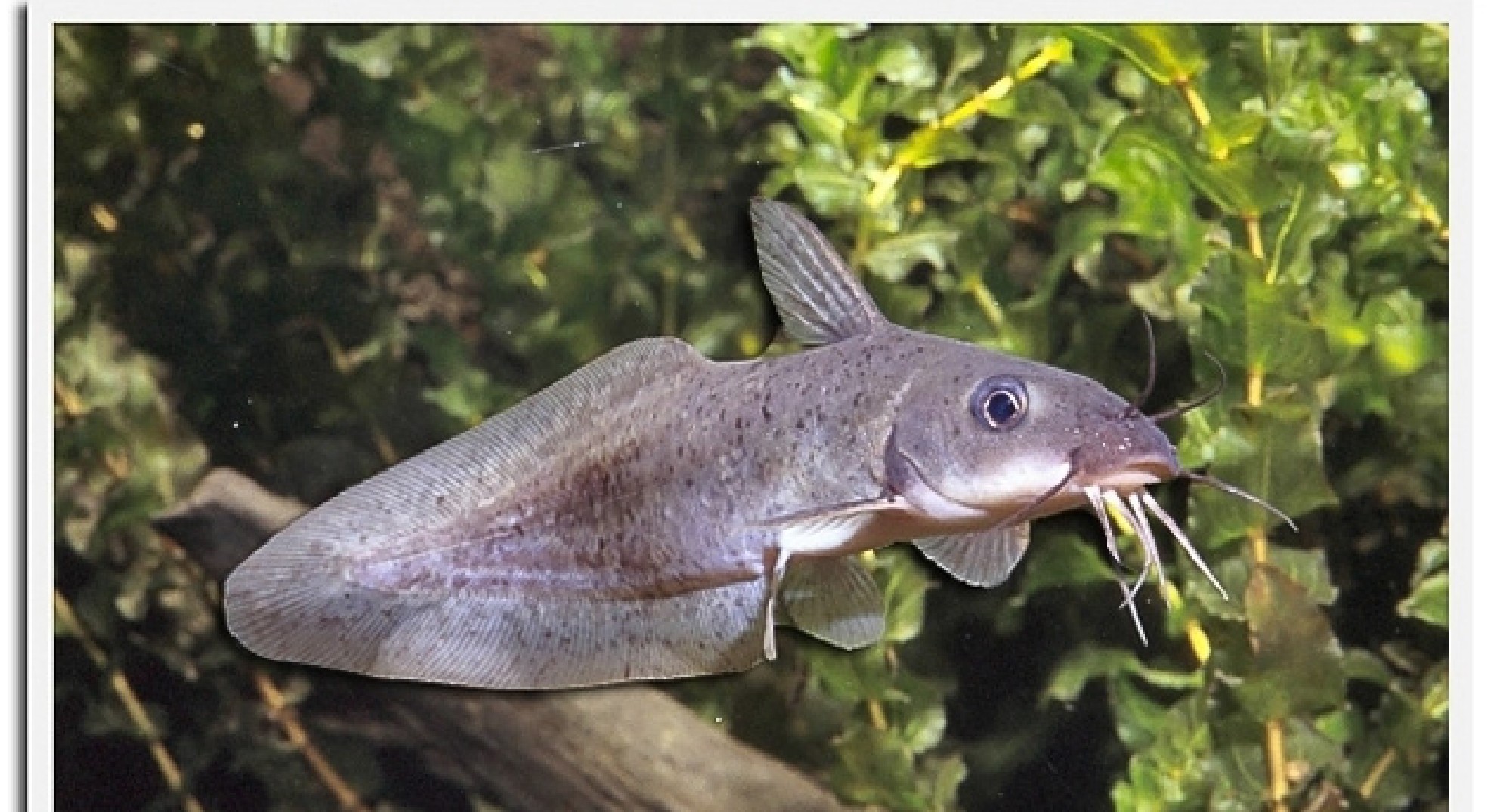
Tandanus tandanus
Freshwater Catfish (also Eel-tailed Catfish, Jewfish, Tandan)
Species Summary
The best known of Australia’s eeltailed catfishes, Tandanus tandanus has a stout body, almost circular in section toward the front and compressed toward the tail, with a large, flattened head, a blunt rounded snout and a down-turned, thick-lipped mouth carrying eight barbels in four pairs. Colouration is usually brown, reddish-brown, olive-green or grey above and along the sides, lighter to white below, with fish under 30 cm typically showing dark brown to black mottling. It grows to 90 cm but is more commonly seen up to 45 cm, can live as long as 22 years, and reaches sexual maturity at around five years of age.
Etymology
The genus name Tandanus is tautonymous with the species name — both are a Latinisation of “Tandan,” the Aboriginal name for this catfish recorded in New South Wales.
Etymology compiled from C. Scharpf (2019), “Fishes of Sahul: An Etymological Survey (Part 2)”, Fishes of Sahul 33(2): 1417–1439, and etyfish.org.
Distribution
Endemic to Australia, Tandanus tandanus occurs through eastern coastal streams from around Sydney north to Cairns, and throughout the Murray-Darling Basin in New South Wales, Victoria and South Australia. As with many native fishes, detailed distribution records are patchy and often anecdotal, but the species has clearly declined significantly across much of its range. Relatively abundant, naturally breeding populations persist in the Queensland portion of the Murray-Darling Basin and in several large New South Wales impoundments, along with Ewenmar Creek, Duck Creek and Lake Victoria; in Victoria it remains in the Little Murray River, Cardross Lakes and the Wimmera River, where a translocated population is now the state’s largest, and it is still present in the Murray River near Mildura. Surveys have found only scattered fish in the Darling River itself, while New South Wales north-coast streams south to the Shoalhaven River carry considerably larger numbers; more recent records tend to extend the known range further upstream into headwater country on both sides of the Great Dividing Range.
Habitat & Ecology
A freshwater, bottom-dwelling fish found across a wide range of climates and conditions, with a preference for slower-flowing water and a tendency to sit near structure such as aquatic vegetation, undercut banks and root masses, though exactly how important each of these is remains poorly understood; fish can be found in shallow water along the shoreline at night. Adults appear largely non-migratory, tending to stay within the same stretch of river for most of their lives, though movement at every life stage needs more study. Small fish may form loose schools, but adults are typically solitary outside the breeding season.
Breeding
Spawning runs from late spring to mid-summer, in nests up to 200 cm across built of pebbles or gravel; water around 24 °C may trigger spawning, which happens several times in a season, each preceded by an elaborate courtship display. Females can lay up to 14,000 eggs per kilogram of body weight; the demersal, non-adhesive eggs are guarded and fanned by the male, generally developing at 21–25 °C. After seven days at 19–25 °C they hatch into 7 mm larvae, with well-formed barbels a further week on, and by three weeks post-fertilisation the young have grown to about 15 mm and developed into juveniles. Sexual maturity is reached at much the same size in both sexes, in the third to fifth year of life, at 35–40 cm. The species tolerates gradual temperature swings from 1 °C up to 38 °C, though only briefly at the extremes, and nests are known to be reused over several consecutive years, whether by the same pair or different ones is not known.
Diet
An opportunistic carnivore, digging through the substrate for small prey and foraging more widely for larger items, moving actively through the water column at night; recorded prey includes fish, shrimp, crayfish, worms, bivalves, aquatic insects and other invertebrates, with juveniles taking zooplankton and small insects. The species lacks a true stomach or specialised alimentary canal, compensating with a larger-than-expected intestine; its small, poorly developed teeth and unmodified gill rakers don’t break food down mechanically, and food location instead relies heavily on a dense covering of sensory papillae around the head and mouth — one of several anatomical features, along with the broad flattened head and fleshy-lipped, slit-like mouth, that mark it out as a benthic specialist.
Remarks
Two species of Tandanus are currently formally recognised — the Freshwater Cobbler (“Tandanus” bostocki) of Western Australia, and Tandanus tandanus across the Murray-Darling system and coastal Queensland and New South Wales streams — but genetic studies point to a number of further coastal species or subspecies still awaiting formal description. Fish from the Daintree River in northern Queensland show significant genetic differences suggesting a distinct species; electrophoretic work has found a single species throughout the Murray-Darling catchment plus a subspecies in Queensland’s Fitzroy River, and two further undescribed species — one shared between the Nymboida and Bellinger Rivers in New South Wales, the other in the Tully River of northern Queensland. This variation runs not only east and west of the Great Dividing Range but between neighbouring eastern drainages too; volcanic activity may have separated the Bellinger River catchment from adjoining coastal streams and allowed the resulting form to spread into the Clarence River system, though many adjacent river systems have not yet been properly investigated. Fish from the Bellinger, Macleay, Hastings and Manning Rivers on the New South Wales coast differ genetically from the species’ Namoi River type locality closely enough that, together, these four coastal systems may constitute a single further undescribed species, while catfish from the Tweed, Richmond and Clarence Rivers further north show a complex population structure that isn’t yet fully resolved.
Compiled for Home of the Rainbowfish from ANGFA sources: “Tandanus tandanus (Mitchell, 1838) Freshwater Catfish”, In-Stream 14(6), December 2005, pp. 22–25.
References
- Allen G.R., S.H. Midgley and M. Allen (2002) Field Guide to Freshwater Fishes of Australia. Western Australian Museum, Perth.
- Clunie P. and J.D. Koehn (2000) Freshwater Catfish: A Recovery Plan. Freshwater Ecology, NRE and Murray Darling Basin Commission.
- Davis T.L.O. (1977) Reproductive biology of the freshwater catfish, Tandanus tandanus Mitchell, in the Gwydir River, Australia II. Gonadal cycle and fecundity. Australian Journal of Marine and Freshwater Research 28: 159-169.
- Merrick J.R. and G.E. Schmida (1984) Australian Freshwater Fishes - Biology and Management. Griffin Press, South Australia.