
Bloodworms
Bloodworms are larvae of the mosquito-like midge family Chironomidae. Almost all chironomids have aquatic larval and pupal stages. They have a world-wide distribution and occur in a wide range of aquatic habitats from fast flowing to completely still and stagnant, and in waters that range from fresh to saline. There may be more than 2000 species but only a small number have been formally identified.
There is little difficulty in recognising the larvae; they are small, distinctly segmented worm-like animals. Although, they are not a true worm due to their exoskeleton and small clawed legs. Their colour is variable; some common ones are white, green, yellow, or deep red. The last is due to the presence in the larval blood of a red pigment, erythrocruorin, the presence of which is of respiratory advantage in waters with low levels of dissolved oxygen (stagnant pools). Some are also transparent and are commonly known as Glassworms. However, only those that contain erythrocruorin are red and hence the common name “bloodworm”. In some countries they are also known as red mosquito larvae.
Chironomidae larvae and pupae are highly nutritious and nourishing and constitute one of the staple food items of rainbowfishes in their natural environment. Chemical analysis (% of dry weight) shows that bloodworms contain 71–93.6% moisture, 47.7–62.5% protein, 4.9–28.6% fat, 2.3– 21% ash, and 4–23% carbohydrates. They are also a good source of iron for the fish since they contain haemoglobin.
Bloodworms are a commonly used live or frozen food source for aquarium fish culture. Almost all fishes will greedily devour them when they are offered. Research has found that most fishes when provided with bloodworms as a supplementary food item have better growth and spawning rates. Frozen bloodworms could be used as a substitute for live tubificids as they have a comparable protein level.
Chironomidae go through a complete metamorphosis in their life cycle, egg, larva, pupa, and winged adult midge. Each stage having different characteristics. After mating in flight the female releases the eggs while skimming the water surface. Egg numbers can range from 50 to 700. The eggs sink to the bottom where, under tropical conditions, they hatch in 24–48 hours into the next stage - the larva or aquatic stage. The newly hatched larvae are not more than 1 mm long but they can measure up to 10–25 mm when they reach the last stage of the larva period. The larva stage can last from less than 2 weeks up to 7 weeks depending on temperature.
Each larva moults four times before it reaches the pupal stage. This stage of the chironomid forms a large part of a rainbowfishes natural diet as they leave the larval tube and actively swim to the surface of the water. Those that reach the surface emerge into flying adults after a few hours and immediately fly off to mate, living only a few hours or days. The adults do not feed during their adult existence and mating normally occurs during the night. The entire life cycle can be completed in 2 weeks, although it is common for the life cycle to take longer to complete.
Midge larvae can be found in most waters with muddy bottoms. They occur in great numbers in ponds, swamps, and streams, usually 1–4 metres deep. Natural breeding sites for chironomid midges are diminishing due to urbanisation, land clearing and other changes to much of the natural environment. However, they are abundant in waste water channels, sewage treatment and settlement ponds, and other man-made water systems. It is these breeding areas that cause a variety of nuisance problems and public health agencies regularly spray these areas with insecticides to control their population and distribution.
If you wish to collect bloodworms the best time to catch them in large numbers is during the night when the larvae leave their self-made tubes and when the dissolved oxygen at the bottom of water is low. They can be caught easily using small mesh netting. Bloodworms can also be obtained by sieving the mud on the spot. The larvae and the coarse particles of detritus will remain in the sieve and then shaken into a bucket filled with water. After a while the larvae will swim to the surface where they can be fished out with a net.
Remarks
Attempts to propagate bloodworms have been carried out in many countries without much success. The major problem is the inability to induce swarming and mating of the chironomid midges in captivity. However, there is now some successful cultivation of bloodworms in Southeast Asia.
There have been some reports of rainbowfishes with swollen abdomens and obstructions from being fed on bloodworms. The concern seems to be related to the structure of the bloodworms “undigestible” exoskeleton and its potential for creating stomach blockages.
A note of caution here on feeding the larger imported frozen bloodworm. These worms have a chitinous exoskeleton and numerous bristles that are indigestible for fishes with small intestinal apertures. The meaty portion of the worm is readily processed, but the hard bits remain and clog up the stomach in an immovable mass. Be careful not to feed your discus, rainbows and some tetras on the larger bloodworms.” ~ Dr Jim Greenwood BVSc. Canterbury Veterinary Clinic, Victoria.
Mortalities of post-larvae can occur due to not digesting the chitin as well as some toxic effects of chemicals of chitin (Steffens 1989). This is because the pupae contain a chitinous body covering which is not digestible in the early larval stages of some fish species due to a lack of a chitinase enzyme in the stomach. The chitinase enzyme develops at a later stage of fry development, which helps them to digest the chitin. Usually early post-larvae cannot produce this enzyme.
The chitinous body covering remain very soft up to the 3rd instar stage which is easily digestible, but becomes harder in the 4th instar and very hard in the pupal stage. Mortalities have been reported when chironomid larvae of 4th instar and pupae were fed to 4–5 days old Clarias batrachus post-larvae (Habib et al. 1993). They found intact body coverings of chironomid larvae and pupae in the intestine of C. batrachus post-larvae which was not digested due to absence of the chitinase enzyme.
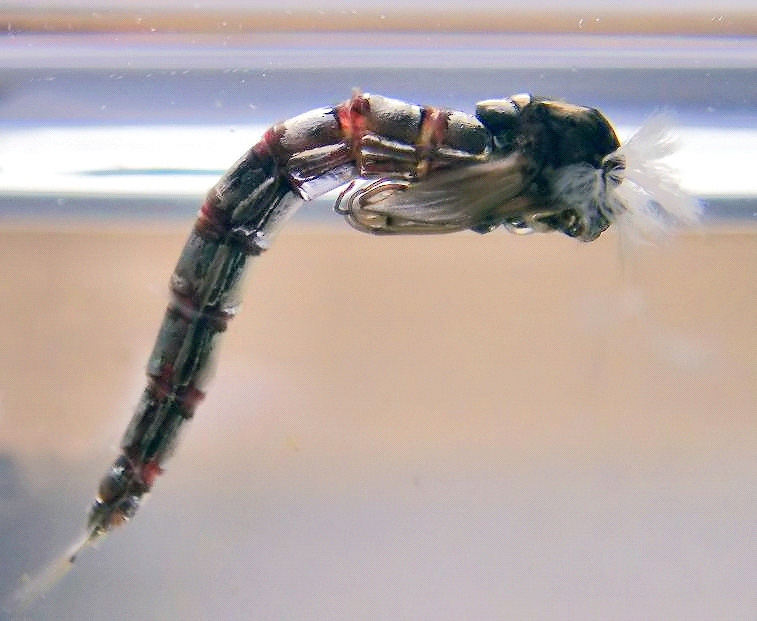
Chitin is the principal structural component of the exoskeletons of invertebrates such as Crustacea. It is also present in the cell walls of most fungi and many algae. Endogenous chitinase, the enzyme that degrades chitin, has been described in the digestive tracts of a number of finfish (Lindsay and Gooday, 1985) and so it can be considered that chitin is available to these animals. However, the efficiency with which it is digested is unknown.
It is also claimed that some bacteria in the digestive tract of fishes participate in chitin digestion. However, enzyme activities measured in the stomach, intestine, blood, liver and lymphomyeloid tissues have all been determined to reflect endogenous enzyme capabilities of fishes, and teleost chitinase genes have been found leaving little doubt that the majority of chitinolytic activity in their digestive tracts is produced by stomach and intestinal mucosa.
Nevertheless, I have fed frozen bloodworms to rainbowfishes for many years and have never experienced this problem. Although there have been some reports on larval mortality of freshwater fish species when being fed live bloodworms.
There have also been some reports of respiratory and/or skin allergy to Chironomids. Cases of aquarium hobbyists developing conjunctivitis, rhinitis with or without bronchial asthma or urticaria after handling fish foods have been reported. The aetiological agents were chironomid larvae, and in the some cases, shellfish/crustaceans present in some fish foods. However, studies suggest that Chironomid allergies are rare and are mainly seen in those who handle bloodworms used for fish foods.