
Copepods
Copepods are small crustaceans that occur naturally in all aquatic habitats and are one the major food items of larval rainbowfishes in their natural habitat. Copepods are aquatic crustaceans, smaller relatives of the crabs and lobsters. They have colonised virtually every habitat from 10,000 metres down in the deep sea to lakes 5,000 metres up in the Himalayas, and every temperature regime from sub-zero polar waters in the Antarctica to hot springs.
Copepods are found in marine, estuarine and freshwater environments and also inhabit the terrestrial realm occurring in mosses and leaf litter. The majority are free-living and benthic, although there are a few pelagic and symbiotic species. This free-living form is only part of the copepod success story, since they have also become parasites of almost every major animal group from sponges and corals to fish and mammals. Copepod’s that parasitise fish skin and gills, for example, are serious pests of commercial fish farms.
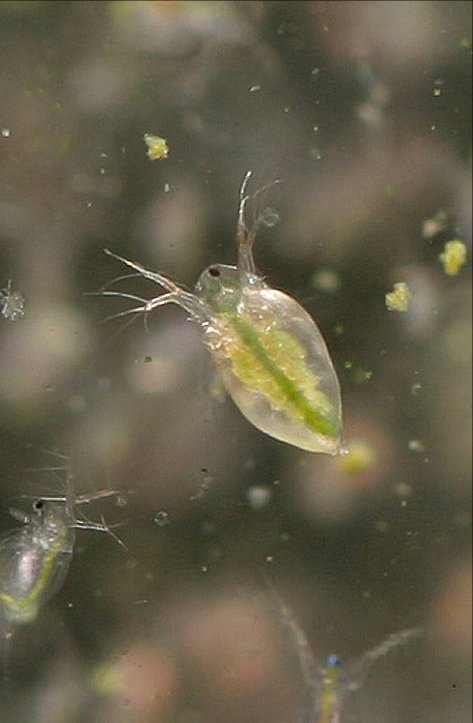
Copepods exhibit a diverse range of body shapes, but in general they are linear and range in length from 0.2 to 28 mm, but most planktonic forms are between 0.5 mm and 2.5 mm. They represent a significant component of the meiofauna in freshwater habitats. The word ‘meiofauna’ is used to define an assemblage of benthic invertebrates smaller than the macrobenthic fauna. Prior to the introduction of the word meiofauna, researchers had referred to small invertebrates as microfauna; however this term now refers largely to Protozoa. Meiofauna are defined as animals that pass through a 500 µm mesh sieve but are retained on 45 µm mesh.
Copepods feed on diatoms, bacteria and protozoans. Food availability and water temperature are thought to be the prime factors influencing their reproduction and growth. Reproduction takes place through copulation and involves the transfer of sperm from the male’s spermatophore to the female oviduct. Prior to reproduction a male copepod will grasp a female with his modified antennules. Coupling arrangements tend to be species specific.
Males may grasp the third or fourth legs of the females, the caudal rami, the caudal setae, and the posterolateral margin of the cephalothorax or around the genital double-somite. Precocious coupling of males and juvenile females is also common. In these situations, a male attaches himself to a juvenile female and stays with her until her final moult, when she is ready to mate. Males have been observed to release their hold on moulted exoskeletons of copepods, and then reclasp the body of the newly matured female. This behaviour ensures that the ‘trailing’ male is the first to mate with the female when she reaches maturity. Post-copulatory coupling has also been observed in some copepods and this is thought to prevent subsequent matings of the female with other males.
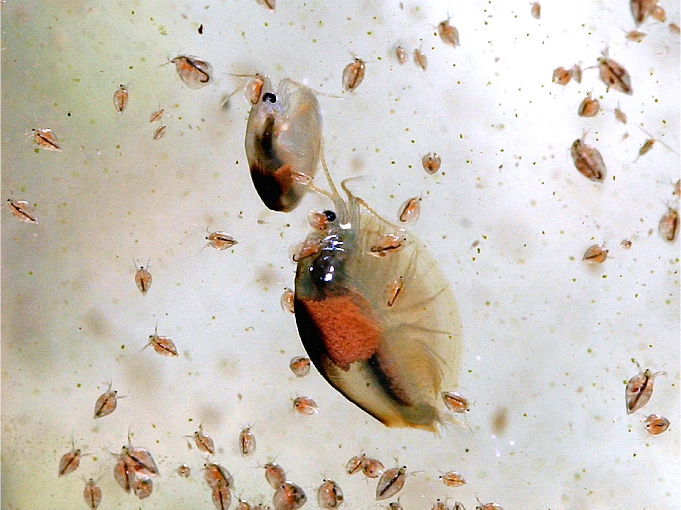
Copepods carry their eggs in either a single egg sac or a pair of sacs, but many pelagic species release their eggs directly into the water column, since the carrying of egg sacs renders the adult more liable to visual predation. After an incubation period of one to eight days eggs hatch, and nauplii are released.
In general, copepods go through six naupliar stages and six copepodite (post-naupliar) stages, the last one being the adult form. The time this cycle takes varies and developmental rates are influenced by temperature, food supply and salinity. Some copepods reach maturity in just six days after hatching; while others can take up to 62 days. The early life stages are very tiny and can be as small as 0.05 mm. Males are smaller than females.