

Daphnia
Daphnia are members of the order Cladocera (cladocerans), and are one of the several small aquatic crustaceans commonly called water fleas due to their small size and jerky swimming motion. They live in various freshwater environments ranging from swamps, lakes, ponds, streams and rivers. They are usually translucent or amber in colour and are an important component of the food chain in freshwater environments. Most species occur worldwide and are truly cosmopolitan, but on the other hand there are several that are endemic in distribution.
The body of daphnia is shaped rather like a clam with a slit along the belly side. A single eye capable of distinguishing light from darkness is present in the head. If a shadow is cast across a daphnia pond, the animals quickly swim out of the shadow into the light. Two large appendages behind the head (actually modified antennae) are used like oars to propel the animal in a jerky fashion through the water. Other appendages are inside the shell, and they are used to filter suspended particles on which the daphnia feed.
Most daphnia are cyclical parthenogens, so are well adapted to short seasons of reproduction such as in seasonal environments. Natural populations are composed of females who clonally reproduce until conditions within their environment deteriorate. One clutch of eggs is normally released into the brood pouch during each adult instar (an instar is the period between moults). Since these animals are crustaceans, the only way they can grow in size is to moult their exoskeleton. As long as environmental conditions remain favourable females will continue to reproduce in this manner, producing only female offspring capable of asexual reproduction.
When unfavourable conditions occur, e.g. severe temperature changes, drying, or crowding which leads to competition for food or a decrease in the quality or size of food, then the production of parthenogenetic eggs declines. Some eggs develop into males and females capable of sexual reproduction. These females have modified carapaces, which are thicker and darker dorsally than a regular carapace and produce haploid eggs that must be fertilised by the males. The fertilised egg goes through several cell divisions, the zygote enters a resting stage and cell division stops. Males are slightly smaller and different in form compared to females.
The mechanisms underlying the production of males and haploid eggs are not clear. Male production seems to be correlated with crowding and a rapid reduction in food supply (a constant low food supply simply inhibits reproduction). Short -day photoperiod seems to increase the production of ephippia in Daphnia pulex in contrast to the longer light periods of midsummer, i.e. as autumn approaches and days get shorter, and the number of ephippia produced seems to increase.
After these haploid eggs are fertilised by the males, the wall of the brood pouch thickens and encloses the eggs in a semielliptical saddle-shaped ephippium. These ephippia contain embryos in a state of arrested development. When the female moults the ephippium is cast off. It does not disintegrate, but remains intact protecting the eggs, which will not complete their development and hatch until favourable conditions return.
Daphnia can suspend their growth and development for years or even centuries during periods of unfavourable conditions. In habitats, which dry completely, annual recruitment is entirely from the ephippia. Ephippia sink or float and are able to withstand extremes of temperature and moisture. When environmental conditions are again favourable the embryos develop into parthenogenetic females and break free of the ephippium. The ephippia are also used as a means of dispersal for many species, being carried by the wind or in the fur, feathers or digestive tracts of animals to new habitats.
The life span of daphnia, from the release of the egg into the brood chamber until the death of the adult, is highly variable depending on the species and environmental conditions. Generally the life span increases as temperature decreases, due to lowered metabolic activity. The average life span of Daphnia magna is about 40 days at 25°C, and about 56 days at 20°C. The average life span of Daphnia pulex at 20°C is approximately 50 days. The time required to reach maturity (produce their first offspring) in Daphnia pulex varies from six to 10 days (mean = 7.78 days) and appears to be dependent on body size.
The growth rate of the organism is greatest during its juvenile stages (early instars), and the body size may double during each of these stages. Daphnia pulex has three to four juvenile instars, whereas Daphnia magna has three to five instars. Each instar stage is terminated by a moult. Growth occurs immediately after each moult while the new carapace is still elastic.
in fibre but low in nutrients; its bulk stimulates peristalsis.
variable and many intermediate forms occur.
the addition of nitrogenous fertilisers for the promotion of algae growth in outside ponds.
Daphnia have a wide tolerance to temperature but grow best at a temperature range of 18–22° Celsius. Moina, on the other hand, withstand extreme temperatures better, resisting daily variations of 5–31° Celsius. Their optimum temperature range is 24–31° Celsius. This higher temperature tolerance makes this species a better choice for culturing in area where temperatures may rise above 22° Celsius. A pH between 6.5 and 9.5 is acceptable.
Starter cultures of daphnia can be collected from the wild but beware of predators like hydra and various carnivorous insect larvae. Obtaining a clean culture from a fellow hobbyist or biological supplier is the preferred source for a starter culture. Immerse the starter culture into your culture water and gently empty the contents (don't pour the starter culture through the air).
Daphnia magna can survive when the dissolved oxygen concentration is as low as 3 mg/L but Daphnia pulex does best when the dissolved oxygen concentration is above 5 mg/L. Therefore it is recommended that the dissolved oxygen concentration in the culture be maintained at 5 mg/L or above. Unless the cultures are too crowded or overfed, aeration is usually not necessary. Daphnia magna is principally a lake dweller, but can also be found in shallow ponds with muddy bottoms rich in organic matter. Daphnia pulex is principally a pond dweller where the oxygen content is higher, but is also found in lakes. It is generally considered a clean water species being dominant in nature during periods of low turbidity.
Daphnia can be successfully raised indoors maintained in any suitable container, although better results will be obtained when they are cultured outdoors. Do not expose indoor cultures to direct sunlight or strong artificial light.
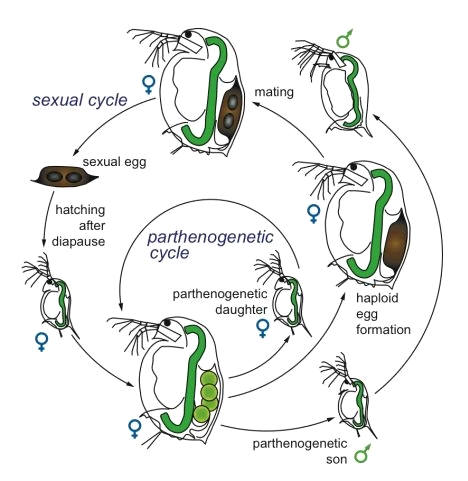
During the parthenogenetic cycle, females produce diploid eggs that develop directly into daughters. The same female may produce diploid asexual eggs that develop into sons. Male production is under environmental control. Furthermore, the same female may produce haploid eggs that require fertilization by males. These eggs are then enclosed in a protective shell (ephippia) and need to undergo a diapause before female offspring will hatch from them.
The variations in ambient light intensities and prevailing day/night cycles in most fishroom situations do not seem to affect daphnia growth and reproduction significantly. However, a minimum of 16 hours of illumination should be provided each day.
Start your culture with approximately 25 daphnia / litre. Although a culture can theoretically be started with a single female, always use an adequate number to develop a harvestable population quickly. If fewer are used, the population in the culture will increase more slowly; therefore, the initial quantity of fertiliser or food should be reduced to prevent overfeeding. A greater number used for inoculation reduces the time to harvesting and lessens the chance of contamination by competitors.
Cultures are usually inoculated 24 hours or more after fertilisation. However, when yeast is used, daphnia can be added to the culture after a few hours of aeration, assuming good water quality, and proper temperature. This is because the yeast cells are immediately available as food. The small amount of phytoplankton present in the water and digestive tract of the daphnia used to inoculate the culture is usually sufficient to initiate a phytoplankton bloom. Sometimes the mortality of the initial inoculation is high and an additional inoculation is required.
The health of the culture is determined by stirring the culture, removing 15 ml of the culture, and examining the sample with a 10X-hand lens or dissecting scope. Green or brown-red daphnia with full intestinal tracts and active movement indicates a healthy culture.
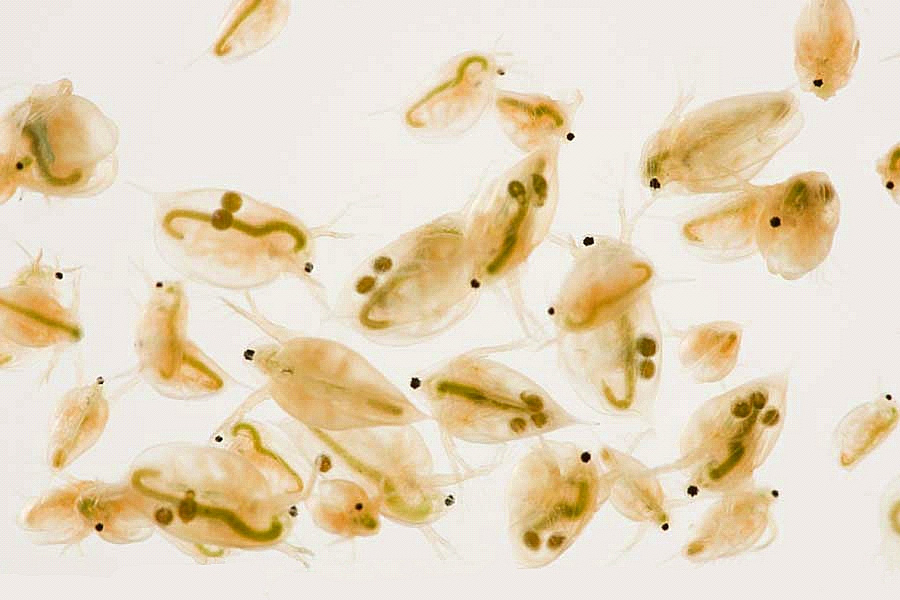
Pale daphnia with empty digestive tracts or females producing resting eggs are indications of sub-optimum environmental conditions or insufficient food.
The food concentration in the culture water, when examined in a clear glass, should appear slightly cloudy and tea coloured or green. Clear culture water is an indication of insufficient food. Feeding the proper amount of the right food is extremely important in daphnia culturing. The key is to provide sufficient nutrition to support normal reproduction without adding excess food, which may clog the animal's filtering apparatus, or greatly decrease the dissolved oxygen concentration and increase mortality.
Daphnia are herbivores or detritivores, feeding on phytoplankton, bacteria, or decaying organic material. They are well adapted to live in algal blooms, which are high in proteins and carbohydrates. Small particles in the water are filtered out by fine setae on the thoracic legs and moved along a groove at the base of the legs to the mouth. Although there is some evidence that certain types of food, such as particular types of algae, protozoa, or bacteria may be selected by some species, it is generally believed that all organic particles of suitable size are ingested without any selective mechanism.
You can feed your indoor culture sparingly with brewer’s yeast, powdered milk or egg yolk, astaxanthin, powdered chlorella algae or hard-boiled egg yolk squeezed through a piece of cloth. Another satisfactory food is spinach juice. It has a minimum of indigestible fibrous material and can be easily made from frozen spinach in a food blender. Keep the spinach juice refrigerated and feed once or twice a day to an active culture.
Powdered spirulina is another suitable food for feeding daphnia: Pre mix a suspension of 1 level tablespoon spirulina powder per litre of distilled water and fed at a rate of about 1050 ml per 20 litres - but only if the water has cleared from any previous feeding.
Care must be taken not to overfeed with these foods, as overfeeding can quickly cause problems with water quality. Regardless of the type of media used, start with small amounts of feed or fertiliser added at frequent intervals; slowly increasing the amount used as you gain experience.
Well-established cultures reproduce very quickly and can quickly become crowded in culture tanks. High population densities of daphnia can result in a dramatic decrease in reproduction, but this is not apparently the case with moina. The maximum sustained density reported in cultures of daphnia is 500 individuals per litre. Moina cultures, however, routinely reach densities of 5000 individuals per litre and are, therefore, better adapted for intensive culture.
The batch culture method of producing daphnia uses a continuous series of cultures. Briefly, a new culture is started daily in a separate container using the procedures outlined below. When all the yeast, bacterial, or algal cells are consumed, usually about 5 to 10 days after inoculation, the daphnia are completely harvested, and the culture is restarted. This method is particularly applicable when a specific quantity of daphnia is needed each day, because daily production is much more controlled. Batch culture is also useful for maintaining pure cultures because there is less chance of the cultures becoming contaminated with competitors (e.g., protozoans, rotifers, copepods) or predators of fish larvae or fry (e.g., hydra, dragonfly larvae).
Semi-continuous cultures can be maintained for two months or more by daily partial harvests, water changes, and regular feeding, keeping the population in a state of rapid growth. Eventually, the culture will fail to respond to additional fertilisation. When it is evident that they are not reproducing well, the daphnia should be completely harvested and a new culture started.
Daphnia can be produced either in combination with their food or as separate cultures. Combined culture is the simplest, but production from separate cultures has been reported to be approximately 1/3 higher. Production from separate cultures has the disadvantage of requiring additional containers for the cultivation of phytoplankton. Regardless of the culture method, always maintain several cultures to ensure a supply in case of a die off.
It is important to do this because once the population of daphnia becomes too crowded or the water too old or not acceptable to the daphnia for whatever reason, the females start producing male offspring and only ephippial eggs are produced. These eggs will not hatch until more favourably conditions return so your culture may just fade away.
Cultures can be maintained in 50-litre aquaria. However, this volume is usually too small to yield enough daphnia to satisfy demand. Tanks or vats (concrete, plastic, or fibreglass), and earthen ponds can be used. Wading pools, old bathtubs, discarded refrigerator liners, and cattle watering troughs also work well. Water depth should be no greater than 45 cm. The shallow water depth allows good light penetration for photosynthesis by phytoplankton. Diffuse light or shade over 1/3 of the water surface of the daphnia culture container is recommended. A greenhouse covered with shade cloth (5080% light reduction) is ideal.
Outdoor cultures should be protected from heavy rain and screened to prevent entry of predacious aquatic insects. Filamentous algae and predators of fish fry can be especially troublesome in daphnia cultures. Gentle aeration can be used to oxygenate the water, keep food particles in suspension, and increase phytoplankton growth, but fine bubbles should be avoided.
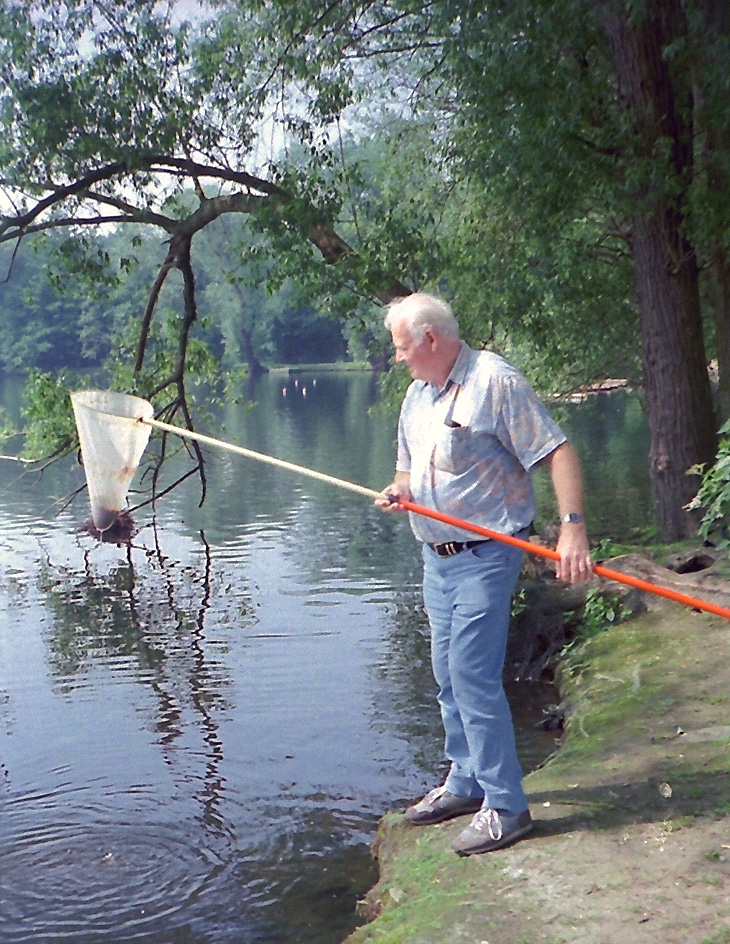
A partial harvest every day is required to keep the culture healthy and productivity high. They can be harvested by simply dipping out the required number with a brine shrimp net as they concentrate in “clouds” at the surface. Cultures may also be harvested by draining or siphoning the culture water into a plankton collector equipped with 50 to 150 µm mesh netting net suspended in a container of water. Turn off the aeration and allow the food particles to settle before harvesting. For semi-continuous culture, do not harvest more than 20 to 25% of the population each day, unless you are restarting the culture. Harvesting by draining the culture tank allows for a partial water exchange, improving water quality.
Daphnia maintained in outdoor ponds will feed on phytoplankton present in water, which is very rich in organic or nutrient matter. A container or pond outside that gets plenty of sun will virtually guarantee alga soup and a successful daphnia culture. The pond is filled with water, fertilised with organic matter, and allowed to stand until it turns green before a starter culture is introduced. In about three weeks, the pond should reach maximum population and the daphnia can start to be harvested.
Organic fertilisers are usually preferable to mineral fertilisers. Mineral fertilisers may be used and usually work better in earthen ponds than in tanks or vats, but can be toxic to some species of daphnia. Organic matter (manure) provides bacterial and fungal cells and detritus as well as phytoplankton as food for the daphnia. This variety of food items more completely meets their nutritional needs, resulting in maximum production. Although not necessary, the manure is frequently dried before use. Although manure is widely used to culture daphnia, micronised rice bran, and agro-industrial wastes, eg wheat bran, soybean meal, and dried blood are less objectionable to use and work well.
The fertiliser can be added to your culture in several ways. One is to soak the dry material in water until it breaks down into a thin mixture, then pour the resulting concoction into the pond, allowing it to slowly deteriorate. Another is to place the dry material in a mesh bag and suspend the bag inside the pond. Change the bag every five days. Cheese cloth, hessian, muslin, nylon, or other relatively loose weave fabrics may be used.
Nylon and other synthetic fabrics, however, do not deteriorate in water as do cotton or hessian. For smaller culture containers, nylon stockings work well for this purpose.
The use of a bag prevents large particles from being a problem when the daphnia are harvested and allows greater control of fertilisation. If fungus occurs in the culture container due to over-fertilisation, the bag containing the organic material should be removed from the culture. If fungus persists in large quantities, the culture should be discarded and restarted.
The nutritional content of daphnia varies with age, and what it has been eating. The protein content is usually around 50% of dry weight. Quite the opposite from brineshrimp, adults normally have a higher fat content than juveniles do about 20– 27% for adults, and 4–6% for juveniles. Some species have been reported to have protein contents exceeding 70%.
The fatty acid composition of food is important to the survival and growth of fish fry. Omega-3 highly saturated fatty acids are essential for many species of fish. Daphnia cultured on brewer's yeast (Saccharomyces cerevisiae) are high in monoenoic fatty acids. By using what is called w-yeast (yeast enriched with cuttlefish oil), daphnia will contain very high levels of omega-3 fatty acids.
Commercial formulas can also be obtained from aquacultural suppliers for the enrichment of brineshrimp, rotifer, and daphnia cultures.
Differences in size, brood production, and optimum environmental conditions exist between different species and varieties of daphnia. Adjustments will need to be made in the culture technique depending on the particular species or variety you wish to produce. It may not always be possible to match production to the food demand of the fish fry. Harvested daphnia can be kept alive for several days in clean water in a refrigerator. However, the nutritional quality of the stored daphnia probably will not be optimal because of the period of starvation, so they should be enriched with algae and yeast before feeding them to the fish.
Daphnia can be stored for long periods by freezing them in flatpacks. Try to make as thin a layer as possible in order to achieve quick freezing. Otherwise it will take too long for the animals to get frozen resulting in the formation of ice crystals, which then puncture the cell walls lowering the nutritional value of the daphnia dramatically. Use plastic bags in order to prevent freezer burn and try to lower the temperature of the freezer compartment. With some practice you should end up with correctly frozen daphnia retaining their nutrients.
Although freezing does not significantly alter the nutritional content, nutrients do leach out rapidly into the water. Nearly all of the enzyme activity is lost within ten minutes after introduction in fresh water. After one hour, all of the free amino acids and many of the bound amino acids are lost. Adequate circulation is required to keep them in suspension after thawing so they will be available to the fish. But of course, live daphnia are better as their movement arouses the hunting behaviour of many fish.
Some “daphnia” cultures are not daphnia at all, and upon further investigation other cladoceran genera such as Ceriodaphnia, Daphniopsis, Bosmina, Bosminopsis, Moina and Moinodaphnia can be recognised. However, as they all are the same to culture and eagerly accepted by all rainbowfishes, it will not matter which species you have; although, there is considerable size variation between the different genera.
Moina, for example, are approximately half the maximum length of daphnia. Adult moina (700 to 1000 µm) are larger than newly hatched brine shrimp and approximately two to three times the size of adult rotifers. Young moina (less than 400 µm), however, are smaller than newly hatched brine shrimp and approximately the same size or slightly larger than adult rotifers. Therefore, moina are ideally suited for feeding rainbowfish fry, and many species can ingest newly hatched moina as their initial food.
Cladocerans occur throughout the world, even in Antarctica. Most are freshwater animals, but some species are estuarine and marine. Eight families (Daphniidae, Moinidae, Macrothricidae, Chydoridae, Sididae, Bosminidae, Sayciidae and Ilyocryptidae) and over 170 species of Cladocera are known from Australian inland waters. Daphnia is the most commonly known genus in this group.