
Feeding in Captivity
Although environmental factors may limit food availability, wild rainbowfishes generally have the opportunity in their natural environment to acquire adequate levels of all their nutritional requirements. The same cannot be said for captive rainbowfishes. Maintaining good health and growth in your rainbowfishes depends directly on the quality and quantity of the nutrients received through their daily diet.
Rainbowfishes that receive an inadequate diet grow poorly or not at all, and often exhibit deformities in the instance of vitamin/mineral deficiencies. Without the right amount of nutrients, rainbowfishes lose colour, stop breeding, and become susceptible to disease and, in certain circumstances, might even die. An undernourished animal cannot maintain its health and be productive, regardless of the quality of its environment. Obviously, no single food will meet their needs at all life stages, and the best way to ensure that they are getting a well-balanced diet is to feed them as wide a variety of food as possible.
Many old-time aquarists relied upon catching and culturing live foods to feed their rainbowfishes. This was mainly due to the fact that there was not the variety of commercially manufactured fish foods available then as there are today. Aquarists who were fortunate enough to discover pristine ponds inhabited by live foods generally keep them a close secret, and set out to collect them at dead of night, in order to keep them to themselves. The live foods that became most popular were those that could be easily collected or cultivated.
Up until the 1950’s, keeping and breeding rainbowfishes in captivity generally required the routine collection of live food from streams and ponds or whatever the aquarist was able to find. Some of the items that were used included bloodworms, small garden worms, gentles (maggots), presoaked wheat, barley or millet grains, and now and then, coffee biscuit, vermicelli crushed small, occasionally varied with a little fresh food or gentles, and the various varieties of animalculae (Aquarium and Terrarium Society of Queensland, 1928).
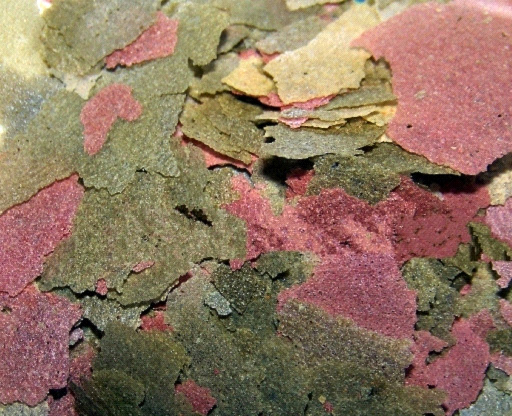
The feeding of aquarium fishes was revolutionised with the invention of dried flake food by Dr. Ulrich Baensch, founder of Tetra Werke. Today, approximately 80% of aquarium hobbyists feed their fish exclusively with prepared foods, usually in flake or pellet formulations.
Flake food is the most common form and is consumed by a wide variety of aquarium fish. Any discussion that involves fish food deserves a brief explanation on these two types of commercially prepared foods. While flakes have been the most popular type of food for the past 50+ years, experienced hobbyists have learnt that pellets are the superior choice for feeding aquarium fishes. Pellets are preferred over flakes due to the fact that each pellet has uniform nutritional value for the fish. Not only can you feed much less on a volume basis, but pellets will also remain stable in the aquarium for an extended period of time. By their very design, flake foods are paper-thin and absorb water very quickly. Some studies suggest that once flakes are added to the aquarium, the majority of water-soluble vitamins (such as vitamin C) are leached out of a flake food within 60–90 seconds.
Most brands are designed to meet the nutritional requirements of multiple species. In this way, the manufacturer can satisfy a larger consumer base. A problem with this approach is that this “all purpose” feed may not be completely suitable for rainbowfishes. Since there are very few published reports on rainbowfish nutritional requirements, or an evaluation of formulated diets on growth and fecundity, it is not known whether the protein, lipid and carbohydrate levels in these diets provide the complete nutritional requirements of rainbowfishes.
Rainbowfishes can be maintained on a diet consisting totally of commercial feeds such as flake and pellet formulations. Such feeds however, need to be not only nutritious and palatable, but also capable of floating or sinking slowly. Rainbowfishes are primarily surface feeders so feeds that sink too quickly may become wasted in the gravel substrate and can cause water quality problems. Avoid feeding pellet feeds developed for the aquaculture industry, as they can cause health problems in rainbowfishes over the longer term.
Rainbowfish keepers determined to keep rainbowfishes in foremost breeding condition and to raise and maintain the finest specimens should be aware that nutritional deficiencies may exist in commercially prepared foods. An ideal aquarium diet for rainbowfishes could include foods such as mosquito larvae, live and frozen daphnia (cladocerans), bloodworms and other aquatic invertebrates; chopped fish or shrimp, duckweed and blanched zucchini, spinach (Spinacia oleracea) or silverbeet (Beta vulgaris ssp. cicla).
In a well-established planted aquarium, rainbowfishes will always fine some green food among the aquatic plants, but a feed of duckweed, zucchini or spinach, at least once or twice a week is to be recommended. If duckweed is taken from natural waters it should be thoroughly cleansed before giving it to the fish. Failure to take this precaution may result in undesirable parasites being introduced into the aquarium.
Duckweed has higher concentrations of the essential amino acids, lysine and methionine, than most plant proteins and more closely resembles animal protein in that respect. Newly harvested duckweed contains up to 43% protein by dry weight with little to no indigestible material. Cultured duckweed also has high concentrations of trace minerals and pigments, particularly beta-carotene and xanthophyll that make duckweed an especially valuable supplement for rainbowfishes. The fairly high concentrations of these pigments deepen the overall body colouration of rainbowfishes. Duckweed can also be a rich source of ascorbic acid (2.78–4.90 mg/100 grams dry weight). The smaller species like Wolffia and Lemna are better for rainbowfishes and most will eat it avidly.
Freeze dried foods are another type of food that can be fed to rainbowfishes. The process of freeze-drying is to remove only the water content, leaving the nutrients content intact. If you feed freeze dried foods all the time then it would be best to pre-soak them in water before feeding to your fishes.
Frozen foods can be a more natural source of nutrients than dry manufactured foods. When feeding frozen foods, always thaw them to room temperature before feeding your fishes. Many frozen foods available from commercial suppliers often contain liquefied nutrients or processing water that may pollute the aquarium water when thawed. The best way to defrost frozen foods quickly is to place the frozen food into a strainer and run it under a cold water tap. This will also wash away the dissolved nutrients or any processing liquid that will remain uneaten if fed to your fishes. Although freezing does not significantly alter the nutritional content, nutrients do leach out rapidly into the water.
I formulated my own food mix which was a gelatine-based blend consisting of about 90% equal portions of fresh/frozen whitebait, shrimp, and mussel plus about 10% of beef liver and spinach. Small additions of other items such as dried mosquito larvae or similar dried foods, spirulina, fish roe, and a host of other gourmet delights can be added to the mix. Food sources of marine origin are often utilised in fish foods because they are an excellent source of essential amino acids, fatty acids, vitamins and minerals. Variations of this formula could be tailored to suit nutritional needs of specific fish and according to available ingredients.
Vitamin supplementation is not necessary. Water-soluble vitamins such as B-complex vitamins and vitamin C are most vulnerable to nutrient leaching and must be replaced each day. Fat-soluble vitamins such as A, D, E and K dissolve in fat before they are absorbed in the blood stream to carry out their functions. Excesses of these vitamins are stored in the liver. Because they are stored, they are not needed every day in the diet and may cause problems if given in large doses. However, over supplementation with the aim to overcoming vitamin degradation and leaching should be avoided to limit the risk of hypervitaminosis. Although, overdose of most vitamins is unlikely to occur as excess vitamins are removed from the body via the kidneys. Brewers yeast, cereals, fish liver and various fish meats and oils contain most of the essential vitamins when fresh, and are key ingredients in most formulated foods.
The quality of ingredients in the food will have an effect on the adequate delivery of key nutrients to the fish especially in relation to all the water-soluble components of the diet. Care must be taken to overcome the leaching properties of certain foodstuffs in the aquarium. Once the nutrients are released from the diet into the water they are lost to the fish. Any vitamins or nutrients that are leached into the water are not known to be taken up through the skin or gills by freshwater fish species which, in a hypo-osmotic environment, do not drink.
The formulation of a nutritionally balanced diet for your rainbowfishes requires efforts in research and evaluation. Inadequate nutrition obviously impairs fish growth and reproduction, and can result in deterioration of health until recognisable diseases ensue. The borderlines between reduced growth and diminished health, on the one hand, and overt disease, on the other, are very difficult to define. There is no doubt that as our knowledge increases, the nature of the departures from normality will be more easily explained and corrected. However, the problem of recognising a deterioration of performance in its initial stages and taking corrective action will remain an essential part of the skill of the aquarium hobbyist.
The first consideration for the formulation of a successful diet is the quality of the feed ingredients. Diets produced with poor quality raw materials and under adverse processing conditions have inferior nutritive value and adverse effects on fish health. The composition of the ingredient obviously plays a determinant role in the quality. However, biological aspects, such as digestibility and utilisation of nutrients are most important and often overlooked.
The use of a good quality food will provide the fish with all the nutrients that they need to remain healthy and to grow. However, you should note that even good quality food will deteriorate if improperly stored or kept too long. Unfortunately, few fish food containers are stamped with an expiration date. Storage time for most commercial fish foods will vary depending upon environmental conditions; however, as a rule of thumb, 90 days is normally the maximum safe storage time for fish feed. Fish foods should be stored in a cool and dry place (refrigerator), and used within 30 days of opening, particularly in hot, humid climates.
Never feed mouldy, discoloured or clumped feed. Moulds on feed may produce aflatoxins, which can kill fish. Only buy large containers of food if you have a large number of fish. Frozen foods can probably be kept for 6 to 8 months. They should not however, be thawed and then refrozen.
Whatever choices you make regarding feeding your fishes, remember that variety is not only the “spice of life”, but is the best way to provide them with the essential nutrients to give energy and build tissue. With proper feeding and aquarium management, most rainbowfishes will have the opportunity to live a much longer life in captivity than they would in the wild. A reasonably knowledge of the function of foods and feeding will therefore help in the choice of the most suitable food available for your rainbowfishes or in formulating your own mixture.
Sometimes rainbowfishes can be encouraged to experiment with unfamiliar food items by withholding other preferred food items. This works well, for example, when feeding blanched zucchini (a good source of B and C vitamins) for the first time. Simply withholding their regular food and offering the less familiar zucchini usually results in rapid acceptance (1 –3 days). Similar strategies can be used to feed rainbowfishes homemade gelatine-based foods. Gelatine-based foods can serve as an excellent carrier for oral medications, but the fish should be use to eating a plain (non-medicated) homemade diet before there is a need to use it as a means of delivering medication. As with many sick animals, the appetite is often significantly depressed in sick fish, and that is not the time to try and introduce an unfamiliar food item.
Feeding live foods may not be necessary, but if you have access to them then this is by far the best food that you can feed to your rainbowfishes. However, the time required collecting live food from local ponds and streams and the risks of introducing pests, parasites and disease to a healthy tank are enough to make even the most avid aquarist question the desirability of such practice. What to watch out for are dragonfly larvae, hydra, leeches, planaria, snails, water beetle larvae, water tigers, and other carnivorous insect larvae. They may not bother larger rainbowfishes, but small fry have no defence against most of these pests. You can overcome all these problems by maintaining live cultures of cladocerans (daphnia, moina etc.), copepods, mosquito larvae, drosophila, whiteworm, etc., at home.
Rainbowfishes are well adapted to capturing live zooplankton and will show an active response to this type of food, indicating that zooplankton is a very attractive food for rainbowfishes. Upon adding zooplankton to the tank, it is quite often the case that rainbowfishes will exhibit an immediate response that somewhat resembles a feeding frenzy. Live zooplankton is preferred over inert food by rainbowfishes, suggesting a moving prey item may stimulate or influence feeding preference. In the presence of both live zooplankton and a pellet diet, rainbowfishes spend significantly more time feeding on zooplankton than on inert pellets. The natural diet of newly hatched rainbowfishes is dominated by zooplankton. Zooplankton is a rich source of protein and varies from 30–70% depending on life stage and nutrient availability of their phytoplankton diet.