

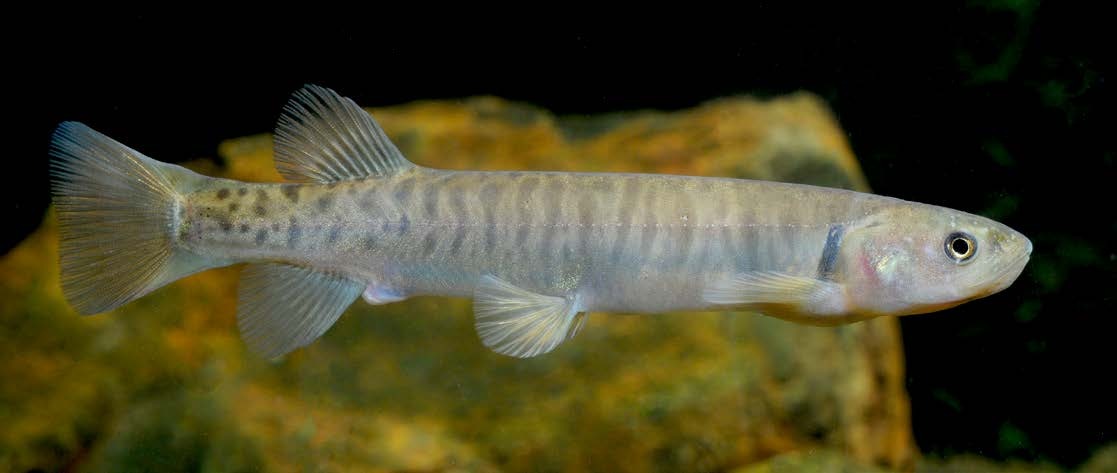
Galaxias brevipinnis
Climbing Galaxias
Species Summary
One of the more remarkable of Australia’s native fishes, Galaxias brevipinnis is considered close to the ancestral stock from which the continent’s other Galaxias species evolved, part of a Gondwanan lineage that predates the break-up of the ancient supercontinent some 60–120 million years ago. The species also occurs in New Zealand, where it is known as the koaro and is reputed to be the first fish able to colonise glacial lakes there, on account of its phenomenal climbing ability.
Etymology
The meaning of the genus name Galaxias was never explained by the French zoologist Georges Cuvier, who proposed it in 1816 based on a species he called Esox truttaceus (see the Galaxias truttaceus account). One theory connects it to the Greek for “milky” (as in the Milky Way), possibly alluding to the starry gold spots of the New Zealand species G. argenteus, but this remains unconfirmed. The species name brevipinnis combines the Latin brevis, short, with pinnis, fin — presumably referring to the length of the anal-fin rays, which, laid backwards, do not reach the base of the caudal fin.
Etymology compiled from C. Scharpf (2019), “Fishes of Sahul: An Etymological Survey (Part 2)”, Fishes of Sahul 33(2): 1417–1439, and etyfish.org.
Description
An elongated, cylindrical fish, light olive-green with dark chevron markings and gold flecks along the back, and bright reddish-orange fins; the body is translucent and satiny. Like other galaxiids it is scaleless and able to take up some oxygen through its skin. Its broad, laterally held pelvic and pectoral fins let it cling to and climb wet, steeply sloping rock faces and wriggle between cobbles even when briefly out of the water — fish have been seen clinging to sloping sandstone bedrock after heavy rain with water rushing over them, letting go to be washed downstream before powering back to the same spot with a flick of the tail, often with an insect or tadpole newly caught in the process.
Distribution & Habitat
Galaxias brevipinnis is widespread across southern Australia and New Zealand, but isolated, landlocked populations also persist in unexpected places — including a single, entirely self-contained population in Curl Curl Creek, part of the Manly Dam catchment in suburban Sydney, first noticed by a local resident in the 1970s but not identified until 1995, when the Australian Museum confirmed it as the only known population within the Sydney metropolitan area. That creek is a bedrock stream cut into Hawkesbury sandstone, alternating between pools, riffles, cascades and waterfalls, with large potholes eroded into the sandstone bed; the galaxias favour the deeper pools of the middle and lower reaches, and can be found hunting in the potholes at night alongside spiny freshwater crayfish. This landlocked population breeds in spring.
Remarks
The Curl Curl Creek population’s survival has been a genuinely close call. A 48-ha golf course built on the catchment’s south-western side in 1972 wiped out every galaxias population in that part of the catchment through bush clearance and chemical runoff, and triggered algal blooms in Manly Dam itself. In 1994 a housing developer applied to build medium-density housing across 4 ha of bushland at the creek’s headwaters, piping the creek itself in the process; the local council’s rejection of the plan was twice upheld by the Land and Environment Court against developer appeals, leaving this small, ancient, self-sufficient population still clinging on in the middle of Sydney’s suburbs.
Compiled for Home of the Rainbowfish from ANGFA sources: A. Lo, “The Galaxias brevipinnis of Curl Curl Creek”, Fishes of Sahul 12, 1998, pp. 541–548.