

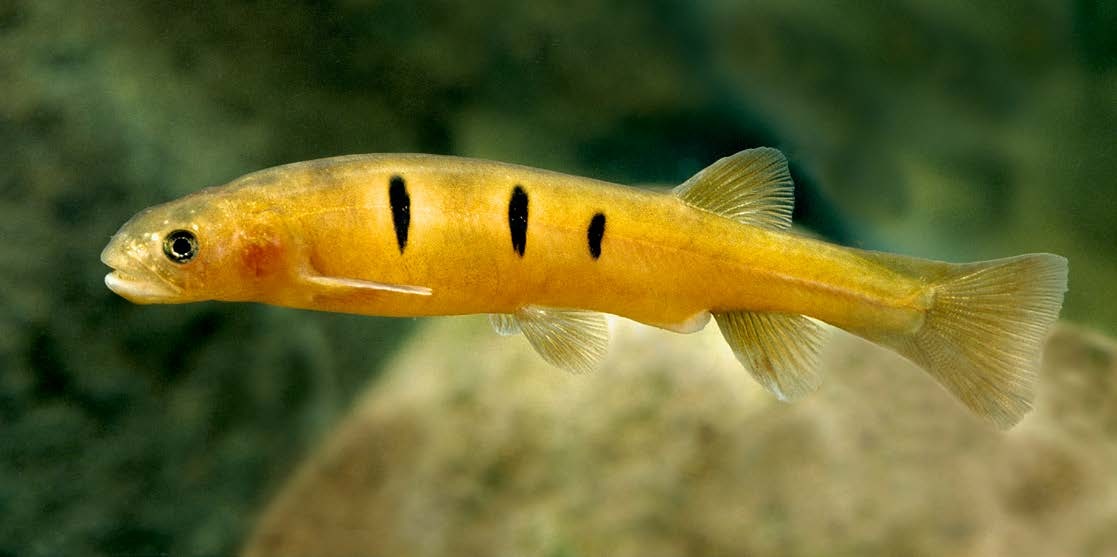
Galaxias fuscus
Barred Galaxias
Species Summary
Galaxias fuscus was known for nearly half a century from only two dried-out specimens, collected in 1936 from the Rubicon River, Victoria. By 1981 it had been formally treated as a mere colour form of the widespread Mountain Galaxias (G. olidus) and was, for taxonomic purposes, considered not to exist as a separate species — until a chance conversation with a gold prospector led to its rediscovery in 1982.
Etymology
The species name is Latin for “brown, dark, dusky or tawny,” probably referring to the greenish-brown colouration and large dark blotches of the original, long-preserved type material.
Etymology compiled from C. Scharpf (2019), “Fishes of Sahul: An Etymological Survey (Part 2)”, Fishes of Sahul 33(2): 1417–1439, and etyfish.org.
Description & Habitat
Yellow to deep orange in colour, with one to seven black oval blotches along the flanks — the blotches vary from fish to fish and are not always solid black. It is confined to a handful of small, cold high-country streams in Victoria’s Great Dividing Range, such as Morningstar Creek near Woods Point, where water temperatures run 10–11 °C even in the height of summer, at a near-neutral pH over a soft, rocky bed.
Keeping & Caring
Easy to feed and care for provided water temperature is kept below 15 °C; warmer conditions are not tolerated.
Remarks
The rediscovery story is a good one. In January 1980, gold prospector and marine aquarist Frank Seymour was panning a stream near Woods Point when he spotted small orange fish with black blotches diving for cover in the shallows. He mentioned them to naturalist Rudie Kuiter, who tracked down the original 1936 specimens at the National Museum, Melbourne, and concluded the description might match the long-lost Galaxias fuscus. In February 1982, Kuiter, Neil Armstrong and Barry Crockford drove out with Seymour to Morningstar Creek and, after wading into startlingly cold water on a 36 °C day, netted about 30 fish up to 120 mm long — unmistakably the missing species. Studies of the dentition of these fresh specimens showed clear differences from G. olidus, including larger teeth, but for years afterward the species was still officially listed on protected-species schedules under the compromise name “Galaxias olidus var. fuscus.” A return visit in 1984 found nearby streams stocked with introduced trout and no barred galaxias to be found at all. Kuiter has argued that recognising or failing to recognise a species like this one can be the difference between its survival and its loss — a unique species implies a unique environment worth protecting in its own right — and the rediscovery duly led to an official research recovery plan for the species in south-eastern Australia. Galaxias fuscus was one of the first threads pulled on what later proved to be a much larger tangle: formal genetic and taxonomic work on the wider “Mountain Galaxias” group (see the G. olidus account) eventually split it into more than a dozen distinct species.
Compiled for Home of the Rainbowfish from ANGFA sources: N. Armstrong, “Re-discovering Galaxias fuscus”, Fishes of Sahul 7(4), 1993, pp. 328–329; and R. H. Kuiter, “More on Galaxias fuscus”, Fishes of Sahul 17(4), 2003, pp. 976–977.