

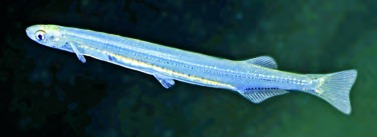
Galaxias maculatus
Common Jollytail (also Common Galaxias)
Species Summary
The most common and widespread galaxiid in Australian and New Zealand waters, Galaxias maculatus has a far broader range still: of Gondwanan origin, it occurs with no recognisable difference right across the southern hemisphere, as far as the coastal streams of Chile and Argentina on the far side of the old supercontinent. With a marine larval stage estimated up to 20 weeks long in some regions, and little apparent reason for its scattered populations to have changed once conditions suited them, the species has stayed essentially the same fish on both the Pacific and Atlantic sides of a continental break-up that began tens of millions of years ago.
Etymology
The species name is Latin for “spotted,” referring to the numerous conspicuous spots and small, irregular transverse bars of black scattered over the body.
Etymology compiled from C. Scharpf (2019), “Fishes of Sahul: An Etymological Survey (Part 2)”, Fishes of Sahul 33(2): 1417–1439, and etyfish.org.
Distribution & Description
In Australia Galaxias maculatus is widespread from around Tasmania to Moreton Bay on the east coast and west to the south coast of Western Australia, travelling far inland wherever no waterfalls or other barriers block its way, and turning up in many large lakes that are landlocked at times. General body colour varies from greenish-grey to quite green, variably spotted from almost none to many dark spots that sometimes merge into indistinct barring; some landlocked populations show unusual colour forms, including juveniles that are bright green on capture but lose the hue within about a week in an aquarium, apparently a diet-related effect rather than a fixed trait.
Breeding
In diadromous populations the adults move downstream to spawn in autumn. At the largest tides of the month, eggs are deposited high on the banks among streamside vegetation near the sea; as the water retreats over the following days the eggs develop out of water, and the next round of big tides carries the newly hatched fry out to sea. They return the following spring and early summer as the transparent, silvery post-larval stage known as whitebait, moving into coastal streams in large numbers. Some landlocked populations breed on the same broad pattern but substitute a lake for the sea, with adults moving from feeder streams into open water where the larvae can feed on lake plankton before returning as juveniles.
Remarks
Few Australian fishes carry a longer paper trail of scientific names than Galaxias maculatus — at least eighteen names have been proposed for it since 1842 alone, from Victoria, New South Wales, New Zealand and Chile, all now recognised as the one wide-ranging species. During the Millennium Drought, Lake Colac in western Victoria dried to little more than a putrid puddle by January 2009, its main tributary littered with dead ducks; when rain finally returned that autumn, both this species and the Spotted Galaxias (Galaxias truttaceus) recolonised the refilling creek within months, and by the following summer Common Jollytail had become abundant enough to be caught with almost every scoop of a hand net through the lake’s shallows — a striking demonstration of how quickly the species can rebound once conditions allow.
Compiled for Home of the Rainbowfish from ANGFA sources: R. H. Kuiter, “Galaxias maculatus — common jollytail”, Fishes of Sahul 23, 2009, pp. 518–520.