

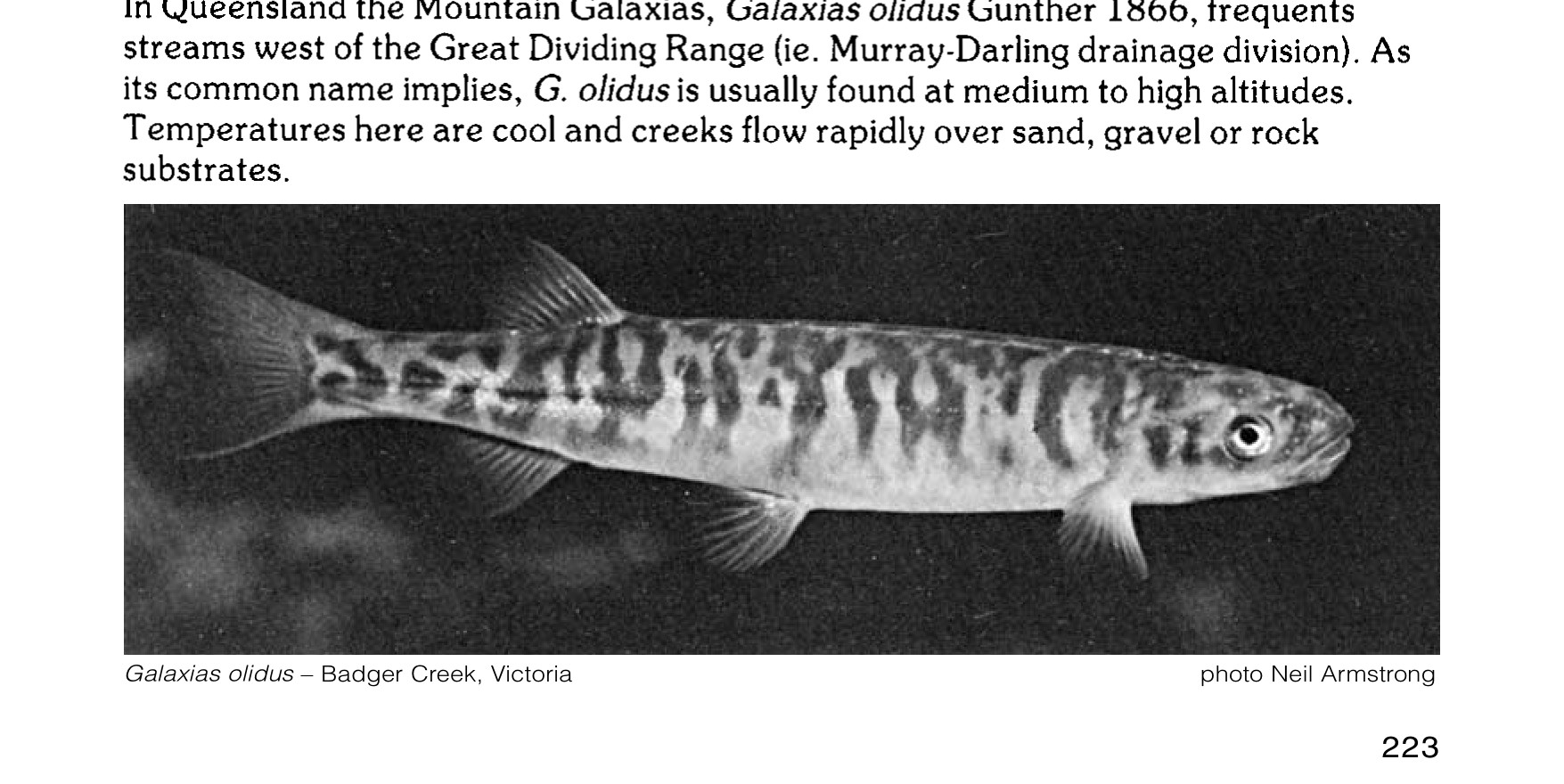
Galaxias olidus
Mountain Galaxias
Species Summary
A small, widespread native fish found in creeks and rivers on both sides of the Great Dividing Range, from southern Queensland through New South Wales, the Australian Capital Territory and Victoria to the Adelaide Hills of South Australia, occupying everything from lowland streams to alpine creeks. Galaxias olidus grows to about 135 mm but is usually seen at 60–70 mm, and feeds on a wide variety of aquatic and terrestrial insects and other small animals, in turn forming an important food source for trout and other angling species.
The taxonomy of the Mountain Galaxias has long been unsettled. A 1981 revision lumped several previously distinct forms — among them the Barred Galaxias, see the Galaxias fuscus account — into this one species, treating it as a single, if highly variable, taxon. Renewed taxonomic and genetic work beginning in 2001 found at least six consistently different forms in Victoria alone, and a formal 2014 revision (“Fifteen from one”, T. A. Raadik, Zootaxa 3898) split the group into more than a dozen newly recognised species, several of which appear alongside Galaxias olidus itself in the same 2019 etymological survey used throughout this section. This account covers the “Mountain Galaxias” broadly, in the sense used by most of the older sources it draws on.
Etymology
The species name means “smelly,” though Günther never explained the allusion. Oddly, freshly preserved modern specimens are not known to carry any distinctive odour, and the holotype today smells only of preservative; one theory holds that the liquid it was originally preserved in, or later transferred to, may itself have had a strong smell at the time of the original description.
Etymology compiled from C. Scharpf (2019), “Fishes of Sahul: An Etymological Survey (Part 2)”, Fishes of Sahul 33(2): 1417–1439, and etyfish.org.
Description
Colouration varies considerably across its huge range. Queensland fish, for instance, are golden tan dorsally and laterally with irregular chocolate-brown blotches over the dorsal half of the body, fading to pale grey-white on the belly.
Keeping & Caring
Galaxias olidus tolerates capture and transport with little apparent stress, and has been seen feeding on insect larvae in a bucket only seconds after being netted. It adapts quickly to captivity and eats all manner of live, frozen and dried food voraciously, becoming tame enough to swim to the front of the tank and nibble at a keeper’s fingers — a school of adults makes an excellent aquarium display. Aquaria must be very well covered, as they will jump through the smallest gap, and fish can be initially frightened by lights being switched on or off, a response that settles once they learn to associate the light with feeding. Queensland populations show a particular sensitivity to warmth: at around 29 °C the vertebral column just behind the head can distort in some individuals, bending the head down into a “Concorde-like” profile, after which the fish stop eating and die, apparently without recovering — a real problem for keeping this species through summer in warm cities like Brisbane, where keeping the tank low to the floor (where it is cooler) has helped.
Breeding
Sexes can be told apart by build: males remain pencil-thin even when large, while females are noticeably deeper-bodied, with gravid individuals showing a distended abdomen from their large ovaries. The whole population in a given stream appears to spawn more or less simultaneously, since juveniles caught at any one time are consistently a similar size. There is no evidence of any migration to the sea for breeding, unlike some other galaxiids — a fish spawning in the upper Condamine River and travelling to the ocean via the Darling and Murray would face a one-way trip of over 3,500 km. One gravid female examined in the field carried around 345 large ova (1.5 mm) plus a second band of several hundred much smaller, undeveloped ova (0.35 mm) in the same ovaries, suggesting the species spawns twice in a season: once not long after the large batch matures, and again later once the smaller batch has developed. A group of wild-caught adults entered in a fish show in a naturalistically planted tank were observed group spawning by darting rapidly beneath leaf litter within a day of being caught.
Remarks
Despite scattered old reports of Galaxias found burrowed into damp soil, controlled experiments draining water slowly from aquaria holding Galaxias olidus found no evidence of true aestivation: fish began dying within a day of the water disappearing, showing no burrowing behaviour and no drop in activity or breathing rate, even under cover of leaf litter. This stands in sharp contrast to the Salamanderfish (Lepidogalaxias salamandroides) of south-western Australia, still the only Australian freshwater fish confirmed to aestivate in the true sense.
Compiled for Home of the Rainbowfish from ANGFA sources: M. A. Rimmer & J. R. Merrick, “Preliminary studies on the capacity to aestivate in the mountain galaxias (Galaxias olidus)”, Fishes of Sahul 2, 1984, pp. 58–60; J. Marshall, “Galaxias olidus in southern Queensland”, Fishes of Sahul 5, 1989, pp. 223–225; and T. A. Raadik, “When is a Mountain Galaxias not a Mountain Galaxias?”, Fishes of Sahul 15, 2001, pp. 785–789.