

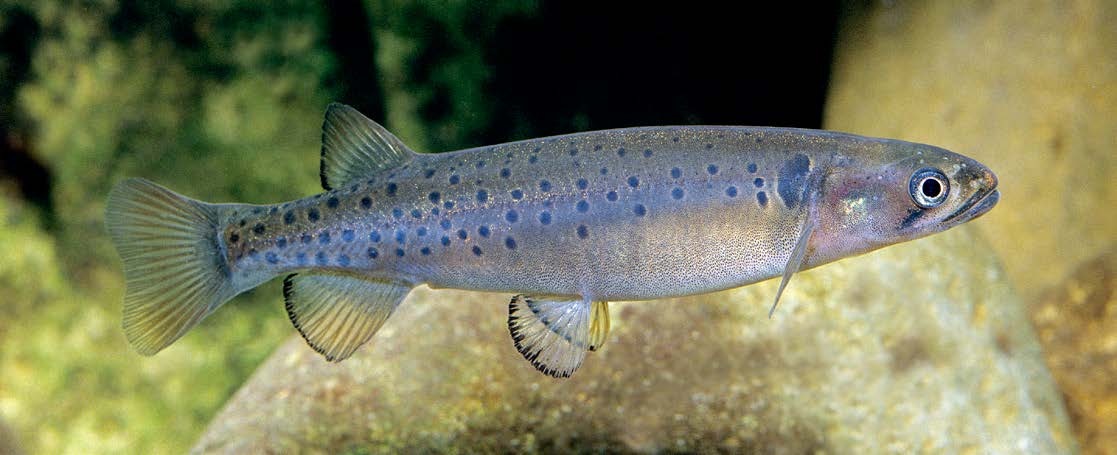
Galaxias truttaceus
Spotted Galaxias (also Trout Galaxias)
Species Summary
Widely regarded as the most beautiful of the Australian galaxiids, Galaxias truttaceus is also one of the largest, growing to at least 250 mm, and one of the most aggressive, with the old common name “Mountain Trout” describing both its appearance and its predatory behaviour.
Etymology
Cuvier proposed the genus Galaxias in 1816 based on a species he called Esox truttaceus, but gave no description or diagnostic characters, leaving the name a nomen nudum. Authorship of Galaxias truttaceus instead belongs to Cuvier’s student and successor Achille Valenciennes, who validly described the Spotted Galaxias under that name in 1846, noting that “the rounded shape of the body and the arrangement of spots make it look like” a small trout — truttaceus being Latin for “trout-like,” from trutta, trout.
Etymology compiled from C. Scharpf (2019), “Fishes of Sahul: An Etymological Survey (Part 2)”, Fishes of Sahul 33(2): 1417–1439, and etyfish.org.
Distribution & Habitat
Galaxias truttaceus occurs in Tasmania, Victoria, and small parts of South and Western Australia. It is widespread across all Tasmanian rivers, and in Victoria occurs in coastal drainages from the Genoa River in the far east to the South Australian border; the small Western Australian population is largely restricted to the Goodga, Angove and Kent Rivers near Albany and Denmark. Most populations are diadromous, migrating between fresh water and the sea, though isolated landlocked populations also exist in several Tasmanian lakes and Lake Colac in Victoria — two other Tasmanian galaxiids, G. auratus and G. tanycephalus, represent former Galaxias truttaceus populations that became landlocked and diverged into separate species within the last few hundred thousand years. Adults favour the margins of rivers, creeks and lakes, staying close to logs, plants or overhanging banks they can retreat to when disturbed, and are most active around dawn and dusk.
Conservation Status
Western Australian populations of Galaxias truttaceus are listed as Critically Endangered under the Commonwealth Environment Protection and Biodiversity Conservation Act 1999 and Endangered under Western Australia’s Wildlife Conservation Act 1950, reflecting their former recognition as a separate subspecies. While the species remains common in parts of its eastern range, it has disappeared from a large share of its former habitat elsewhere.
Keeping & Caring
An accomplished predator by galaxiid standards, Galaxias truttaceus has been fed earthworms up to 100 mm long, Gambusia, glass shrimp, dragonfly-larvae mudeyes and small fish to 50 mm, and readily takes adult brine shrimp, daphnia and tubifex too, though it responds poorly to prepared frozen foods; a 70 mm fish has been seen catch and eat a 30 mm Gambusia followed by two 50 mm earthworms in a single feed. It is a temperate species best suited to cool water, ideally 10–20 °C; while some individuals tolerate short spells up to 30 °C, most adults cope poorly above 25 °C and can die quickly and with little warning, so a chiller is close to essential through summer in warm climates. Kept well, however, it can live a long time: Neil Armstrong maintained one female, collected from Main Creek on the Mornington Peninsula, for nine years, during which she grew to over 20 cm and was comfortable even at mid-20s temperatures in summer. Like all scaleless fishes it is very sensitive to certain diseases, particularly velvet disease, and to some of the commercial treatments for it, so tanks need close monitoring during and after treatment. A tank mixing several Galaxias species of different sizes darting among driftwood, rocks and plants makes a rarely seen but spectacular native display; suitable cool-water tankmates include larger Pygmy Perch (Nannoperca spp.), and scavengers such as gudgeons or catfish are useful, since this species does a poor job of cleaning up food that reaches the substrate.
Breeding
Adult and juvenile Galaxias truttaceus show no reliable external differences between the sexes, though fish kept for six months or more sometimes show a visibly enlarged belly, strongly suggestive of egg production, in females. Diadromous populations breed in freshwater through autumn and winter; 1,000–16,000 small adhesive eggs are laid amongst dense submerged vegetation, hatching after about four weeks into larvae 6.5–9.0 mm long, which are washed out to sea and grow for several months before returning to estuaries in spring as whitebait, 45–65 mm long. Landlocked Victorian and Tasmanian populations instead spawn in spring after migrating to feeder streams, with larvae completing their pelagic stage in lakes rather than the sea, while landlocked Western Australian populations migrate upstream within rivers to spawn in mid-to-late autumn.
Remarks
During the Millennium Drought, Victoria’s Lake Colac dried to a putrid, shallow pool by January 2009, and it seemed likely every native fish in the system had been lost. Autumn rains that year slowly refilled the lake, and by summer both Galaxias truttaceus and the Common Jollytail (G. maculatus) had recolonised the reviving Barongarook Creek in numbers — though the Galaxias truttaceus recorded there afterwards looked distinctly different from coastal-stream fish nearby, paler and more silvery, with dramatic juvenile banding not usually seen at that size in coastal populations, illustrating just how much this species’ appearance can vary between even fairly close populations.
Compiled for Home of the Rainbowfish from ANGFA sources: A. Caughey, “Some aquarium notes on Galaxias truttaceus”, Fishes of Sahul 7, 1992, p. 319; and D. Shoesmith, N. Romanowski, G. Briggs, P. J. Unmack & C. Scharpf, “Fish in focus: Spotted Galaxias Galaxias truttaceus (Galaxiidae)”, Fishes of Sahul 33(2), December 2019, pp. 1509–1518.