

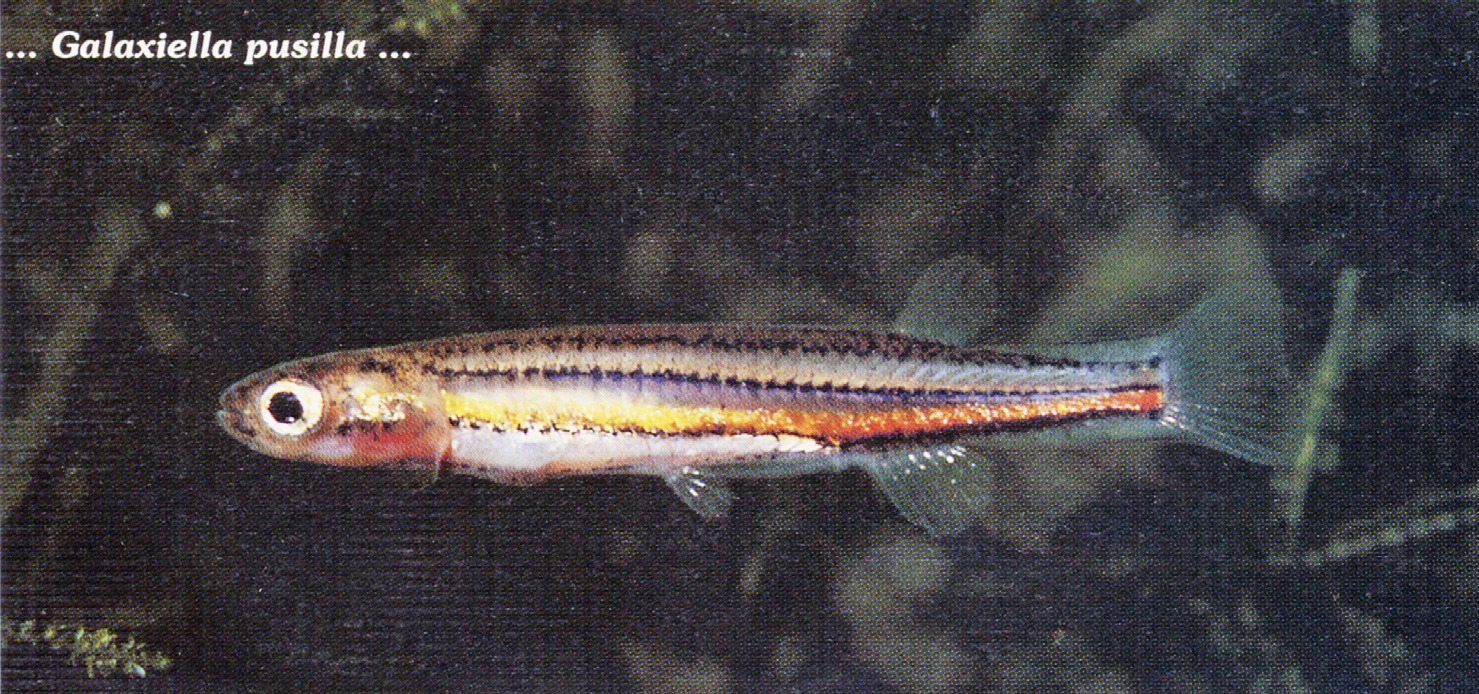
Galaxiella pusilla
Dwarf Galaxias (also Eastern Dwarf Galaxias)
Species Summary
One of Victoria’s smallest freshwater fishes, Galaxiella pusilla has been the subject of more ANGFA coverage than almost any other small native, tracking both its natural history and a decades-long conservation struggle around Melbourne. Males are strikingly coloured, with a bright red-orange stripe down the flank flanked by two black lines; females are silver-grey all over. Maximum length is about 45 mm for females and 35 mm for males — the marked size and colour difference between the sexes is not known from any other galaxiid species.
Etymology
The genus name Galaxiella uses the diminutive suffix -iella, referring to the small size of its three species (all under 47.5 mm). The species name is Latin for “very small,” the original type specimen having been described at just 31 mm.
Etymology compiled from C. Scharpf (2019), “Fishes of Sahul: An Etymological Survey (Part 2)”, Fishes of Sahul 33(2): 1417–1439, and etyfish.org.
Distribution & Habitat
Galaxiella pusilla is found in coastal Victoria from the Mitchell River in Gippsland west to drains in the south-east of South Australia, plus north-western Tasmania and Flinders Island in Bass Strait. It favours still or slow-flowing water — swamps, drains and the backwaters of creeks and streams — typically shallow and overgrown with aquatic plants, and often in habitat that dries up partially or completely over summer. In large pools it stays close to marginal vegetation, rarely venturing into open water; juveniles gather in loose groups of up to twenty, while adults tend to be more solitary.
Breeding
Spawning happens in late winter and early spring, when habitat is at its most extensive. A ripe female is typically attended by two or three males; she and one male select an egg-laying site, usually the underside of a leaf, and she deposits her eggs singly, swimming forward under the leaf and rolling quickly to lay each one, with the male following to fertilise it. Pair bonds last only moments — males move straight on to the next ready female — and a female may spawn several times a day over an extended period, laying perhaps ten eggs daily out of a total of 150–200. Eggs are 0.7–0.8 mm unfertilised, swelling to 1.1–1.3 mm once fertilised, becoming eyed after five to six days and hatching after 10–14 days at 16–21 °C; larvae emerge tail-first, 4.2–4.8 mm long, absorb their yolk sac within three days and then congregate near the surface. Wild fish are thought to be largely annual, living only one to two years, though some captive fish have been recorded delaying maturity and living for close to two.
Keeping & Caring
A handsome, diminutive species that is easy to keep and breed given care during collection, since it damages easily when handled roughly. It should not be housed with larger or more aggressive fish and generally does best kept by itself, though the Southern Pygmy Perch is safe company and is often caught alongside it in the wild. A thickly planted, gently aerated tank kept slightly acid (around pH 6.0–6.8) suits it well, and it is best fed live food — brine-shrimp nauplii are particularly good conditioning food ahead of spawning, alongside mosquito wrigglers and small cladocerans. Colonies are readily maintained in outdoor ponds, where breeding populations have been kept successfully for decades at a time. Note, however, that Galaxiella pusilla is listed as threatened federally and in most of the states where it occurs, and collecting or keeping it without a permit is illegal in several jurisdictions.
Remarks
The species’ decline around Melbourne has been tracked in detail since the 1990s. By 1993 only four populations remained in the Port Phillip Bay drainage, and by the mid-1990s the noxious mosquitofish (Gambusia holbrooki) had eliminated or was actively invading most of what was left, creek by creek and population by population, despite occasional local rescue efforts. There have been better signs since: a large remnant population discovered in a suburban table drain at Narre Warren South in the mid-2000s, right in the path of one of Melbourne’s fastest-growing outer suburbs, became a long-running ANGFA Victoria conservation project, and the species is now understood to be more resilient than once feared — surviving harsh dry spells that wipe out invasive gambusia, then reappearing in force once conditions improve. It is also strongly suspected of being able to aestivate through dry summers, sheltering in the burrows of freshwater crayfish or beneath drying leaf litter and soil; fish have been recovered, apparently unharmed, from beneath a soil-filled plant tray on cracking clay in air temperatures around 40 °C, reviving within hours once returned to water. One western Victorian population has also produced a striking, unexplained “bump-headed” deformity in both sexes, suspected to be caused by a parasite affecting only that population — a reminder of how much about this tiny fish’s biology is still being worked out.
Compiled for Home of the Rainbowfish from ANGFA sources: G. N. Backhouse, “The dwarf galaxias, Galaxiella pusilla (Mack, 1936) in Victoria”, Fishes of Sahul 1, 1983, pp. 5–8; P. J. Unmack & G. J. Paras, “Galaxiella pusilla: around Melbourne, going going, nearly gone”, Fishes of Sahul 9, 1995, pp. 398–400; N. Romanowski, “Notes on dwarf galaxias Galaxiella pusilla”, Fishes of Sahul 18, 2004, pp. 80–86; R. H. Kuiter, “More on dwarf galaxias”, Fishes of Sahul 19, 2005, pp. 161–163; and T. Tucceri, “Conservation of Galaxiella pusilla re-visited”, Fishes of Sahul 26, 2012, pp. 694–700.
References
- Backhouse G.N. and R.W. Vanner (1978) Observations on the biology of the Dwarf Galaxiid, Galaxiella pusilla. Victorian Naturalist 95: 128-132.
- Beck R.G. (1985) Field observations upon the Dwarf Galaxiid (Galaxiella pusilla) in the south-east of South Australia. South Australian Naturalist 60(1): 12-22.
- Humphries P. (1986) Observations on the ecology of Galaxiella pusilla in Diamond Creek, Victoria. Proceedings of the Royal Society of Victoria 98: 133-137.