

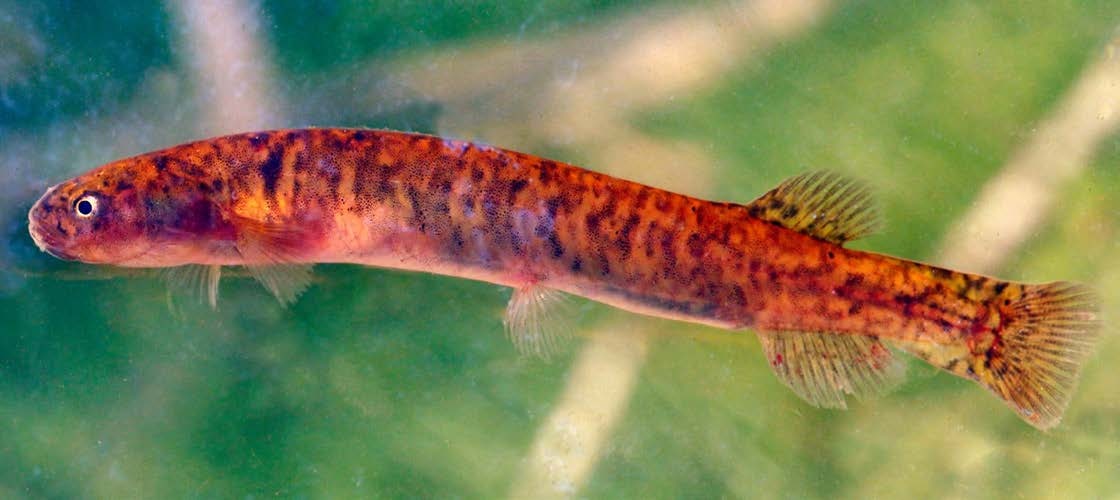
Neochanna cleaveri
Tasmanian Mudfish
Species Summary
A slender, eel-like galaxiid with a talent for surviving out of water, Neochanna cleaveri was long thought confined to Tasmania before mainland Victorian populations began turning up from the 1980s onward, including one memorable accidental find in a Gippsland dip-net sample of far more familiar fish.
Etymology
The genus name Neochanna combines the Greek neo-, new, with Channa, the genus of Asian snakeheads, several of which — like the New Zealand type species N. apoda — likewise lack pelvic fins. The species name honours Mr. F. Cleaver of West Ulverstone, Tasmania, who discovered the type specimen burrowed inside the root of a eucalypt, where it had been aestivating.
Etymology compiled from C. Scharpf (2019), “Fishes of Sahul: An Etymological Survey (Part 2)”, Fishes of Sahul 33(2): 1417–1439, and etyfish.org.
Description
An elongate, scaleless body, brown overall with irregular mottling, a single dorsal fin, small ventral fins (absent altogether in some New Zealand relatives), a rounded caudal fin with strongly developed flanges, and a blunt, rounded head with small eyes and obvious tubular nostrils in adults. Movement has been described as distinctly eel-like — fittingly, an early name proposed for the species was Saxilaga anguilliformis, “eel-shaped.” It grows to about 14 cm, and is the smallest species that takes part in Tasmania’s whitebait runs, entering fresh water at only 30–35 mm.
Distribution & Habitat
Recorded around coastal Tasmania, most commonly in the tannin-stained, acidic waters (pH 6.0 or lower) of the Henty and Pieman Rivers on the west coast and the Huon and Lune Rivers in the south-east, Neochanna cleaveri has also been found on the Australian mainland since the 1980s, with records from the Yarra River, Wilsons Promontory, the Otway Ranges and South Australia. Mainland records remain scarce, likely because its preferred habitat of coastal swamps with estuarine influence is difficult country to survey. One notable mainland record came in May 2009, when a fish survey of the Lang Lang River in South Gippsland turned up an unfamiliar mottled fish mixed in among a routine catch of Common Galaxias; only after briefly (and almost fatally, for scientific record-keeping purposes) mistaking it for a parasite-riddled specimen and nearly dissecting it did the collector realise he was looking at something unusual, later confirmed by genetic authority Tarmo Raadik as a new record of Tasmanian Mudfish well outside its known range.
Breeding & Aestivation
Spawning is thought to occur in winter, producing several thousand small eggs; as with other diadromous galaxiids, the larvae appear to spend some months at sea before returning to fresh water as juveniles, and no non-migratory, fully landlocked population is known. The species’ standout trait, though, is its ability to survive the drying of its habitat by burrowing into soft substrate beneath a log or rock and entering a semi-torpid state for weeks at a time, keeping cool and moist rather than fully desiccating. Unlike true aestivators it does not spin a protective mucous cocoon, and it responds fairly readily to being touched or exposed, becoming mobile again within moments; nitrogenous waste is thought to be excreted as urea during this period, similarly to some aestivating invertebrates, with oxygen absorbed through the skin. This adaptation is presumed to let the species occupy habitat that predatory fish simply cannot reach.
Remarks
In captivity the species rapidly loses its schooling instinct and becomes reclusive, hiding by day and emerging mainly to feed, readily taking freeze-dried food, particularly tubifex worms; reduced eye size and its daylight-hiding habit both point to a largely nocturnal lifestyle. In Victoria it is listed as threatened under the state’s Flora and Fauna Guarantee Act 1988.
Compiled for Home of the Rainbowfish from ANGFA sources: W. Fulton, “The Tasmanian mudfish Galaxias cleaveri Scott”, Fishes of Sahul 4, 1986, pp. 150–151; and P. Littlejohn, “A rare find from the Lang Lang River — Neochanna cleaveri”, Fishes of Sahul 26, 2012, pp. 668–672.