

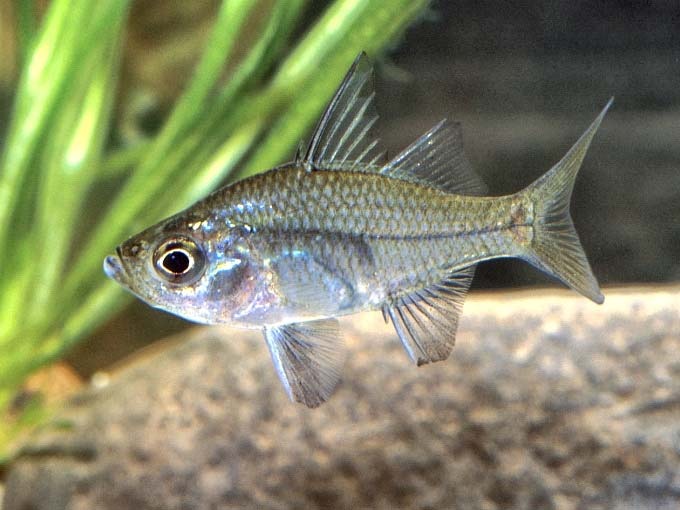
Ambassis agassizii
Agassiz’s Glassfish (also Olive Perchlet, Agassiz’s Perchlet, Western Chanda Perch)
Species Summary
The genus Ambassis comprises small, spinous-finned fishes of the family Ambassidae, ranging from India to Australasia; roughly two-thirds of its species live in fresh water and the rest mostly in coastal seas and estuaries. Most are translucent across the back and tail, the trait behind the common name “glassfish”. Six species occur in Australian fresh waters — Ambassis agassizii, A. agrammus, A. elongatus, A. macleayi and A. miops — alongside at least two further undescribed forms that don’t fit the existing identification keys, plus a separate group of six species shared between estuaries and fresh water. Ambassis agassizii is a small, near-transparent member of the genus reaching about 6–7 cm, though more commonly seen around 5 cm.
Distribution & Habitat
Ambassis agassizii was historically recognised as two separate species: an eastern population — once described as A. nigripinnis — in coastal drainages from the Bellinger River in northern New South Wales north to the Mossman River in Queensland (also Fraser Island, North Stradbroke Island, and reported from the Mitchell River in the Gulf of Carpentaria), and a western population through tributaries of the Murray–Darling system in western Queensland, western New South Wales, northern Victoria and south-eastern South Australia. Although the two are no longer treated as distinct species, genetic studies to confirm how closely related the populations really are have not yet been completed, and they are thought likely to prove genetically distinct. Where its range overlaps other Ambassis species in north-eastern Australia, especially towards the north, it can be difficult to separate from its relatives on sight, and the true northern limit of the species in Queensland remains uncertain.
The species favours a wide range of freshwater habitats: still or slow-flowing sections of lowland and upland rivers and streams, small coastal creeks, dune lakes on Fraser and North Stradbroke Islands, ponds, swamps and river impoundments, generally wherever there is dense submerged or emergent vegetation or woody structure for cover. It appears to make upstream migrations triggered by rises in flow. Northern populations tolerate water temperatures of roughly 12–36 °C, southern coastal populations 11–28 °C, and inland Murray–Darling populations sometimes below 10 °C.
The Murray–Darling population has declined sharply. It was once widespread through the Lachlan, lower Murrumbidgee and lower Murray Rivers and the wider Darling drainage, but is now largely restricted to a handful of localities in the Darling drainage upstream of Bourke, with no confirmed record from the lower Murray or lower Darling in any New South Wales survey since the 1960s. It remains reasonably secure only in the Queensland/New South Wales corner of the system, in the Dumaresq and Warrego Rivers and parts of the Condamine, Severn and MacIntyre Rivers. It is regarded as extinct in Victoria (last recorded 1922), and the last confirmed record from the South Australian section of the Murray was a single fish in 1986. The IUCN Red List currently classes the species as Data Deficient.
Description
An oval-bodied, laterally compressed fish, appearing almost transparent, silvery overall and often with a yellowish tinge, the scale edges outlined in dark pigment. Two dorsal fins sit close together, and the mouth and eyes are both relatively large. The sexes look alike at a glance; the more reliable difference is internal, in the shape of the line where the dorsal edge of the gonads meets the abdominal wall near the swim bladder — rounded in females, straight in males, and most obvious in fish in spawning condition.
Keeping & Caring
Ambassis agassizii is a microcarnivore, taking microcrustaceans, aquatic and terrestrial insects, small arachnids, very small fishes and occasionally algae. It has a reputation for being tricky in the aquarium, sometimes fading slowly over months for no obvious reason, and it can become agitated in cramped quarters. It does best in a reasonably large, well-planted aquarium, kept at roughly 22–28 °C, pH 6.0–7.5 and hardness of about 5–100 ppm.
Breeding
In the wild, males mature at around 34 mm and females at 37 mm, with most fish spawning for the first time at one year old (larger individuals up to 68 mm may not spawn until their second year, and females that don’t breed in their first year typically do so in their second). Like other ambassids, this is a multiple spawner, releasing eggs in one sitting or over several days and spawning again some weeks later, generally at water temperatures of 19–34 °C; New South Wales populations spawn mainly in November and December once the water reaches about 23 °C, with a female capable of producing 2,000 or more eggs, scattered loosely among vegetation. Eggs hatch in 12–36 hours at 20–29 °C into poorly developed larvae; a pro-larval stage lasts about 10 days, after which growth is rapid — roughly 13 mm at 30 days, 25 mm at 80 days and 35–40 mm total length by around 150 days. The species is thought to live for about four years.
In the aquarium, courtship involves the male showing sustained interest in females, swimming up to and around each one in turn before eventually chasing a receptive female into aquatic plants; raising the temperature towards 28 °C tends to bring the fish into more active breeding condition. A steady supply of appropriately sized live crustaceans and small aquatic insects, alongside suitable water conditions, appears important for consistent breeding success. Rearing the larvae is the harder part: their preferred natural foods aren’t practical to culture, so the usual approach is to start them on infusoria with a little phytoplankton (green water) added, which both feeds the smallest larvae directly and helps keep the infusoria themselves nutritious for longer. As larvae grow they can move on to live brine shrimp nauplii, vinegar eels or microworm (smaller larvae continue on infusoria while larger ones switch across), taking small insect larvae too by this stage, and are generally eating adult foods by about six weeks old.
One of the earliest documented captive breedings, reported in 1984, followed a simple formula: two males and four females in a bare 600 × 600 × 400 mm aquarium over dark gravel, planted along the back and sides with Limnophila indica and left unfiltered, in aged Brisbane tap water (hardness 75 ppm, pH 7.0) at 20–25 °C. A dominant male coloured up and displayed in front of the females, leading a receptive one into the plants to spawn side by side in typical egg-scatterer fashion; the eggs are tiny and easiest to spot at night with a torch shone through the glass. Fry began appearing about nine days after the adults were removed, taking finely strained hard-boiled egg yolk and infusoria at first and moving on to newly hatched brine shrimp from about day 24, reaching 12 mm by 60 days and maturity at around 11 months. The same account notes the species is not uncommonly found in brackish stretches of Australian rivers, with the largest specimens often turning up where some salt is present, and suggests a pinch of aquarium salt (roughly a teaspoon per 20 litres) can benefit captive fish.
Remarks
Ambassis agassizii carries several junior synonyms reflecting a confused early taxonomic history, including A. castelnaui, A. pallidus and A. nigripinnis — the last of these, described by Ogilby in 1910, was for a long time the name used for the species’ eastern population and still turns up in older Australian aquarium literature under the common name Olive Perchlet. Other common names in use include Agassiz’s Perchlet and Western Chanda Perch.
Compiled for Home of the Rainbowfish from ANGFA sources: A. R. Tappin, “Agassiz’s Glassfish Ambassis agassizii”, In-Stream 23(12), December 2014, p. 17; “Ripples & Reflections: Ambassis agassizii”, In-Stream 13(4), August 2004, p. 14; and R. Leggett, “The Olive Perch Ambassis nigripinnis”, Fishes of Sahul 1(3), 1984, pp. 29–30.
References
- Allen G.R. and W.E. Burgess (1990) A review of the glassfishes (Ambassidae) of Australia and New Guinea. Records of the Western Australian Museum, Supplement 34: 139-206.
- Allen G.R., S.H. Midgley and M. Allen (2002) Field Guide to the Freshwater Fishes of Australia. Western Australian Museum.
- Herbert B.W., J.A. Peeters, P.A. Graham and A.E. Hogan (1995) Freshwater fish and aquatic habitat survey of Cape York Peninsula. Cape York Peninsula Land Use Strategy (CYPLUS), Brisbane.
- Llewellyn L.C. (2008) Observations on the breeding biology of Ambassis agassizii Steindachner, 1867 (Teleostei: Ambassidae) from the Murray Darling Basin in New South Wales. Australian Zoologist 34(4): 476-498.
- Pusey B.J., M.J. Kennard and A.H. Arthington (2004) Freshwater Fishes of North-Eastern Australia. CSIRO Publishing, Victoria.