

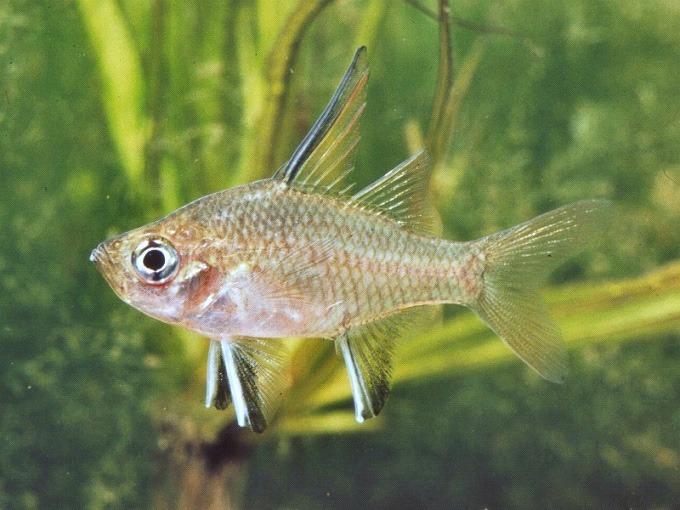
Ambassis agrammus
Sailfin Glassfish
Species Summary
A small glassfish to about 6–7 cm, Ambassis agrammus is largely transparent with a yellowish tinge across the back and a silvery sheen on the head and sides, the scales outlined to give a fine network pattern. The two closely set dorsal fins are mostly clear, with a dark blotch on the membrane between the second and third spines; the anal and pelvic fins each carry a broad blackish band across their outer portion. The sexes look alike outwardly, with no reliable colour or shape differences reported between them — the only practical way to sex a pair is to watch their behaviour at spawning time.
Distribution & Habitat
Ambassis agrammus has a wide but disjointed distribution across three main areas: the Kimberley region of Western Australia and the Northern Territory coast east to the Gulf of Carpentaria, Cape York Peninsula and down the Queensland coast to around the Burdekin River, and central-southern New Guinea in drainages flowing to the Arafura Sea and Gulf of Papua — with some differences in fin-ray counts distinguishing the Australian and New Guinea populations. Because it can be easily confused with other Ambassis species, its true distribution across northern Australia remains somewhat uncertain, and unidentified Ambassis specimens from the King Edward and Fitzroy Rivers in the Kimberley, at one point attributed to this species, are now thought to belong to the separate, still-undescribed north-west form.
It inhabits still or slow-flowing water with abundant submerged or emergent vegetation, or snags and similar cover, and is often abundant in large billabongs. It tolerates an unusually wide range of conditions — water temperatures of 24–41 °C, pH 4.5–9.1 and conductivity of 4–160 µS/cm — consistent with its broad range, and rising salinity may trigger it to move upstream into fresher water.
Keeping & Caring
The diet consists mainly of microcrustaceans, aquatic and terrestrial insects, small arachnids and algae, with small fishes taken occasionally; the balance varies considerably by locality, with microcrustaceans (particularly cladocerans and copepods) dominant in some populations and aquatic insects, especially chironomid, trichopteran and mayfly larvae, more important in others.
Breeding
Ambassis agrammus has a well-defined breeding season running from the late dry season into the early wet season, mostly beginning once the wet season sets in; a rise in temperature alone does not appear to trigger spawning, which in the wild occurs at 28–32 °C, somewhat cooler in the aquarium at 25–29 °C. Spawning takes place among aquatic vegetation over a number of consecutive days, with batches of five to 250 small, spherical, adhesive eggs (0.50–0.56 mm across) laid at a time depending on the size of the female. Eggs hatch in 19–23 hours at 27–35 °C into poorly developed, inactive prolarvae only 1.5 mm or so long, which begin feeding about three days later once their yolk sac is absorbed. Sexual maturity comes within the first year, probably at eight to nine months, at a small size — around 26–27 mm for wild fish, while aquarium-reared fish have first bred at 30 mm and three months old. Few wild individuals are found larger than 60 mm, suggesting most adults live only about a year and few reach two.
As with other glassfishes, rearing larvae is the more demanding part of breeding this species in captivity, since their preferred natural foods are impractical to culture. Start newly hatched fry on infusoria, ideally with a little green water (phytoplankton) added, which both feeds the smallest larvae directly and helps the infusoria itself stay nutritious for longer. As the fry grow, live brine shrimp nauplii, vinegar eels or microworm can be introduced — the smallest larvae will continue taking infusoria while larger ones switch across, also beginning to take small insect larvae — and by around six weeks old the fry should be ready for ordinary adult foods.
Compiled for Home of the Rainbowfish from ANGFA sources: A. R. Tappin, “Ambassis agrammus Günther 1867: Sailfin Glassfish”, In-Stream 20(9), September 2011, p. 19, and expanded as “Ambassis agrammus, Günther 1867, Sailfin Glassfish”, In-Stream 22(12), December 2013, p. 15.
References
- Allen G.R. and W.E. Burgess (1990) A review of the glassfishes (Ambassidae) of Australia and New Guinea. Records of the Western Australian Museum, Supplement 34: 139-206.
- Allen G.R., S.H. Midgley and M. Allen (2002) Field Guide to the Freshwater Fishes of Australia. Western Australian Museum.
- Bishop K.A., S.A. Allen, D.A. Pollard and M.G. Cook (2001) Ecological studies on the freshwater fishes of the Alligator Rivers Region, Northern Territory: autecology. Supervising Scientist Report 145, Supervising Scientist, Darwin.
- Morgan D., M. Allen, P. Bedford and M. Horstman (2004) Fish fauna of the Fitzroy River in the Kimberley region of Western Australia. Records of the Western Australian Museum 22: 147-161.
- Morgan D., M. Sefton, D. Cheinmora, G. Charles and P. Nulgit (2005) Fishes of the King Edward and Carson Rivers. Report to Land & Water Australia.
- Pusey B.J., M.J. Kennard and A.H. Arthington (2004) Freshwater Fishes of North-Eastern Australia. CSIRO Publishing, Victoria.