

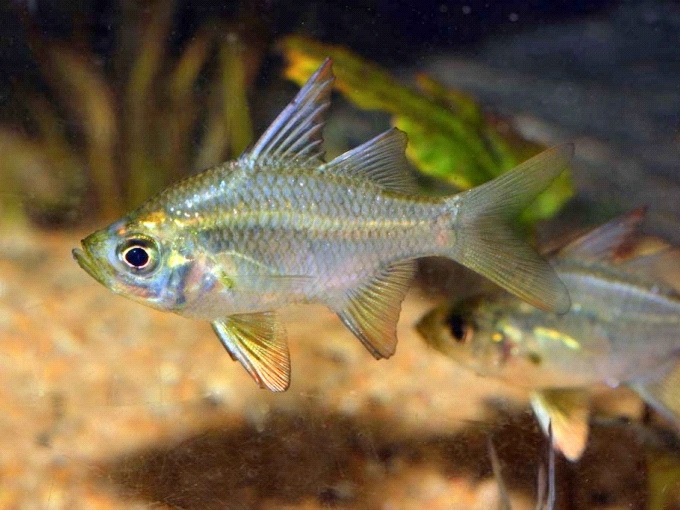
Ambassis macleayi
Macleay’s Glassfish (also Reticulated Perchlet)
Species Summary
Ambassis macleayi is a small, semi-transparent glassfish to about 8–10 cm, its two adjoining dorsal fins and oval, laterally compressed body typical of the genus. A network of dark-edged scales gives the body a distinctive reticulated pattern, the source of one of its common names. It can be told apart from similar-looking relatives by its relatively deep body, a dark patch at the base of the pectoral fin, an interrupted lateral line and a comparatively high gill-raker count; males and females look alike, though males tend to grow a little larger.
Distribution & Habitat
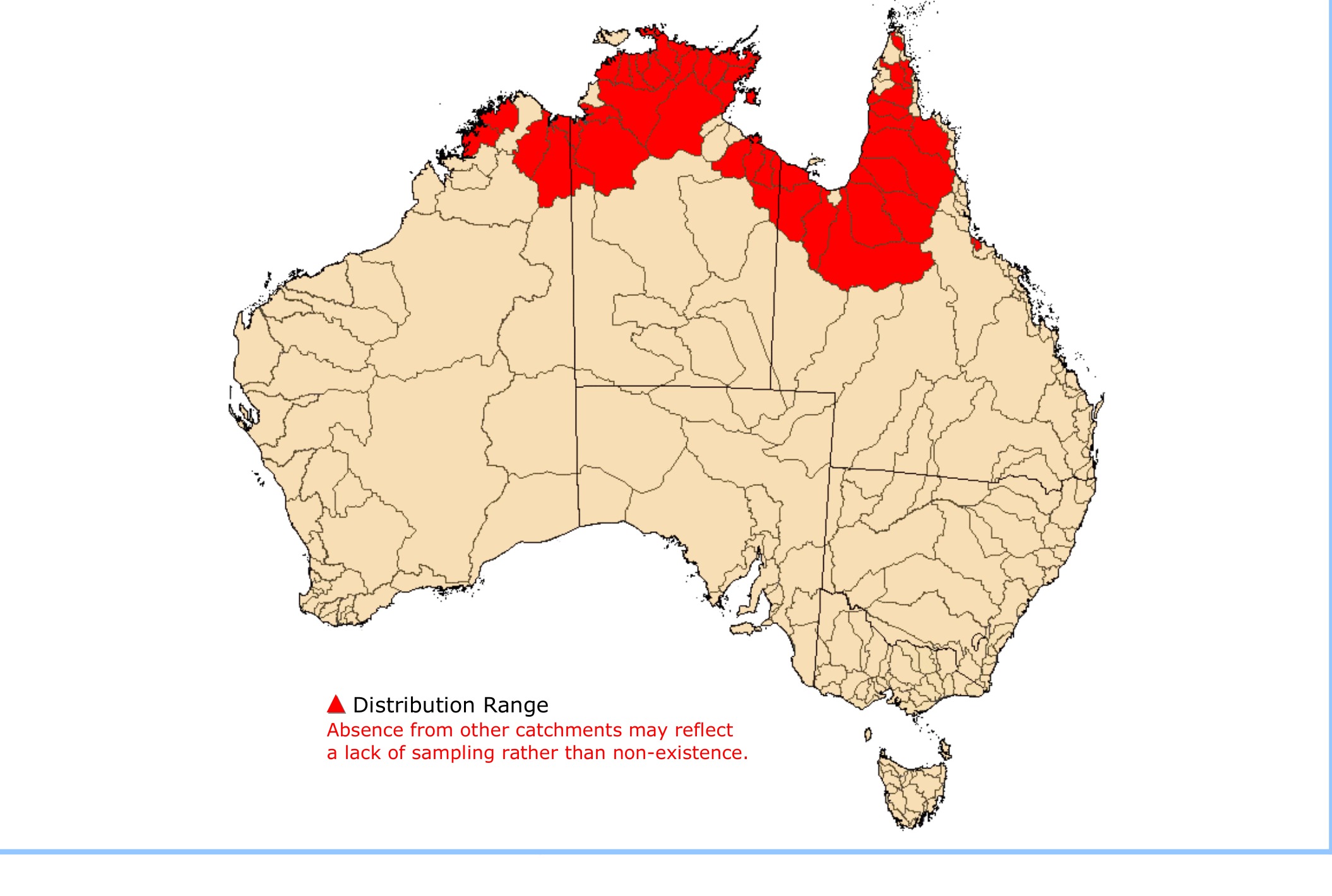
Ambassis macleayi is found through the Gulf of Carpentaria and Timor Sea drainages of northern Australia and in rivers of southern Papua New Guinea, sharing much of its range with A. agrammus, alongside which it is often collected schooling together. It favours still or slow-flowing water with dense submerged or emergent vegetation, or snags and other cover, in backflow billabongs, corridor waterbodies and floodplain billabongs. Its tolerance for a wide range of conditions matches its broad distribution: water temperatures of 23–38 °C, pH 4.8–7.7 and conductivity from 2 to 620 µS/cm have all been recorded.
Keeping & Caring
In the wild, microcrustaceans (mostly cladocerans and copepods) and aquatic insects (chironomid and baetid larvae and pupae) make up the bulk of the diet, with traces of algae, aquatic arachnids, larger crustaceans, small fishes, plant material and detritus also recorded. In the aquarium it feeds readily at any depth, taking food from the surface, midwater, plants or the substrate, and will actively chase down aquatic insects with sudden darting strikes, giving up quickly on prey that evades the first few attempts. It is active by both day and night but has not been observed feeding after dark, and when not feeding tends to hover motionless beside vegetation. When pursued it first swims to the far end of the aquarium and may leap clear of the water if cornered; if chased further it will dive into planted cover and wedge itself among the stems, raising its fins and gill covers to resist being dislodged.
Breeding
Courting pairs come together during the day and spawn at sunrise. The male approaches from behind and below, nudging the female’s anal fin and belly with his head; once paired, the two hover side by side near the bottom before rising together through the water, sometimes almost vertically to 15 cm above the weed, barely touching the vegetation as they go — it is thought eggs are released during these rises, since the highest concentration of eggs is found on the weed directly below where the activity took place. A pair may spawn on two to four consecutive mornings before resting for two to six weeks; small females produce as few as ten to thirty eggs at a time, larger females up to 250. The eggs are demersal, transparent, spherical and adhesive, 0.50–0.55 mm across once water-hardened, each carrying a single oil droplet that persists through the larval stage, and hatch in 21–23 hours at 25–28 °C. Newly hatched fry are barely 1.5–1.6 mm long and very poorly developed, but by three days old their mouth and gut are functional and they move off to feed; fry that fail to find suitable food die within four days. Under aquarium conditions eggs were also released in small numbers on the first day of a spawning bout, rising to as many as 200 or more by the second and third days, with the whole spawning period lasting about a week followed by a rest. At 26 °C, fry reach 30–34 mm by 80 days and 36–40 mm by 150 days, with the species first spawning at around three months old and 34 mm standard length.
Remarks
Where A. macleayi and A. agrammus occur together, as they do through the Alligator Rivers region, they can be seen schooling side by side with no obvious difference in behaviour — raising the question of what keeps the two closely related species from interbreeding. A deliberate cross-breeding attempt found the answer: a male A. agrammus placed with a gravid female A. macleayi released sperm normally but the female never spawned, and repeating the trial with a second female produced the same result. Comparing normal spawning under aquarium conditions showed why — A. macleayi consistently spawns around dawn, while A. agrammus spawns within an hour of sundown, a difference in timing alone apparently enough to keep the two species reproductively isolated even when sharing the same water.
Compiled for Home of the Rainbowfish from ANGFA sources: G. Semple, “Ambassis macleayi — maintenance, reproduction and development of the Reticulated Perchlet”, Fishes of Sahul 2(4), 1985, pp. 90–94; and D. Wilson, “Ambassis macleayi (Castelnau 1878)”, In-Stream 21(10), October 2012, p. 12.