

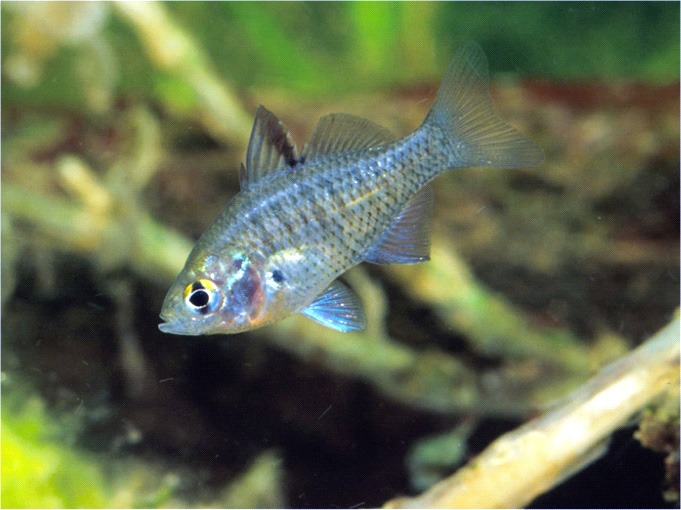
Denariusa australis
Pennyfish — still very widely known by its longstanding junior synonym, Denariusa bandata Whitley, 1948
Species Summary
A small, seldom-kept relative of the glassfishes, Denariusa australis could easily be mistaken at a glance for a young Ambassis in a brightly lit, sparsely planted tank. Given the conditions it prefers — plenty of plants, particularly floating cover, a dark substrate and background, and the company of its own kind — it colours up attractively: vertical black bars appear along the body, the fins take on a bluish tint, and the body ground colour becomes a pale greenish copper. It stays small, to about 50 mm, and shoals of it tend to shelter in planted cover, emerging into open water when left undisturbed.
Bandata or Australis? A Naming Puzzle
The valid name for this species has had an unusually tangled history, and Denariusa bandata remains the name most Australian aquarists still use for it. In 1867 Steindachner described Apogon australis from a collection said to be from the Fitzroy River at Rockhampton, Queensland — and for well over a century afterwards it sat, largely forgotten, as an obscure and poorly known apogonid (cardinalfish). No further specimens matching the description turned up, and later authors were unable to reconcile it with any real apogonid species; some simply included it in checklists without comment, others questioned whether it was an apogonid at all, and by 1989 a review of Australian fishes listed it among several names considered impossible to identify with confidence, the type specimens being missing or in poor condition.
The mystery was resolved in 1996, when researchers Ofer Gon and Barbara Herzig-Straschil tracked down Steindachner’s original two specimens in the Natural History Museum in Vienna — part of a large historical collection that had sat largely unstudied since the Second World War until reorganisation began in 1980. Despite their poor condition (both had dried out at some point), the specimens turned out not to be apogonids at all, but glassfishes of the genus Denariusa, differing from the familiar D. bandata in small details of the preorbital and preopercle bones. That finding meant Apogon australis (1867) had priority over the much later, better-known D. bandata (1948) — making Denariusa australis, technically, the correct name.
One puzzle remains only partly resolved: the type locality, the Fitzroy River at Rockhampton, lies more than 700 km south of the Murray Swamps near Cardwell, the southernmost point Denariusa is otherwise known from. Ichthyologist Gerald Allen has doubted the species truly occurs that far south and raised the possibility of a labelling error, though a check of the Vienna museum’s original 1866 accession records found no other Australian localities north of Rockhampton among that batch of specimens, which argues against a simple mix-up. Notwithstanding that loose end, D. bandata is now generally accepted as a junior synonym of Denariusa australis.
Distribution & Habitat
Denariusa australis is widely, if patchily, distributed across northern Australia — reported from as far east as the Barron River in Queensland across to the Darwin region in the Northern Territory — and into southern New Guinea. It is predominantly a wetland species, strongly associated with aquatic macrophytes, and is most often found in oxbow lakes, lagoons and other floodplain wetlands connected to river systems permanently, seasonally or only sporadically, as well as the still backwaters of rivers and swamps where semi-aquatic grasses, sedges and waterlilies grow thickly. Juveniles are frequently netted from weed beds in tropical streams and waterholes, though the species is rarely offered for sale even in shops specialising in native fish.
Keeping & Caring
Two independent, decades-old ANGFA Queensland accounts of keeping this species agree closely: soft, neutral to slightly acid water (around pH 6.2–6.6) and a temperature of roughly 24–29 °C (75–85 °F) suit it well, in a heavily planted tank with gentle filtration. It settles best either in a species-only aquarium or a community of other small, peaceful fish such as blue-eyes, smaller rainbowfishes, other glassfishes and hardyheads. Feeding is reported as the trickiest part of keeping it successfully: it is not a big eater, and while an occasional individual will take frozen or dried food, most specimens thrive only on a mostly live diet — small amounts of worms, brine shrimp, mosquito larvae, daphnia and tubifex fed regularly, with close attention paid to water quality. The species is notably sensitive to toxins, particularly chlorine, so water changes are best made gradually rather than as large, sudden swaps.
Breeding
Both keeping accounts describe a similar breeding pattern: rather than one large spawning event, a group produces only a small number of eggs at a time, repeated every few days over an extended period. One aquarist, moving eight adults through a series of tanks at two-week intervals, reported what may have been the first documented captive breeding of the species. Both accounts found outdoor ponds in summer more productive than indoor aquaria for consistent results, with one reporting new batches of similarly sized fry appearing roughly every six to eight days from a trio of adults kept outside over summer.
Compiled for Home of the Rainbowfish from ANGFA sources: A. R. Tappin, “Denariusa australis: the correct name for Denariusa bandata?”, In-Stream 20(8), August 2011, p. 10; R. Leggett, “Keeping & Caring — Denariusa bandata (Pennyfish)”, ANGFA Qld Newsletter Vol.5 Ed.6, November 1989, p. 3; and B. Hansen, “Keeping & Caring — Denariusa bandata (Pennyfish)”, ANGFA Qld Newsletter Vol.8 Ed.6, November 1992, p. 3.
References
- Allen G.R. (1991) Field guide to the freshwater fishes of New Guinea. Publication No. 9. Christensen Research Institute, Madang, Papua New Guinea.
- Gon O. and B. Herzig-Straschil (1996) Taxonomic status of Steindachner's Apogon australis and Apogonichthys gillii (Teleostei, Apogonidae). Copeia 1996(4): 1029-1031.
- Pusey B.J., M.J. Kennard and A.H. Arthington (2004) Freshwater Fishes of North-Eastern Australia. CSIRO Publishing, Victoria.
- Whitley G.P. (1948) Studies in ichthyology, No. 13. Records of the Australian Museum 22(1): 70-94.