

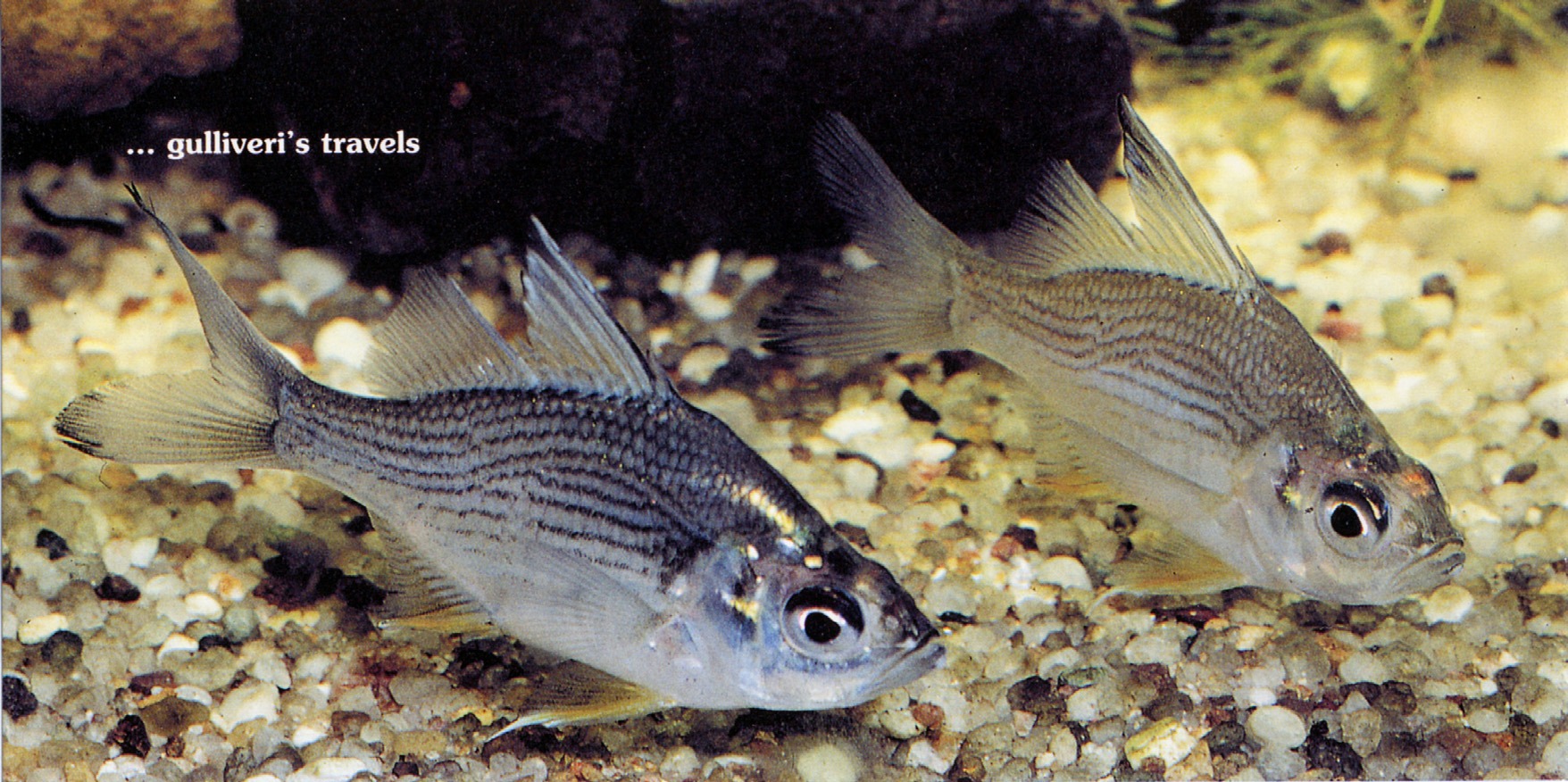
Parambassis gulliveri
Giant Glassfish
Species Summary
The largest of the Australia–New Guinea glassfishes commonly seen by aquarists, Parambassis gulliveri is a genuine rarity in the hobby — a real find for anyone who comes across it. Juveniles can be told apart from similarly sized Ambassis species by their elongated, yellowish ventral fins and a complete (rather than interrupted) lateral line.
Distribution & Habitat
Parambassis gulliveri turns up widely across northern Australia, with records spanning the Gulf of Carpentaria drainage (including the Flinders River near Normanton), the Ord River system and other Kimberley catchments in Western Australia, and the Victoria River in the Northern Territory. Like many fishes of the seasonal Gulf river systems, it can turn up in drying, turbid waterholes as the dry season progresses, sometimes going unnoticed until a net happens to find it — one field report describes a batch of juveniles caught only by accident while the collectors were really after some unusually marked archerfish sharing the same pool.
Keeping & Caring
Parambassis gulliveri does best in moderately hard water around neutral pH, with a steady supply of protein-rich food. It is a predatory fish, particularly on small fish and shrimp, though it is not reported to trouble tankmates too large for it to swallow whole. Fish freshly collected from drying wild waterholes are prone to a rough transition into captivity, with severe fungal infections a real risk in the weeks after capture — one collector’s batch of about a dozen wild-caught juveniles was reduced to six survivors within five months, though those that pulled through went on to do well and to delight their keepers.
Breeding
Captive breeding of this species does not appear to have been documented. Since other glassfishes in the family are known to spawn among thickets of aquatic plants, that seems as reasonable a starting point as any for anyone wanting to attempt it.
Remarks
Parambassis gulliveri is sometimes confused in indexing and record-keeping with Denariusa australis (Pennyfish), a much smaller, unrelated glassfish that shares the family Ambassidae but not much else; the two are easy to tell apart in the hand by size alone, Parambassis gulliveri being by far the larger of the two once past the juvenile stage.
Compiled for Home of the Rainbowfish from ANGFA sources: “Gulliveri’s Travels”, Fishes of Sahul 12(1), 1996, pp. 551–552.