
Chlamydogobius eremius
Desert Goby
Species Summary
The genus Chlamydogobius comprises six small goby species, all endemic to Australia and collectively known as desert gobies. Chlamydogobius eremius is by far the most familiar of them, the only one regularly available in the aquarium hobby; several of its relatives, including the Edgbaston and Elizabeth Springs species, are considered endangered and are essentially unobtainable.
Distribution & Habitat
Chlamydogobius eremius was first collected from a bore at Coward Springs, South Australia, and described as Gobius eremius by Zietz in 1896, moving to its current genus in 1930. It lives in the slow-flowing artesian springs, streams and bores of central Australia, part of the Great Artesian Basin’s network of naturally isolated spring wetlands. Water chemistry in these springs varies widely, from fresh to brackish and generally alkaline and saline to some degree, and the surrounding vegetation ranges from sedges and reeds at the water’s edge to saltbush, samphires and acacias on the spring mounds. These artesian springs are a permanent wetland refuge in an otherwise arid landscape, but are under pressure from stock and feral-animal grazing and trampling, increasing groundwater extraction, and the introduced mosquitofish (Gambusia sp.); rehabilitation of damaged bores has been identified as one path to protecting them.
Description
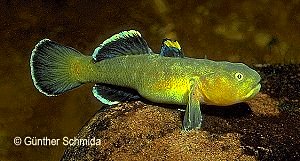
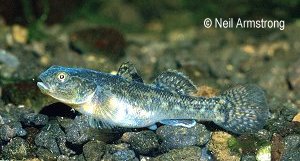
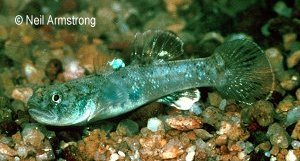
A small goby to about 60 mm, showing considerable colour variation depending on how it is kept. Males typically show a bright yellow head against a purple-bronze or olive-green body, with dark purple fins; the first dorsal fin carries a blue flash below a yellow edge, and the second dorsal, anal and caudal fins are white-edged with a black sub-marginal band. Females are far plainer, a brownish speckled version of the male pattern.
Keeping & Caring
In the wild Chlamydogobius eremius tolerates extreme conditions — recorded temperatures span 5–41 °C, with salinity to 6 ppt, pH 7.1–8.7 and dissolved oxygen as low as 0.8 ppm in places — though none of that is a target for the aquarium. A comfortable captive range is roughly pH 7.0–8.5, alkalinity 1–6 meq/L and general hardness 20–200 ppm, supported by effective biological filtration. It is an omnivore, taking insects, small aquatic crustaceans, other invertebrates, filamentous algae and organic matter in the wild, and accepting good flake and small pellet foods in captivity, with live foods such as daphnia, mosquito larvae or bloodworms (or their frozen equivalents) useful when conditioning fish for breeding. It favours a sandy bottom with cover from vegetation, stones or other debris, and appreciates the same in the aquarium. One quirk worth planning for: this species can climb the corners of an aquarium and clamber right out, so a well-fitted cover or a water level kept well below the rim is worthwhile, and open filter overflows are worth guarding against for the same reason — a reminder that, in its natural habitat, Chlamydogobius eremius can breathe air directly and practises aerial respiration.
Breeding
Wild breeding activity runs roughly November to April, but in the aquarium this species will spawn throughout the year given suitable conditions. Males are territorial, so a spawning tank is best kept to one male with one or more females. Successive spawns of 20–150 eggs are laid on the ceiling of a cave, rocky crevice, small clay pot or a length of PVC tubing sized just large enough for a pair to enter — too wide a diameter and the fish tend to ignore it. The male first clears the chosen site of debris; the eggs themselves are laid in rows, each with a sticky base anchoring it to the surface, and the male usually drives the female off immediately afterwards, making that a good time to remove her. He then fans the clutch until it hatches, typically in 10–15 days depending on temperature — the fry’s eyes become visible within the eggs after 4–5 days. Once the fry begin free-swimming the male loses interest and should also be removed. Newly hatched fry take brine shrimp nauplii straight away and grow quickly on a plentiful live-food diet, reaching about 45 mm in 3–4 months, after which growth slows; males tend to outpace females at every stage.
Remarks
A 1995 review of the genus by Helen Larson of the Museum and Art Galleries of the Northern Territory described five further Chlamydogobius species: C. ranunculus, unusually found in fresh and brackish coastal waters of northern Australia rather than inland springs; C. micropterus from Elizabeth Springs and C. squamigenus from Edgbaston Station, both in western/central Queensland; C. gloveri from Dalhousie Springs in northern South Australia; and C. japalpa from the upper Finke River drainage in the Northern Territory.
Account compiled for Home of the Rainbowfish from A. R. Tappin (1996–2000), “Rainbowfish On-line”, originally published at rainbowfish.angfa.org.au, archived by the National Library of Australia. Republished with the author’s permission.
References
- Larson H.K. (1995) A review of the Australian endemic gobiid fish genus Chlamydogobius, with description of five new species. The Beagle, Records of the Museums and Art Galleries of the Northern Territory 12: 19-51.
- Morelli J. and M.C. de Jong (1995) A Directory of Important Wetlands in Australia. South Australian Department of Environment and Natural Resources.