

Lentipes venustus
Sicydiine gobies, or “cling gobies,” are a subfamily (Sicydiinae) of around 80–90 species in eight genera, more than half described only in the last twenty years. Every species is amphidromous: adults live and spawn in fast, clear freshwater streams, but the tiny hatchlings are swept out to sea, where they spend a planktonic larval phase before returning to fresh water as post-larvae — often in a synchronised pulse the day after a full moon — and migrating back upstream, sometimes climbing waterfalls along the way using a sucking disc formed from fused pelvic fins. Most species graze algae and biofilm from rock surfaces using a distinctive fleshy sac of replacement teeth above the upper jaw, and males in breeding condition are typically brilliantly coloured, in sharp contrast to drabber females. All Australian cling gobies are protected species — look, but don’t touch.
Etymology
The species name venustus is Latin for “beautiful” or “graceful,” a fitting name for one of the most colourful gobies in New Guinea’s freshwaters.
Species Summary
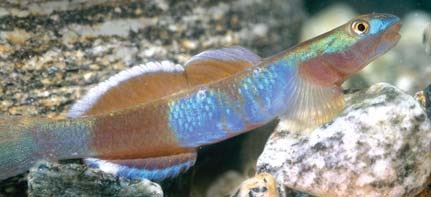
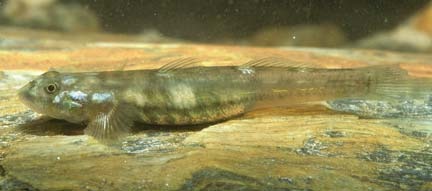
Described from the D’Entrecasteaux Islands of Milne Bay Province, Papua New Guinea — the holotype from the Tuabeda River on Goodenough Island, with further specimens from Fergusson Island (upper Awaetowa River) and Normanby Island (upper Aawaetowa and Dibuwa Rivers) — Lentipes venustus lives in cool (22–24 °C), fast, boulder-and-cobble mountain streams from 100 m to over 600 m elevation, often alongside its close relative Lentipes multiradiatus and several Sicyopus, Sicyopterus and Stiphodon species. Breeding males are mostly bright blue with a red ventral head and a broad reddish bar below the second dorsal fin, red dorsal and anal fins with pale margins; females are semi-translucent tan, either lacking or only faintly showing the dark lower-side stripe found in female L. multiradiatus.
Compiled for Home of the Rainbowfish from ANGFA sources: G. R. Allen, “Two new species of gobiid fishes (Lentipes and Stenogobius) from fresh waters of Milne Bay Province, Papua New Guinea”, Fishes of Sahul 18, 2004, pp. 87–96.