
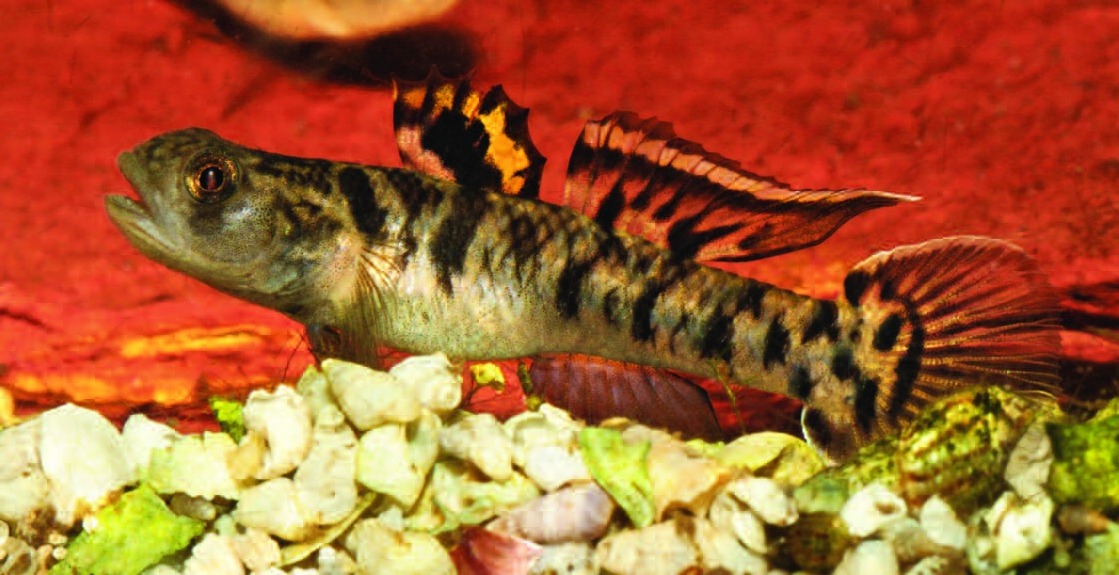
Mugilogobius wilsoni
Wilson’s Mangrovegoby
Mugilogobius (“Mangrove Gobies”) is a genus of small, hardy gobies typically found in mangrove creeks, storm drains and other brackish or freshwater habitats close to the coast. A 2001 taxonomic revision by Helen Larson recognised 25 species in the genus, nine of them then known from Australia.
Etymology
Named by Northern Territory Museum goby taxonomist Dr Helen Larson for ANGFA life member Dave Wilson, a self-described “puddle pirate” who provided great support to Larson’s survey work, documenting unusual native aquatic animals including gobies around Darwin; Wilson was later awarded a Pride of Australia medal for his conservation work with traditional owners in the Northern Territory.
Distribution & Habitat
Mugilogobius wilsoni occurs coastally from around Manly in Brisbane, Queensland, to at least Pago Mission in the northern Kimberley, Western Australia, and also in New Guinea, where it is replaced further west, beyond the Wallace Line, by its sister species Mugilogobius chulae. It has been recorded from rockpools at East Point and Nightcliff in Darwin, at Gunn Point Beach, and among Brisbane mangrove tidal flats.
Breeding
First bred from wild-caught Darwin fish, Mugilogobius wilsoni spawns readily given a length of 15–20 mm PVC pipe as a nest site, with wild males also observed guarding spawns in small seasonal freshwater springs feeding into Darwin River. A typical spawning setup uses two pairs in a 15–20 litre tank with a length of conduit pipe as the spawning cave; another keeper working in soft Canberra water recorded clutches of 50–60 eggs. Fry hatch small and free-floating, requiring fine first foods.
Compiled for Home of the Rainbowfish from ANGFA sources: D. Wilson, M. Hammer & C. Scharpf, “Fish in focus: Wilson’s Mangrovegoby Mugilogobius wilsoni (Gobiidae)”, Fishes of Sahul 32, March 2018, pp. 1240–1246; N. Armstrong, “Mangrove gobies”, Fishes of Sahul 16, 2002, pp. 892–897.