

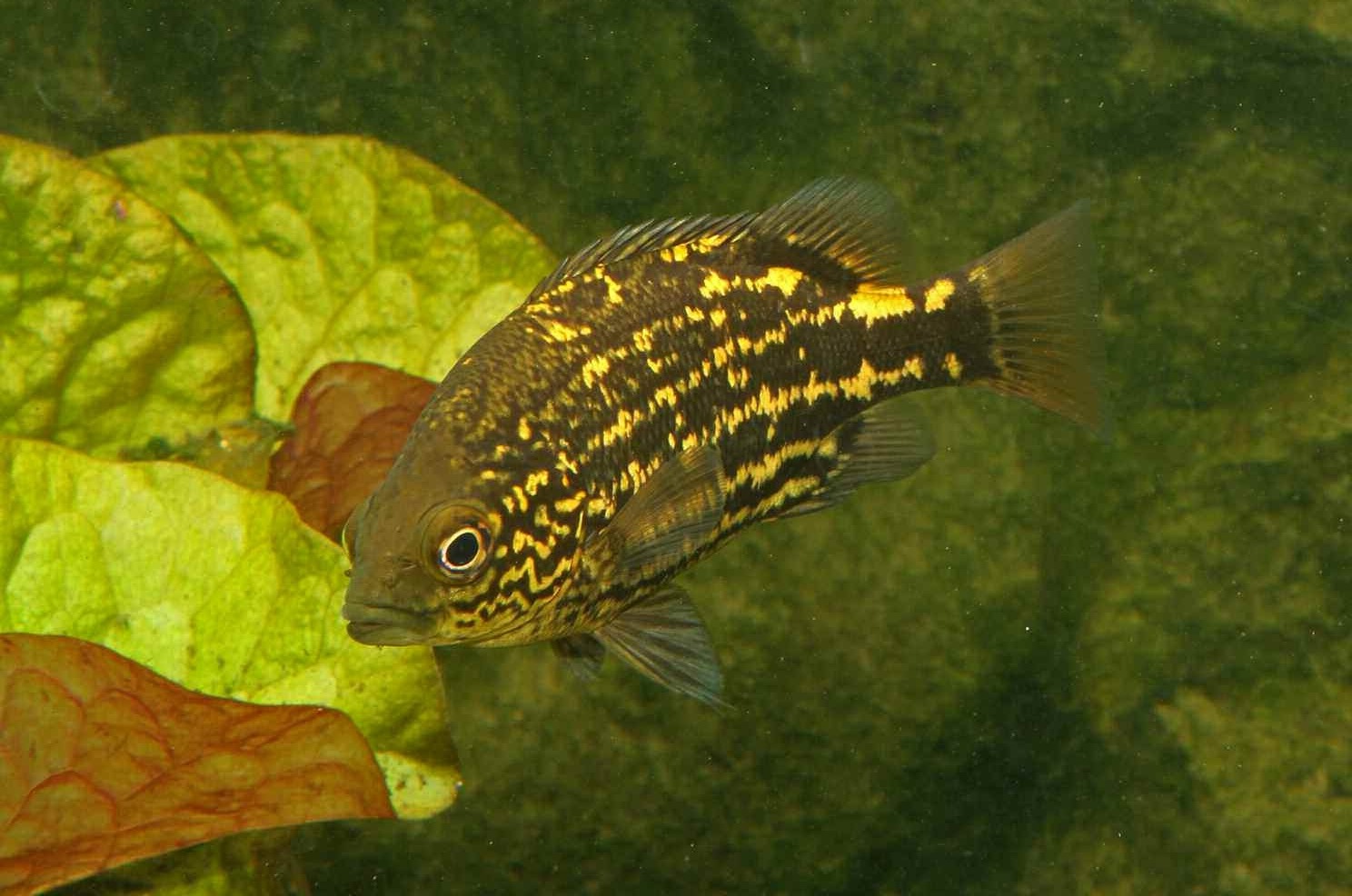
Hephaestus carbo
Coal Grunter
Species Summary
Hephaestus carbo has a disjunct distribution across northern Australia: in the Northern Territory it occurs through most river basins from the Mary River east to the north-eastern tip of Arnhem Land, while an isolated Queensland population sits in the Gregory River (part of the Nicholson River Basin), alongside most westward-flowing streams from the Mitchell River Basin north to the Jardine River Basin and many eastern Cape York rivers south to the Lockhart River. It favours clear, well-flowing streams over sandy substrate, typically close to submerged tree limbs and other snags, and has no conservation listings.
Etymology
The species name carbo is Latin for coal — “a lump of coal,” according to the original authors — referring to the uniform blackish colouration typical of larger preserved adults. British-born zoologist Charles Walter De Vis proposed the genus name Hephaestus in 1884 for the Khaki (or Tully) Grunter without explaining his reasoning; since Hephaestus is the Greek god of blacksmiths, the likeliest guess is that De Vis was alluding to that species’ colouration, also originally described as “uniform blackish.”
Description
Colour pattern changes considerably with age: small juveniles (3–4 cm) show gold markings mainly as horizontal stripes, which become matched by an equally prominent vertical pattern as the fish grows, settling into a random mosaic of gold or black scale markings in adults, which can also turn almost entirely black when alarmed or unhappy with water conditions. Even old, duller fish often retain a gold spot on top of the caudal peduncle. Reported to grow to 33 cm and 1.5 kg, though more commonly caught to 20 cm; aquarium specimens can reach 28–30 cm. Small juveniles have been observed forming a coordinated, swirling “living ball” in the wild, similar to the schooling behaviour of the marine Striped Catfish, a habit lost as they grow older.
Keeping & Caring
Whitley was calling this species the “Cichlid Grunter” as far back as 1947, recognising its aquarium potential early. Hephaestus carbo adapts quickly to captivity, and small specimens can share a tank with similarly sized rainbowfish or gudgeons for some months without harm, but as they grow they become increasingly boisterous, coming to see tankmates as either food or territorial intruders — mature fish are best kept solo or in very large tanks with similarly robust species. Kept singly, Hephaestus carbo becomes remarkably responsive to its owner, presenting at the front glass whenever someone appears — endearing, but a habit that tends to earn extra feeds and a real risk of obesity. One co-author of a Fishes of Sahul feature on the species kept a single Coal Grunter for 15 years before it finally met an untimely end leaping from its aquarium. It occupies all levels of a tall tank (60 cm or more) but favours the middle and lower reaches, and appreciates driftwood or rockwork arranged into a cave for security. A tropical species, it does best at 20–27 °C; water chemistry is not critical (pH 6.8–8.0, hardness 100–300 ppm). It has an excellent appetite for bulky live or thawed frozen food — freshwater shrimp, small fish, prawn and earthworms are particular favourites, with Macrobrachium prawns especially relished — and some fish can be trained onto pellets, though frozen food heavy in beef heart increases the risk of obesity.
Breeding
The sexes look alike, though ripe females are noticeably heavier-bodied, particularly around the abdomen. Maturity is reached at 100–130 mm, apparently depending more on age than size — in commercial aquaculture, “running” males are often seen at 100 mm, while females with viable eggs rarely are at the same size, and a 15 cm female produces around 5,000 eggs. No natural spawning has been recorded in aquaria, though one co-author of a Fishes of Sahul feature on the species had a lone female release a large quantity of eggs unfertilised. Commercial breeders induce spawning by hormone injection once water temperatures sit a little above 25 °C; Hephaestus carbo are pelagic spawners like Silver Perch, and the slightly larger eggs must be kept in suspension while developing, hatching in roughly 30–48 hours. Larvae can hatch fully developed and ready to feed on newly hatched brine shrimp, or, if the eggs hatch early, in a more helpless state that must simply be carried by the current until ready; one commercial breeder uses a 1,000-litre cone-based tank with airstones to keep larvae in suspension until they are fully pigmented and feeding, before moving them to a plankton pond to grow on to fingerling size.
Compiled for Home of the Rainbowfish from ANGFA sources: G. Briggs, B. Sambell, B. Hansen & C. Scharpf, “Fish in focus: Coal Grunter Hephaestus carbo”, Fishes of Sahul 30, March 2016, pp. 973–978.