

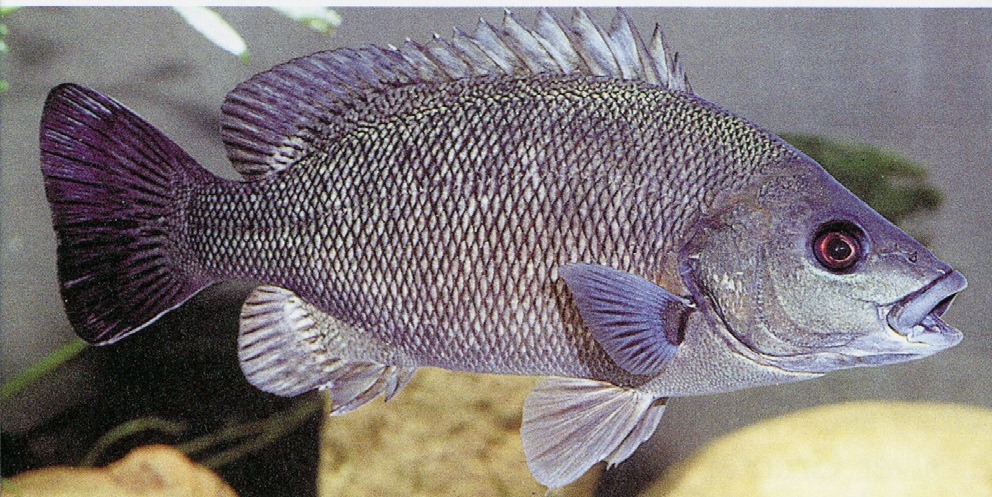
Hephaestus fuliginosus
Sooty Grunter (also Black Bream)
Species Summary
An important recreational angling species across northern Australia, Hephaestus fuliginosus is commonly called Black Bream by anglers, a name shared with several unrelated marine and freshwater species. Shape is typically perch-like, with many minor regional variations in form and colouration — the most spectacular being a “blubber-lips” form — and base colour ranging from gold to brown to black with considerable mottling. One long-term keeper caught his fish as a 3 cm pale grey juvenile with a large black blotch at the rear of the dorsal and anal fins in the Edward River, and still had it 22 years later, by then over 20 cm and showing a strong metallic-green suffusion through its smoky grey colouring.
Distribution & Habitat
Hephaestus fuliginosus ranges across tropical northern Australia from the Daly River through the Carpentaria streams to Central Australia. A highly adaptable fish, it is found in both still and flowing water, usually lurking around rocks or submerged logs and often in pools below waterfalls, tolerating an unusually wide range of conditions in the wild: pH 4–8, hardness from soft to 200 ppm, temperatures 12–34 °C, and turbidity from crystal clear to muddy, even with significant salinity. It shares its range with other large predators such as Barramundi, Saratoga, Spangled Perch, other grunters and larger gudgeons, and these are often caught together.
Keeping & Caring
A large tank is the main requirement — 100–150 litres is adequate whether housing a single 10–12 cm fish or a group of 3–4 cm juveniles. Any aged domestic water supply suits it provided changes are gradual, and a heater is worth adding if ambient temperatures regularly drop below 15 °C. As with other large, voracious grunters, vigorous filtration and regular partial water changes matter more than precise water chemistry, and a secure cover glass is essential given how readily they jump. Plants may survive if the tank is spacious and well furnished with rocks and driftwood, though Hephaestus fuliginosus may rearrange them purely for entertainment even without eating them. Appetite is prodigious and indiscriminate — one long-term captive thrived on frozen meat and vegetable mix, kitchen scraps, dog food (including raw kangaroo meat) and live Gambusia, worms, beetles and moths, and readily learned to take food from its keeper’s fingers.
Breeding
Breeding in the wild occurs above 25 °C following a rise in water levels, with mature fish (males over 20 cm, females over 30 cm) spawning as a group in backwaters away from the current. Each female may produce around 100,000 non-adhesive, demersal eggs, dispersed by the current, hatching after two days and feeding within a further four. Hatcheries breed the species regularly in outdoor earthen ponds using hormone induction, but successful aquarium breeding is considered unlikely — if nothing else, few aquarists would relish the challenge of feeding 100,000 fry.
Compiled for Home of the Rainbowfish from ANGFA sources: B. Hansen, “The Sooty Grunter — Hephaestus fuliginosus”, Fishes of Sahul 5, 1989, pp. 233–234.