
Giurus aporocephalus
Snakehead Gudgeon (also Mud Cod)
Species Summary
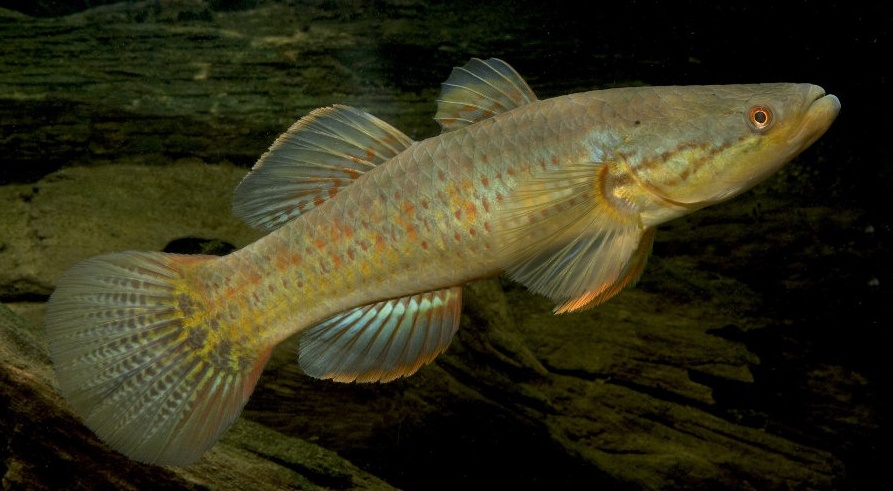
A large, distinctively shaped gudgeon with an elongate, snake-like head, Giurus aporocephalus has been known to Australian aquarists over the years under a shifting set of scientific names — including Ophieleotris aporos and Giuris margaritacea — reflecting a genuinely unsettled taxonomy for this wide-ranging species complex. Common Australian names include “Mud Cod,” a name it shares confusingly with the unrelated New Guinean species Ophiocara porocephala. Codfish Creek, south of Cairns, is reportedly named for how abundant the species once was there; it is still sometimes used as live bait for Barramundi.
Distribution & Habitat
Within Australia, Giurus aporocephalus is found only in Queensland, from the Embley River near Weipa north to the tip of Cape York and south along the coast to the Pioneer River at Mackay, most commonly between Cooktown and the Burdekin River. Beyond Australia this species complex ranges through the Indo-West Pacific from Madagascar to India, the Philippines and Melanesia, including New Guinea. It favours coastal freshwater rivers, creeks, swamps and billabongs below about 40 m elevation, and is frequently seen resting with its back out of the water near the bank — quite possibly the origin of the “snakehead” name — defending that position aggressively against intruders as large as an eel or a water rat. Colouration varies noticeably between populations, from spectacular at Cape Tribulation to comparatively dull around Cairns, and captive colour often fades over time, hinting at a strong influence from diet or water quality.
Keeping & Caring
Giurus aporocephalus does well with larger, faster tankmates, or in a species tank of up to four fish given caves and a raised basking rock. A tank of at least 1200×450×450 mm is recommended, with a secure, weighted lid — this species is a notorious jumper, to the point of being a recorded workplace hazard for ANGFA members collecting them at night by spotlight. It can bury itself in mud to survive a drying floodplain and, remarkably, appears to “come back to life” if seemingly dead and dry specimens are returned to water. Captive individuals have been kept for up to 15 years, though no aquarium breeding has been documented.
Breeding & Migration
Sexual maturity is reached at just 5 cm, though adults can grow to 40 cm (commonly around 20 cm). Fecundity ranges from 40,000 to 200,000 tiny (0.3 mm) eggs, laid on hard substrate and guarded by the male. Breeding is tied to the wet-season rise in water levels, with adults moving downstream towards estuaries, lakes and floodplains; larvae pass through a pelagic phase, and juveniles turn up far more often in marine and estuarine habitats than in fresh water. One striking migration was witnessed first-hand at Dinner Creek in the North Johnstone system, where more than 200 adult fish (12–30 cm) were seen jumping upstream through a road-crossing culvert pipe over the course of about an hour — a local water-tanker driver reported having watched the same spectacle for two days running.
Compiled for Home of the Rainbowfish from ANGFA sources: B. Hansen, “Snakehead gudgeon observation”, Fishes of Sahul 19, 2005, pp. 187–190; G. Moores, J. Lenagan, P. J. Unmack, K. C. Martin & C. Scharpf, “Fish in focus: Snakehead Gudgeon Giuris margaritacea”, Fishes of Sahul 30, December 2016, pp. 1061–1066.