
Gobiomorphus coxii
Cox’s Gudgeon
Species Summary
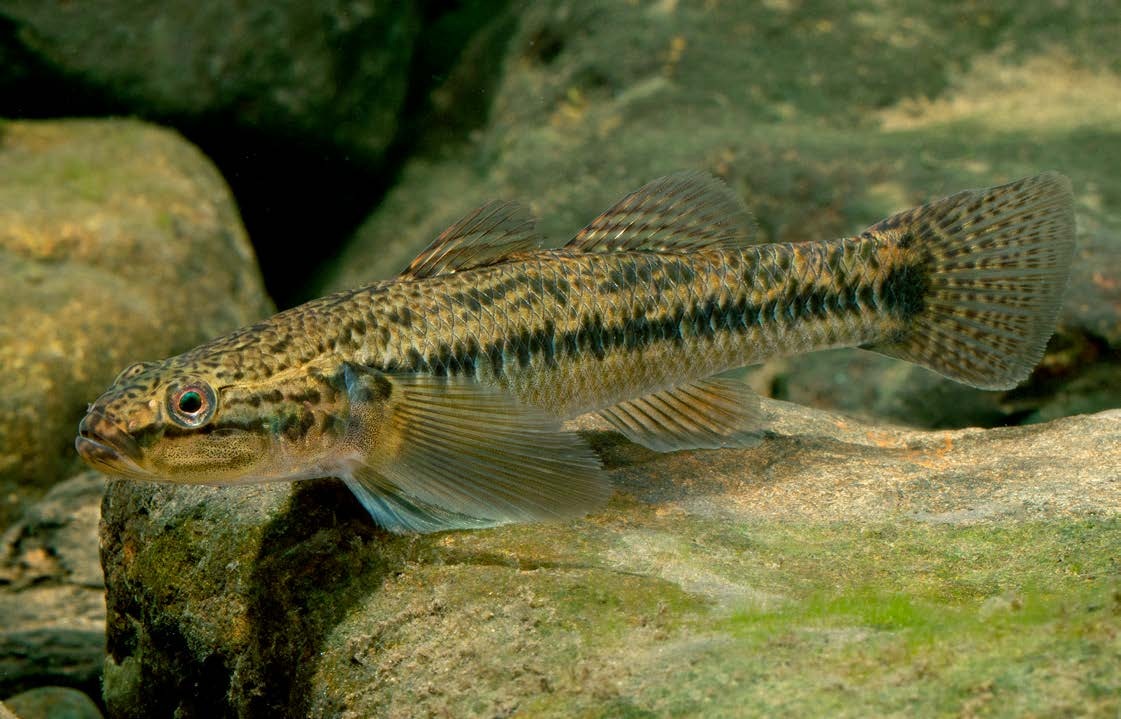
A moderately slender, cylindrical gudgeon with a dorsally flattened head and a small mouth not reaching the eye, Gobiomorphus coxii is coloured dark-to-light brown, purple or olive-green, with mottled yellow sides, a pale tan, blue or gold belly, a single dark mid-line stripe, faint gill-cover stripes and a dark chin. It reaches around 19 cm, though 12–15 cm is more typical.
Distribution & the Climbing Habit
Gobiomorphus coxii occurs from the Caboolture River in south-eastern Queensland to Wilsons Promontory in Victoria, generally more abundant in the state’s southern rivers. It ranges further upstream than most gudgeons, to as much as 700 m elevation, and is more abundant where rapids are frequent — a preference explained by a genuinely remarkable ability: juveniles can climb wet, near-vertical rock faces against cascading water, using their enlarged pectoral fins pressed flat against the surface to hold position or propel themselves upward in short, darting bursts. Little has been published on the species’ reproduction, but larvae are apparently swept downstream after hatching, spend their early life in brackish estuarine water, and migrate back upstream as 25–40 mm juveniles over winter and spring, with spawning itself thought to occur between January and May. It feeds on small aquatic insects, including mosquito larvae.
The climbing behaviour was documented in dramatic fashion at Mermaid Pool, below Manly Dam in Sydney, when three children at a community bush-regeneration day spotted “little baby fish scaling up the vertical ledge” below a waterfall. A host of small, black-striped juveniles, 3–5 cm long, were seen climbing the wet rock face and congregating in droves on a ledge behind the falls, repeatedly washed back down only to dart straight back up without hesitation. The juveniles vanished after the next rain, presumably having completed their journey upstream — a striking, easily overlooked piece of natural history playing out in a well-used suburban park, and a reminder of why keeping urban waterways connected matters for fish that rely on both fresh and brackish water at different life stages.
Compiled for Home of the Rainbowfish from ANGFA sources: Anonymous, “Gobiomorphis coxii (Krefft 1864) Cox’s Gudgeon”, In-Stream 19, 2010, p. 17; A. Lo, “The Mermaid Pool climbing Cox’s gudgeon”, Fishes of Sahul 24, 2010, pp. 542–543; W. Woodhouse, “An urban oasis in south-eastern Sydney – the gudgeons of Cooper Park”, Fishes of Sahul 34, 2020, pp. 1531–1535.