
Hypseleotris compressa
Empire Gudgeon (also Carp Gudgeon)
Species Summary
The Empire Gudgeon is one of the most striking members of the gudgeon family (Eleotridae), a large group of Australian and New Guinean freshwater and brackish-water fishes closely related to the true gobies. It grows to around 10 cm, is strongly sexually dimorphic, and is only rarely offered commercially — most aquarium specimens are wild-collected.
Distribution & Habitat
Hypseleotris compressa is widespread along the coast of northern New South Wales, Queensland, the Northern Territory and the Pilbara and Kimberley regions of Western Australia, and also occurs in southern New Guinea. It favours freshwater lakes, swamps and the lower reaches of coastal streams above tidal influence, though juveniles are often abundant in brackish estuaries in large numbers — they have even been found in fresh seepage just metres from the surf on Fraser Island, Queensland.
Description
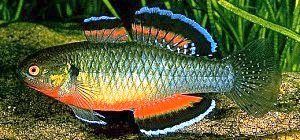
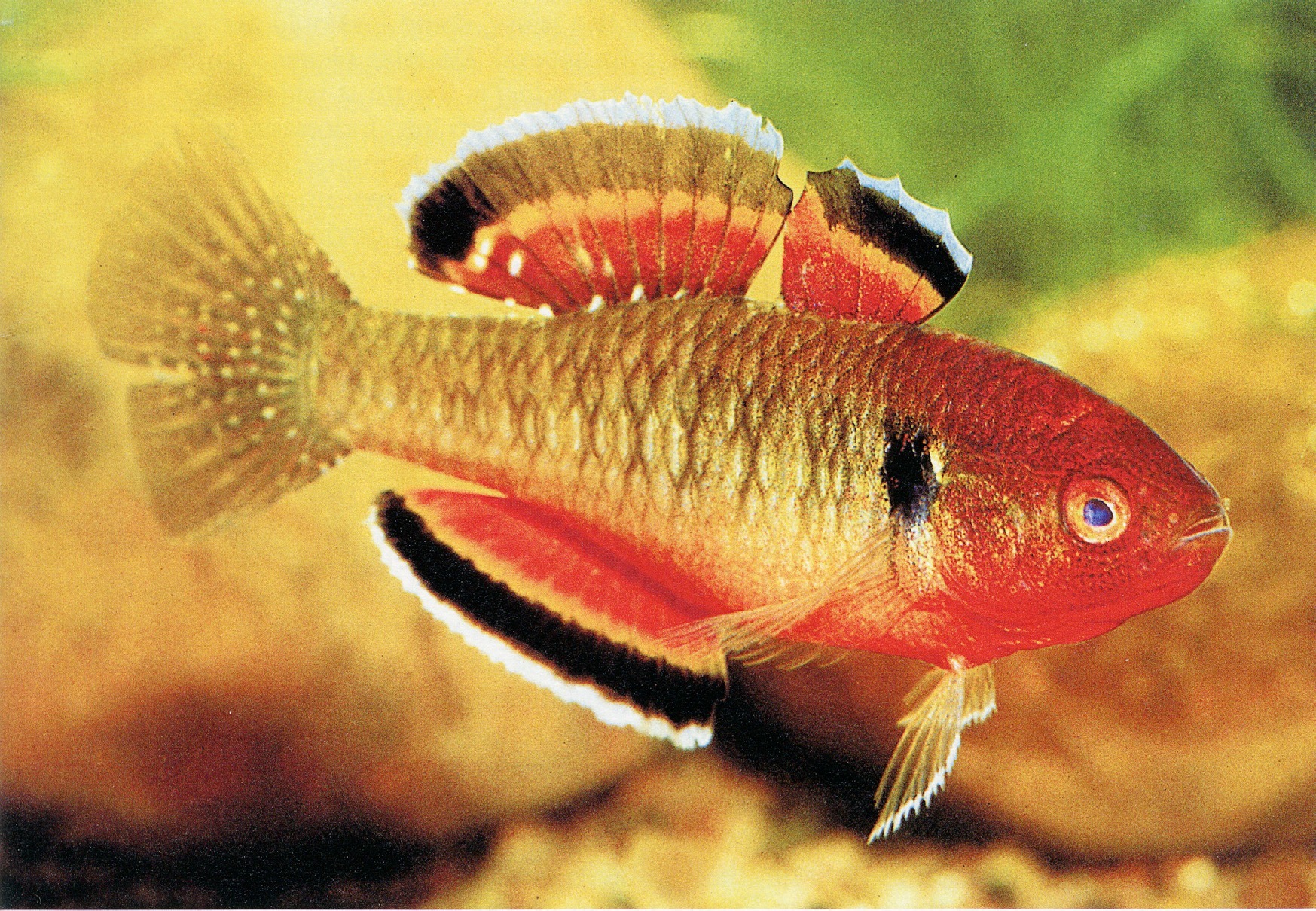
A bottom-dwelling, territorial fish with pronounced differences between the sexes. Breeding males develop a vivid red flush across the head and breast — striking enough that the species has been nicknamed the “Fire Goby” in Europe — along with bold banding of brown, red, black and white across the dorsal and anal fins, and a fleshy nuchal hump as they mature. Females are a plainer translucent greenish-brown with only a hint of fin barring, and keep a slimmer, more rounded profile that becomes quite plump when in spawning condition; small immature males can be hard to tell apart from young females.
Keeping & Caring
In the wild, Hypseleotris compressa tolerates an unusually wide range of conditions — water temperatures from as low as 14 °C to 38 °C, pH between 4.2 and 8.7, and hardness from almost zero up to 350 mg/L — and settles well into captivity once past an initial adjustment period, which can take several days for wild-caught fish. A quarantine period of at least two weeks is recommended before introducing wild-caught stock to a permanent aquarium. It is an omnivore, feeding mostly in midwater but also taking food from the bottom and surface; in the wild its diet includes terrestrial and aquatic insects, worms, copepods, algae and pollen, and in captivity it readily accepts flake and pellet foods, with live or frozen foods such as daphnia, mosquito larvae or bloodworms useful for conditioning prior to breeding. It adapts well to a community aquarium of at least 50 litres, though a larger tank suits it better, especially if breeding is the goal.
Breeding
Territorial males display side-on with fins fully erect, chasing rivals in tightening circles until one withdraws; this dominance display intensifies as temperatures rise above about 20 °C and quietens down below it. Courtship follows a similar lateral display directed at a receptive, well-rounded female, accompanied by short darting movements towards the chosen spawning site; the male may also sweep his urinogenital papilla across the site, likely depositing pheromone trails that encourage the female to spawn. Spawning itself can run for hours with short rest periods, producing thousands of small, adhesive, pear-shaped eggs laid in parallel rows on rock, gravel, plants or aquarium glass. The male alone guards the clutch, and the eggs develop quickly, hatching in 12–24 hours at 25 °C. Newly hatched fry are tiny and poorly developed, living off their yolk sac for the first several days before they are ready to take fine foods such as micro-algae or rotifers, graduating to newly hatched brine shrimp and microworm as they grow. Spawning itself is not usually difficult; raising the fry through to independence is considered the real challenge with this species.
Etymology
The genus name Hypseleotris was coined by American zoologist Theodore Gill in 1863, from the Greek hypsēlós, “high,” referring to the taller body of the type species compared with other sleeper gobies then lumped into Eleotris. The meaning of Eleotris itself is less certain: Cuvier and Valenciennes derived it from an unidentified Nile fish name, while Jordan and Gilbert took it from the Greek for “bewildered,” possibly describing the sluggish, sit-and-wait habit that also gives the group its English name of “sleeper.” The species name compressa is Latin for “compressed,” referring to the fish’s flattened body shape.
Distribution Notes
An isolated, self-sustaining population lives in Lake Garrawongera on Fraser Island, Queensland, well away from any tidal or estuarine influence — an unusual situation for a species otherwise closely tied to brackish water for at least part of its life cycle. A single record from the Preston River in south-western Western Australia, far outside the species’ normal range, may represent an aquarium release or a chance larva carried in on ocean currents. A striking black-flushing colour form, in which breeding males darken almost to black rather than showing the usual red flush, has been reported from gorge pools of the Hamersley Range in the Pilbara. In Victoria, at the southern edge of the species’ range, Hypseleotris compressa is listed as threatened under the Flora and Fauna Guarantee Act.
The Challenge of Rearing Fry
Spawning Hypseleotris compressa is one thing; rearing the larvae through to independence has defeated generations of aquarists. The newly hatched fry are minute and drift for some time before they are developed enough to feed, and exactly what they need to eat during that early planktonic phase has never been fully solved in the aquarium. One long-documented attempt trialled both a wild plankton-culture method and a micro-encapsulated diet, day by day, and achieved only partial success by either route. A German aquarist’s multi-year attempt did somewhat better by culturing marine ciliates, rotifers and copepods specifically for the larvae, keeping a detailed developmental log — eye development by day 3, mouth and pectoral fins forming by day 4, forward-facing eyes by day 11, body pigment spots appearing around day 20, and a recognisably fish-shaped fry by day 29 — but even that best-documented run lost its fry at 32 days. Not every attempt fails outright, though: one wholesaler found around 30 juvenile pond-raised Western Australian Hypseleotris compressa, sitting in a bare tank, spontaneously burst into full breeding colour and spawned en masse overnight, to everyone’s surprise — and were gone again the next day, a reminder of how readily this species spawns once conditions are right, even if raising the resulting fry remains the hard part.
Account compiled for Home of the Rainbowfish from A. R. Tappin (1996–2000), “Rainbowfish On-line”, originally published at rainbowfish.angfa.org.au, archived by the National Library of Australia. Republished with the author’s permission.
Compiled for Home of the Rainbowfish from ANGFA sources: P. J. Unmack, B. Hansen, G. Briggs, M. Stanton & C. Scharpf, “Fish in focus: Empire Gudgeon Hypseleotris compressa”, Fishes of Sahul 30, September 2016, pp. 1033–1037; G. Wager, “Rearing the Empire Gudgeon”, Fishes of Sahul 30, September 2016, pp. 1015–1024 (written c. 1991); T. Thierbach, “My experiences with the Empire Gudgeon”, Fishes of Sahul 30, September 2016, pp. 1010–1014; G. Briggs, “Glorious empire gudgeons”, Fishes of Sahul 24, 2010, p. 562; M. Young, “A tank spawning of Hypseleotris compressa”, Fishes of Sahul 4, 1987, pp. 162–164.