

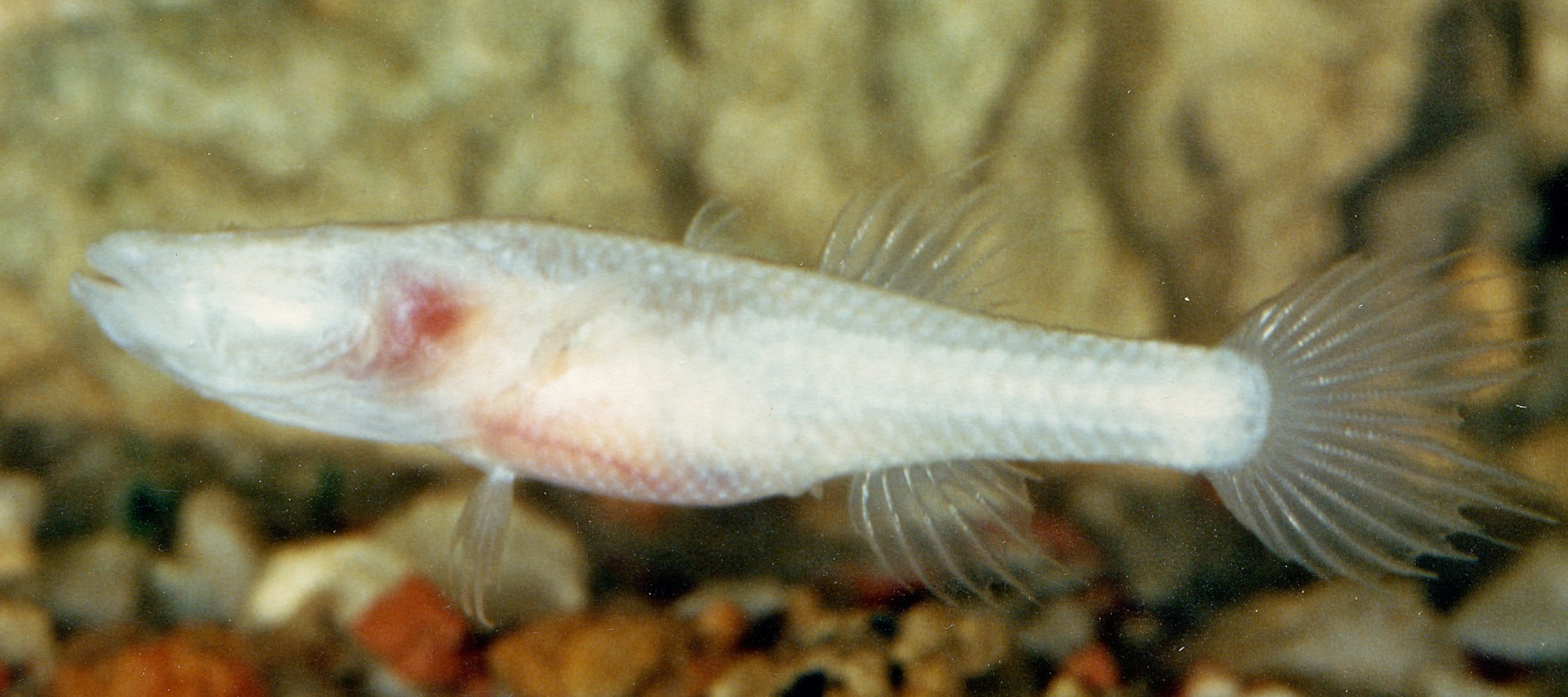
Milyeringa veritas
Blind Gudgeon (also Cave Gudgeon)
Species Summary
Milyeringa veritas has evolved to occupy the totally light-free environment of a shallow anchialine (tidally influenced, brackish) aquifer beneath the Cape Range peninsula on North West Cape, Western Australia. It is eyeless and completely unpigmented — chalky white, like the small prawns and the cave eel that share its subterranean home — and reaches only about 35–40 mm. First described by Gilbert Whitley in 1945 from Milyering, some 20 miles south-west of Vlamingh Head, it has since been recorded from a number of sinkholes and bores across the Cape Range Coastal Plain and, more recently, on Barrow Island, though the Barrow Island population is now recognised as a separate species, Milyeringa justitia.
Distribution & Habitat
The aquifer system Milyeringa veritas inhabits reaches the surface only in scattered crevices and limestone sinkholes, each acting as little more than a window onto fish passing through an otherwise inaccessible underground world. Water levels on the Coastal Plain rise and fall with the tide, since the outward flow of groundwater towards the sea is periodically backed up by high tides. Small prawns appear to be the key link in the food chain, living on organic matter washed in through cracks and fissures, and in turn supporting a population of small blind fish and a co-occurring blind cave eel.
A Cave Diver’s Encounter
One vivid first-hand account describes the difficulty of even finding the right sinkhole: after driving from Exmouth on the strength of half-remembered directions to a cave visited years earlier, the party finally located the entrance and climbed down using a metal pipe wedged between rock ledges. A low, dark crawl led to a clear pool where, to the diver’s surprise, “like ghosts, their white shapes were motionless or slowly moving at various depths of the pool.” Two or three fish were captured by hand and net, photographed against a plain background back at the surface, then released again on a return trip — that second visit undertaken specifically to photograph the totally dark habitat itself, using electronic flash and a torch to focus by, without any idea what the resulting images would show until the film was developed. Everything in the cave — fossilised coral, shell fragments — “looked like something from the sea,” a reminder that this landscape was seabed within relatively recent geological time.
Keeping & Caring
Milyeringa veritas is a genuinely specialised aquarium subject, unsuited to a mixed collection. Wild-caught fish are extremely sensitive to temperature shock during transport — one early consignment died overnight after being freighted through cold conditions — and readily develop Saprolegnia fungal infections when kept in typical freshwater conditions, since the species never evolved any resistance to a pathogen it would rarely encounter in its naturally brackish habitat; raising salinity to roughly 1,200 ppm (about a teaspoon of sea salt per gallon) has been recommended to help control fungal outbreaks while still keeping the water fresh enough to support aquarium plants at the lit end of a part-shaded tank. Fish acclimatise slowly, taking weeks to settle and months to show much interaction with each other, but eventually learn to associate a particular spot with feeding, first on mosquito wrigglers and then on live or frozen brine shrimp. Sensory papillae on the head, snout and fins are used to detect prey by touch and water movement rather than sight: a live insect sitting still on the surface film is often missed entirely, but the faint disturbance of a small live shrimp moving just below the surface is rarely missed. Milyeringa veritas develops a highly reliable “pathway memory” of its surroundings, is generally lethargic, and can be disoriented by a sudden swirl in the water, but is capable of a startling burst of speed over a short distance when it senses a threat.
Compiled for Home of the Rainbowfish from ANGFA sources: M. Young, “Bringing the blind gudgeon into captivity”, Fishes of Sahul 4, 1986, pp. 145–148; R. H. Kuiter, “Blind gudgeon”, Fishes of Sahul 15, 2001, pp. 782–784.