

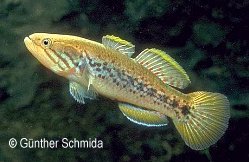
Mogurnda adspersa
Southern Purple-Spotted Gudgeon
Species Summary
First described from the Fitzroy River, Queensland, in 1878, Mogurnda adspersa is a small gudgeon (family Eleotridae) reaching around 100 mm, and has one of the longest histories of any Australian native fish in captivity: it was already being bred by Albert Gale of the Royal Zoological Society of New South Wales as early as 1912, and by 1918 live specimens had reached the international hobby by way of San Francisco.
Distribution & Habitat
Mogurnda adspersa occurs through the Murray–Darling river system across South Australia, Victoria, New South Wales and Queensland, and separately along suitable coastal drainages from northern New South Wales to northern Queensland. It typically inhabits slow-flowing or still, swampy water among aquatic vegetation.
Keeping & Caring
An omnivore in the wild, taking terrestrial and aquatic insects, worms, small crustaceans, algae and pollen, it accepts flake and pellet food readily in the aquarium, with live or frozen foods such as daphnia, mosquito larvae or bloodworms helpful when conditioning fish for breeding. It is not demanding: ordinary tap water suits it well provided extremes of pH and hardness are avoided, with a comfortable range of roughly pH 6.8–7.5 and hardness up to about 150 ppm, supported by effective biological filtration.
Breeding
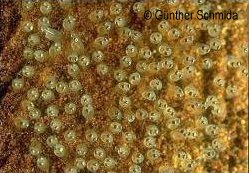
In the wild, spawning takes place between December and February once temperatures exceed 20 °C; in the aquarium, given suitable conditions, Mogurnda adspersa will breed throughout the year. Females may lay several successive broods of 300–1,200 eggs, deposited in a circular cluster on a hard surface such as rock or driftwood that the male has carefully cleared beforehand. The female inspects the prepared site repeatedly before committing to it, then positions herself at roughly 45 degrees to lay; the male follows head-to-tail with her to fertilise the eggs, then drives her off once spawning is complete. He alone tends the clutch afterwards, taking up a position above the eggs and fanning them with his pectoral and caudal fins until they hatch — typically in 5–9 days, depending on temperature. The tiny fry are free-swimming soon after hatching and take newly hatched brine shrimp immediately; they reach about 25 mm within two months, begin showing their parents’ spotted pattern by around four months, and are fully coloured at 45–50 mm after five to six months.
The “Zombie Fish”: a Victorian Conservation Success
Mogurnda adspersa was long thought extinct in Victoria, where the last confirmed sighting had faded into history, until Dr Dion Iervasi rediscovered a population at Third Reedy Lake near Kerang in late 2019, during a survey ahead of a planned lake drawdown. The drawdown was halted, a multi-agency Advisory Group was formed, and broodstock were collected in March 2021 and split between two dedicated breeding facilities, Chris Lamin’s Middle Creek Farm in Gippsland and Aquasave–Glenelg Nature Trust in South Australia. The first breeding cycle relied on a single successful male — nicknamed “Dion” after the fish’s discoverer — and produced around 1,200 offspring; a second cycle, with three breeding males and eight females, produced roughly 3,000 juveniles after a frustrating gap when no spawning occurred despite seemingly ideal conditions. It was North Central Catchment Management Authority’s Anthony Radford who coined the nickname “Zombie Fish” for a species risen from presumed local extinction, a name later picked up by the ABC, The Guardian, Australian Geographic and the Daily Mail. Three public release events followed, in December 2021, December 2022 and March 2024, carrying fish to around twenty-five sites across Victoria — from a suburban Bendigo dog park and private conservation dams to the Kerang weir pool, where Barapa Barapa Traditional Owner Graham Kirby took part in the release. By 2024 more than ten thousand Mogurnda adspersa juveniles had been released across Victoria, with at least ten new breeding populations established, and over twenty thousand released across the southern Murray–Darling Basin as a whole. The project sits alongside a similar rescue effort for the Southern Pygmy Perch as part of a wider “Magnificent Six” program targeting the region’s most imperilled small-bodied native fishes.
A South Australian Parallel
A similar boom-bust-and-recovery story played out earlier in South Australia. Mogurnda adspersa was first recorded there in 1917, became scarce by the 1940s (likely due to predation by introduced redfin perch), and was presumed extinct in the state by the 1990s — only to be rediscovered in 2002 in a wetland between Murray Bridge and Mannum. That population dried out in 2007, prompting an emergency fish rescue and a captive breeding program; descendants were released into the Paiwalla wetland in 2010 and were breeding and recruiting successfully within a year. A cold-tolerance anecdote from further north is worth noting for aquarists in cooler climates: fish of the “Inverell” form have been netted from Deadman Creek near Tenterfield, NSW, in June water of only 10.5–11 °C, despite older reference works insisting the species needs subtropical warmth — a reasonable case for keeping this species unheated through a mild southern Australian winter.
Remarks
Two similar, widely distributed Australian gudgeons share the common name “Purple-Spotted Gudgeon”: the northern Mogurnda mogurnda and the southern Mogurnda adspersa described here. The two are difficult to separate by eye and differ mainly in scale counts; some evidence suggests the group may eventually be shown to include further, currently unrecognised species. The various populations are geographically separated in the wild, though flood events occasionally bridge those barriers, so aquarists are encouraged to keep stock of known, separate provenance from being cross-bred. American aquarist William Innes was less charitable about the species’ community-tank manners in his 1935 book Exotic Aquarium Fishes, writing that “as a community fish, it is one of the world’s worst, being comparable in this respect to the much better known Gambusia affinis.”
Account compiled for Home of the Rainbowfish from A. R. Tappin (1996–2000), “Rainbowfish On-line”, originally published at rainbowfish.angfa.org.au, archived by the National Library of Australia. Republished with the author’s permission.
Compiled for Home of the Rainbowfish from ANGFA sources: G. Martin, C. Lamin & D. Rose, “The rediscovery of the Victorian Southern Purple-spotted Gudgeon (aka ‘Zombie Fish’) – a conservation success story”, Fishes of Sahul 38, 2024, pp. 2194–2231; A. R. Tappin, “Mogurnda adspersa Common Name: Southern Purplespotted Gudgeon”, In-Stream 21, 2012, pp. 8–14; G. Briggs, “Murray-Darling Mogurnda adspersa”, Fishes of Sahul 12, 1998, pp. 553–556; G. Briggs, “Australian purple-spotted gudgeons”, Fishes of Sahul 23, 2009, pp. 532–535.