
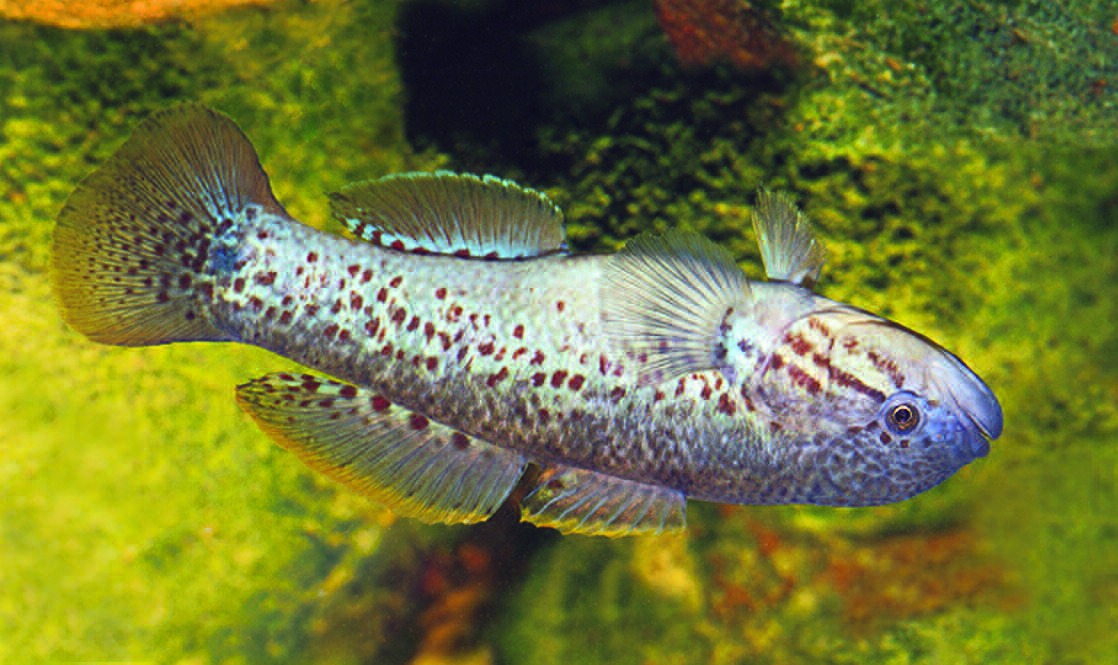
Mogurnda clivicola
Flinders Ranges Mogurnda
Etymology
The species name clivicola combines the Latin clivus, “hill” or “slope,” with colo, “to dwell,” a reference to its steep-sided Flinders Ranges habitat.
Distribution & Conservation
Mogurnda clivicola is known from spring-fed pools in steep-sided valleys near Balcanoona in the northern Flinders and Gammon Ranges, South Australia — the only fish species recorded from the Flinders Ranges proper — along with genetically confirmed Queensland populations in the Barcoo River near Blackall, the upper Belyando River, a spring near Yaraka, and hybrids with Mogurnda adspersa in the Comet River; these Queensland fish had previously been treated simply as Mogurnda sp. or mistaken for Mogurnda adspersa. It is listed as Vulnerable under the federal EPBC Act and is protected in South Australia; the Barcoo River population at Blackall has not been recorded since 1997, likely lost to drought. A 2010 government survey found the species remaining at only two of seventeen historically surveyed Flinders Ranges sites, with a total population estimated around 4,000 individuals — broadly stable compared with a decade earlier, but with a concerning finding that up to 20 per cent of adults at one site showed signs of melanoma-like skin growths.
Field Notes
An early collecting account describes an overnight drive from Adelaide into the Flinders and Gammon Ranges, searching a string of dry waterholes before finally finding two pools at Balcanoona — the lower one full of fish, six specimens caught in five minutes by torchlight after dark. In the aquarium, that founder population bred within three weeks, and later observation in a larger tank revealed a clear dominance hierarchy: a single dominant male prepared four separate spawning sites and courted for hours, while other Mogurnda sharing the tank “remained absolutely motionless” for the duration — a striking piece of observed social behaviour, followed by some aggression from the male towards his own mate once spawning was complete. Mass spawning in the wild has been observed to follow River Red Gum bark-shedding events each December, which litter the creek bed with fresh underwater surfaces for eggs to be laid on.
The three Central Australian Mogurnda species — the Flinders Ranges, Finke and Dalhousie Mogurnda described below — share a common set of aquarium requirements. None are fussy about water conditions and all adapt quickly to feeding, but they can be very aggressive towards each other and towards tankmates, especially in a small tank: a group of 6–10 adults needs at least 200 litres, and older males can be physically harsh on smaller females, so numbers are worth monitoring — it is not uncommon for a seemingly stable tank to be reduced, within a few weeks, to a tank of males only. A comfortable range is 20–27 °C, pH 7.0–8.2 and hardness 50–300 ppm. Adults take chunky raw prawn, fish or other seafood, frozen brine shrimp cubes, pellets and live blackworm or earthworms, the latter two especially useful for conditioning; fry prefer brine shrimp nauplii, microworm and vinegar eels. Males are typically slightly larger with more pointed fins, heavier patterning and a more “boof-headed” appearance than females, which grow heavier around the vent when gravid. Courtship follows the familiar Mogurnda pattern of extended fins and body-wagging, with eggs laid on rock, driftwood or aquarium glass (vertical surfaces preferred), guarded and fanned by the male, hatching in 7–9 days; the male loses interest once the fry are free-swimming.
Compiled for Home of the Rainbowfish from ANGFA sources: G. R. Allen & A. P. Jenkins, “Australian freshwater gudgeons, genus Mogurnda”, Fishes of Sahul 14, 2000, pp. 685–687; T. G. Walker, “Mogurnda species ‘Balcanoona’”, Fishes of Sahul 9, 1995, pp. 414–416; G. Briggs, P. J. Unmack, M. Hammer & C. Scharpf, “Fish in focus: Central Australian Mogurnda species”, Fishes of Sahul 32, 2018, pp. 1324–1334; Anonymous, “Mogurnda clivicola Allen and Jenkins 1999, Flinders Ranges Morgunda”, In-Stream 22, 2013, pp. 18–24.