
Mogurnda larapintae
Finke Mogurnda
Etymology
The species name larapintae comes from “Larapinta,” the Arrernte name for the Finke River, the only drainage in which the species is found. First described by Zietz in 1896, it was long treated as a junior synonym of Mogurnda mogurnda until resurrected as a valid species by Gerald Allen and Anthony Jenkins in 1999.
Distribution & Description
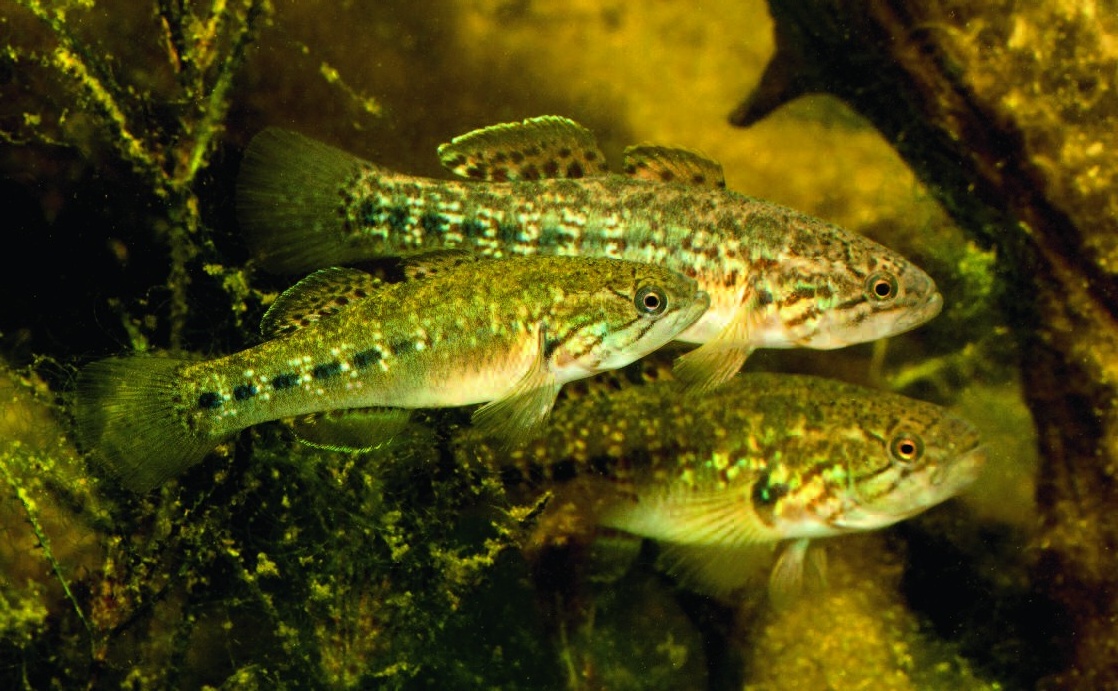
Mogurnda larapintae is known only from the Finke River system in central Australia, mainly from permanent rocky waterholes through the MacDonnell Ranges — Serpentine Gorge, Hermannsburg Rockhole, Ormiston Gorge, Glen Helen Gorge and Redbank Gorge — with its southernmost record at Running Water Yard near Finke Gorge National Park. It is distinguished from other Mogurnda mainly by smaller, more numerous scales, and carries a heavier-set body than its relatives, with a tan base colour, dark brown markings, dark red spots and cream-edged fins, lacking the blue-green flank colouration of some other species in the genus.
Field Notes & Breeding
One aquarist’s account describes finally obtaining live Mogurnda larapintae after a year of reading about the species, through a chain of ANGFA contacts that led to a keeper at the Alice Springs Desert Park who collected and air-freighted fish south — first a single 70 mm specimen, later three more. In a 60×45×45 cm tank set up at roughly pH 8.0 and 250 ppm hardness to approximate Finke River conditions, the fish spawned within a week of arrival — not, as might be expected, on the slate tiles provided, but on the housing of the tank’s undergravel filter (“how typical!”). Clutches of 200–300 eggs are usual, hatching after 9 days at 24–25 °C; the roughly 5 mm fry feed the following day on brine shrimp nauplii and vinegar eels, are fast growers needing regular size-grading, and reach 20–25 mm within three months.
The three Central Australian Mogurnda species — the Flinders Ranges, Finke and Dalhousie Mogurnda described below — share a common set of aquarium requirements. None are fussy about water conditions and all adapt quickly to feeding, but they can be very aggressive towards each other and towards tankmates, especially in a small tank: a group of 6–10 adults needs at least 200 litres, and older males can be physically harsh on smaller females, so numbers are worth monitoring — it is not uncommon for a seemingly stable tank to be reduced, within a few weeks, to a tank of males only. A comfortable range is 20–27 °C, pH 7.0–8.2 and hardness 50–300 ppm. Adults take chunky raw prawn, fish or other seafood, frozen brine shrimp cubes, pellets and live blackworm or earthworms, the latter two especially useful for conditioning; fry prefer brine shrimp nauplii, microworm and vinegar eels. Males are typically slightly larger with more pointed fins, heavier patterning and a more “boof-headed” appearance than females, which grow heavier around the vent when gravid. Courtship follows the familiar Mogurnda pattern of extended fins and body-wagging, with eggs laid on rock, driftwood or aquarium glass (vertical surfaces preferred), guarded and fanned by the male, hatching in 7–9 days; the male loses interest once the fry are free-swimming.
Compiled for Home of the Rainbowfish from ANGFA sources: G. Briggs, “Finke Mogurnda”, Fishes of Sahul 15, 2001, pp. 734–739; G. R. Allen & A. P. Jenkins, “Australian freshwater gudgeons, genus Mogurnda”, Fishes of Sahul 14, 2000, pp. 685–687; G. Briggs, P. J. Unmack, M. Hammer & C. Scharpf, “Fish in focus: Central Australian Mogurnda species”, Fishes of Sahul 32, 2018, pp. 1324–1334.