
Mogurnda thermophila
Dalhousie Mogurnda
Etymology
The species name thermophila is built from the Greek thermos, “heat,” and philos, “loving” — “heat-loving,” for its restriction to a thermal artesian spring complex.
Distribution & Habitat
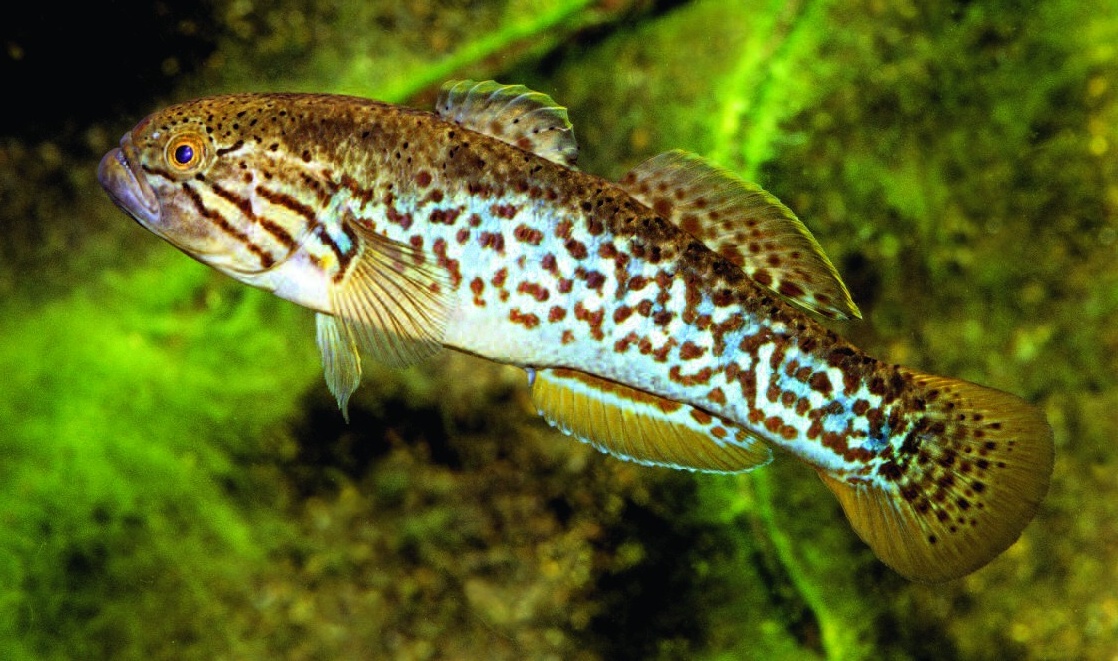
Mogurnda thermophila is known only from the Dalhousie Springs complex in far northern South Australia, one of the country’s premier hotspots of freshwater endemism, shared with four other fish species found nowhere else — Neosilurus gloveri, Craterocephalus dalhousiensis, Craterocephalus gloveri and Chlamydogobius gloveri — alongside the widespread Spangled Perch. It has been recorded across 11 of roughly 20 Dalhousie springs, in water ranging 13–36 °C, with an experimentally determined upper thermal tolerance of 41.2 °C for fish acclimated to 31.8–36.0 °C water — an extraordinary tolerance even by the standards of Australia’s heat-adapted desert fishes. It reaches up to 135 mm total length and feeds largely on filamentous green algae and small fish, with at least one specimen found to have eaten a small gastropod.
Keeping & Caring
Mogurnda thermophila has the smallest natural range of the three Central Australian Mogurnda species, restricted entirely to the Dalhousie complex. One long-term keeper maintained the species successfully for two captive generations before hatch rates declined and third-generation larvae were unable to swim properly — a useful, honest reminder that the precise conditions needed for sustained multi-generational breeding of this species have not yet been fully worked out.
The three Central Australian Mogurnda species — the Flinders Ranges, Finke and Dalhousie Mogurnda described below — share a common set of aquarium requirements. None are fussy about water conditions and all adapt quickly to feeding, but they can be very aggressive towards each other and towards tankmates, especially in a small tank: a group of 6–10 adults needs at least 200 litres, and older males can be physically harsh on smaller females, so numbers are worth monitoring — it is not uncommon for a seemingly stable tank to be reduced, within a few weeks, to a tank of males only. A comfortable range is 20–27 °C, pH 7.0–8.2 and hardness 50–300 ppm. Adults take chunky raw prawn, fish or other seafood, frozen brine shrimp cubes, pellets and live blackworm or earthworms, the latter two especially useful for conditioning; fry prefer brine shrimp nauplii, microworm and vinegar eels. Males are typically slightly larger with more pointed fins, heavier patterning and a more “boof-headed” appearance than females, which grow heavier around the vent when gravid. Courtship follows the familiar Mogurnda pattern of extended fins and body-wagging, with eggs laid on rock, driftwood or aquarium glass (vertical surfaces preferred), guarded and fanned by the male, hatching in 7–9 days; the male loses interest once the fry are free-swimming.
Compiled for Home of the Rainbowfish from ANGFA sources: G. R. Allen & A. P. Jenkins, “Australian freshwater gudgeons, genus Mogurnda”, Fishes of Sahul 14, 2000, pp. 685–687; G. Briggs, P. J. Unmack, M. Hammer & C. Scharpf, “Fish in focus: Central Australian Mogurnda species”, Fishes of Sahul 32, 2018, pp. 1324–1334.