

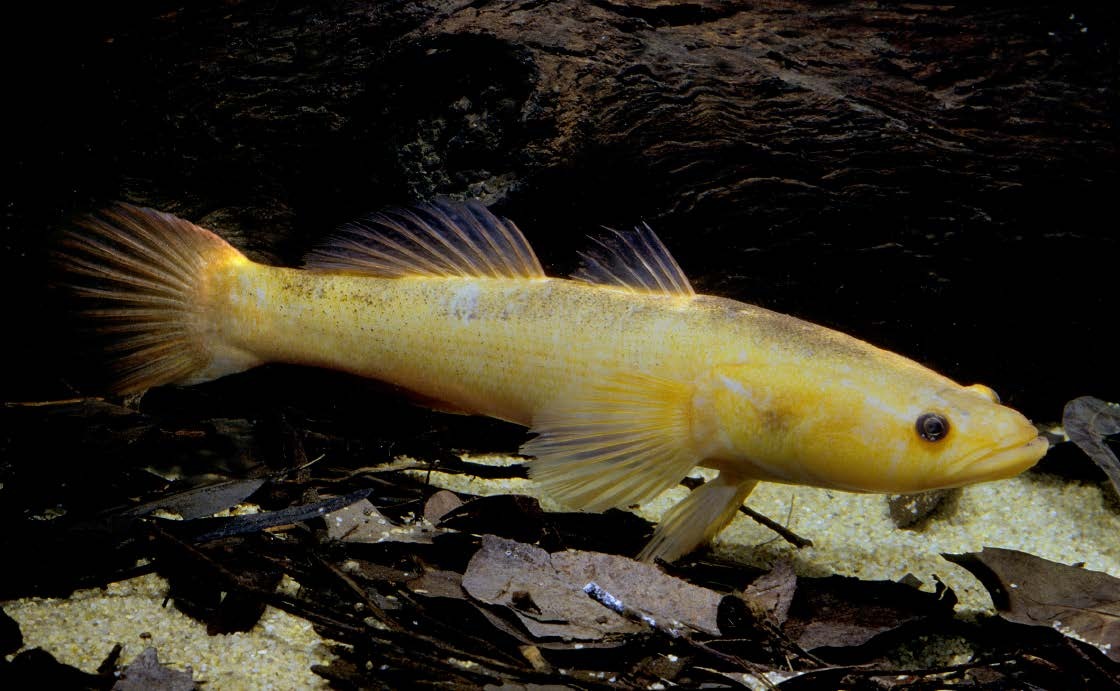
Oxyeleotris lineolata
Sleepy Cod
Species Summary
The largest Australian gudgeon in general aquarium and angling circulation, Oxyeleotris lineolata reaches around 50 cm, though most individuals encountered are considerably smaller. Colouration is normally an unmarked grey-brown to dark chocolate-brown with lightly spotted dorsal and caudal fins, but a striking golden-to-orange-to-red colour form occurs in parts of far north Queensland.
Distribution & Habitat
Oxyeleotris lineolata occurs naturally from the Ord River in Western Australia to the Fitzroy River in Queensland, and has also been introduced to the Barron and Burdekin rivers; genetic evidence suggests Queensland populations in the Mitchell River/Gulf drainages may be distinct from those in the Fitzroy/Dawson system. It favours quiet or slow-flowing water among vegetation or log snags, floodplain billabongs and lowland sandy creekbeds, and moves upstream during floods to colonise new habitat, sometimes found 50–60 km from the nearest permanent water once floodwaters recede.
Breeding
Spawning occurs roughly year-round in warmer water, possibly peaking in the mid-to-late dry season, once temperatures exceed about 24 °C; maturity is reached around 32 cm in males and 29 cm in females. Fecundity is enormous for a gudgeon — 35,000 to 174,000 tiny (0.3–0.5 mm), adhesive eggs per spawning, averaging around 100,000 — laid on a substrate patch and guarded by the male; the eggs must be kept constantly agitated by water movement or the developing embryo’s heartbeat stops and it dies. Hatching takes 5–6 days, and the resulting 3 mm larvae have pigmented eyes and are attracted to light, feeding first on zooplankton before graduating to chironomid and corixid larvae and eventually larger insects and small fish. In the wild, adult Oxyeleotris lineolata prey on aquatic insects, small fish (particularly rainbowfish, blue-eyes and glassfish), freshwater shrimp, snails and other invertebrates.
Compiled for Home of the Rainbowfish from ANGFA sources: Anonymous, “Oxyeleotris lineolata (Steindachner, 1867)”, In-Stream 11, 2002, pp. 10–11.