
Oxyeleotris nullipora
Poreless Gudgeon
Species Summary
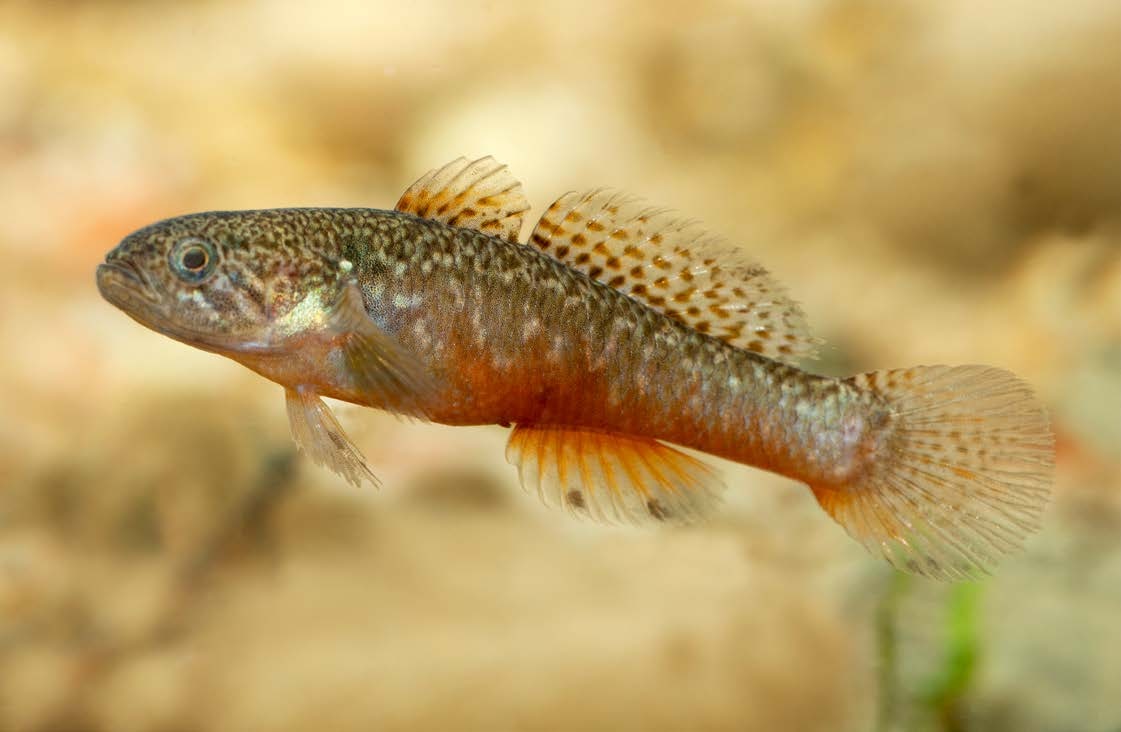
Despite being one of Australia’s smallest gudgeons, Oxyeleotris nullipora is, according to those who keep it, unfairly overlooked: peaceful, characterful, and an excellent candidate for a nano tank. First impressions can be misleading — a settled specimen might be dismissed as a “boring brown fish,” but closer inspection reveals intricately marked fins and, once comfortable, a rich orange-red flush developing near the belly. It grows to only about 40 mm and, unlike most of its relatives, is not a jumper.
Etymology
The genus name Oxyeleotris was proposed by Dutch physician and ichthyologist Pieter Bleeker in 1874, from the Greek oxys, “sharp” or “pointed,” likely referring to the pointed, depressed head of the type species, combined with Eleotris, the genus from which it was split — together, “pointed Eleotris.” The species name nullipora combines the Latin nullus, “none,” with porus, “pore,” since original author Tyson Roberts found the species to differ from all other known Oxyeleotris in entirely lacking cephalic sensory pores on the head.
Distribution & Habitat
Oxyeleotris nullipora has a disjunct distribution across the top of Australia and southern New Guinea. In Queensland it occurs between Ingham and Cairns (most commonly in the lower Tully River), in an isolated pocket around Hope Vale, and around Cape York from the Endeavour River north to the tip and down to the Edward River; in the Northern Territory it ranges from the Giddy River west to the Reynolds River and onto the Tiwi Islands. In New Guinea it is common throughout the Fly River system and is thought to occur west to around Timika. Its distribution closely mirrors that of the Spotted Blue-eye and Pennyfish, with which it is often caught, and it favours smaller, low-gradient creeks and floodplain wetlands, typically in shallow water near the margins.
Keeping & Caring
Oxyeleotris nullipora is quite peaceful and not prone to fin-nipping, doing no harm to tankmates the size of a Neon Tetra, though it will eat its own fry and smaller fish given the chance. It spends most of its time close to the bottom, secretive at first but soon coming out in anticipation of food, and is capable of very fast, almost startling bursts of movement despite its generally placid nature. It is comfortable at cool temperatures around 20 °C and spawns readily at 25 °C, is not fussy about water chemistry, and eats most freeze-dried and live foods — brine shrimp, daphnia and bloodworms, plus live grindal worms, blackworms and hatched brine shrimp — though it is generally not keen on dry foods until it learns to accept good-quality sinking pellets. Sparring between rival males is a notably polite affair, with fully stretched fins and body-wagging displays but little or no actual damage done.
Breeding
Oxyeleotris nullipora shows interest in spawning from about 24–25 °C, favouring a small “cave” such as a length of white PVC pipe around 20 mm in diameter and 75 mm long, capped at one end, or a rock with just enough clearance to enter beneath. Around 40 translucent, ovoid eggs (about 2 mm long) are laid on the underside of the pipe’s roof, darkening as they develop and hatching after 8–10 days; the male alone guards and fans the clutch. Newly hatched fry are around 4 mm and take microworm or paramecium as first foods, graduating to baby brine shrimp after about a week; growth is described as fairly slow but could likely be sped up with more food and heat, since the parents themselves are enthusiastic feeders. As with other gudgeons the fry prefer to stay near the bottom and can be raised alongside rainbowfish or blue-eye fry, though tankmates growing much faster than the gudgeons will out-compete them for food.
Related Species
Two closely related, undescribed-at-time-of-writing New Guinean species share part of the range: the Few-pored Gudgeon (Oxyeleotris paucipora), found between the Fly River and Timika, and the Swamp Gudgeon (Oxyeleotris stagnicola), known from a single Timika site where it co-occurs with both Oxyeleotris nullipora and the Few-pored Gudgeon. A fourth, still undescribed form — a strikingly red-bellied fish — has also been photographed at Timika, in puddles fed by acidic, soft rainwater alongside the blue-eye Pseudomugil luminatus.
Compiled for Home of the Rainbowfish from ANGFA sources: J. Cousins, G. Briggs, P. J. Unmack & C. Scharpf, “Fish in Focus: Poreless Gudgeon Oxyeleotris nullipora”, Fishes of Sahul 35, June 2021, pp. 1753–1766; R. Leggett, “Oxyeleotris nullipora, the collecting, spawning behaviour and growth of a new gudgeon from the Jardine River”, Fishes of Sahul 4, 1987, pp. 159–162.