
Tateurndina ocellicauda
Peacock Gudgeon
Species Summary
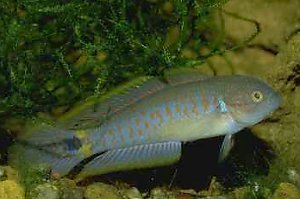
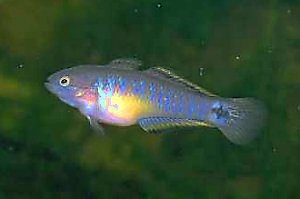
A tiny, brilliantly coloured gudgeon reaching only 4–5 cm, Tateurndina ocellicauda more than earns its common name: a light blue body carries bold red markings and yellow-to-orange edging on the dorsal, anal and tail fins, with colours showing to best effect in soft, tannin- or peat-stained water.
Distribution & Habitat
First collected in 1953 from Peria Creek, a tributary of the Kwagira River roughly 10 miles inland in eastern Papua New Guinea, and described in 1955 by John T. Nichols of the American Museum of Natural History, Tateurndina ocellicauda is common in small rainforest streams around Popondetta and Safia, typically in water of about 21–22 °C, pH 7.0–7.6 and around 80 ppm hardness. It reached the Australian aquarium hobby in 1982, when Melbourne aquarist Barry Crockford brought back live specimens collected at Safia Creek; German aquarist Heiko Bleher introduced the species to Europe the same year from nearby Safia-Tal.
Description
Males develop a pronounced cephalic hump on the forehead, while females carry a smaller, more forward-sloping head, smaller and more rounded fins, and a dark border on the anal fin; females coming into spawning condition also develop a bright golden-yellow abdomen.
Keeping & Caring
The species is thought to feed in the wild on terrestrial insects, worms, small crustaceans and aquatic insect larvae. In the aquarium it accepts good-quality flake and small pellet foods, with live or frozen foods such as cladocerans, mosquito larvae or bloodworms useful for bringing fish into breeding condition. It settles well at a temperature of 20–26 °C, pH 6.8–7.8 and hardness up to about 150 ppm, and will breed year-round in the aquarium if conditions are favourable.
Breeding
A pair prepares a secluded spawning site by clearing it of debris before laying; females produce successive broods of 30–200 eggs (typically around 30–40), deposited in rows on a hard surface such as rock or driftwood. As with other gudgeons, the male drives the female off once spawning finishes and then takes sole charge of the eggs, fanning them until they hatch after 6–10 days depending on temperature. Free-swimming fry take microworm or newly hatched brine shrimp immediately — a visibly orange gut is a good sign they are feeding well — and grow quickly into small yellowish versions of the adults, complete with a dark spot at the base of the tail fin.
Etymology
The genus name Tateurndina honours the American Museum of Natural History’s 1953 Fourth Archbold Expedition to New Guinea, on which the type specimens were collected, and specifically the brothers George H. H. and Geoffrey M. Tate, both AMNH mammalogists; the second half of the name, -urndina, links it to the related genus Mogurnda. The species name ocellicauda is Latin for “eye-tail,” referring to the dark, eye-like spot at the base of the caudal fin.
From the Wild to the Hobby
The first wild specimens were photographed in the field in 1982 by Neil Armstrong, the same year Barry Crockford imported roughly twenty live fish collected at Safia Creek — the founding stock of the entire Australian aquarium population. Legal live import of Tateurndina ocellicauda into Australia was only formally gazetted on 15 September 2004, following years of advocacy by ANGFA to have the species properly recognised under import regulations.
Account compiled for Home of the Rainbowfish from A. R. Tappin (1996–2000), “Rainbowfish On-line”, originally published at rainbowfish.angfa.org.au, archived by the National Library of Australia. Republished with the author’s permission.
Compiled for Home of the Rainbowfish from ANGFA sources: J. Lenagan, P. J. Unmack, B. Hansen & C. Scharpf, “Fish in focus: Peacock Gudgeon Tateurndina ocellicauda”, Fishes of Sahul 31, 2017, pp. 1174–1180; A. R. Tappin, “Tateurndina ocellicauda Common Name: Peacock Gudgeon”, In-Stream 23, 2014, pp. 16–18.